Ever arrived at your destination after a long flight only to feel wide awake at 3 a.m. and exhausted by lunchtime? Jet lag can make even the most exciting trip feel tiring.
Travelling across multiple time zones can temporarily disrupt your body's internal clock, or circadian rhythm, leaving you struggling with sleep, daytime fatigue, poor concentration, mood changes and even digestive discomfort.
Also Read: Natural Sleep Aid: 5 Astonishing Supplements To Beat Insomnia - Infographic
While your body needs time to adjust to the new time zone, gentle yoga for jet lag recovery can help you unwind, loosen stiff muscles after prolonged sitting and create a relaxing bedtime routine.
The best part? You don't need an intense workout. A simple 10–15-minute yoga session can be enough to stretch, breathe and relax after a tiring journey.
So, roll out your mat, take a deep breath, and let's explore five simple yoga poses that may help you feel more comfortable while adjusting to a new schedule.
What Is Jet Lag?
Jet lag is a temporary sleep-wake disturbance that occurs when you rapidly travel across different time zones. Your body's internal clock remains aligned with your previous location while your surroundings operate according to a new local schedule.
Common symptoms include:
Difficulty falling or staying asleep
Daytime sleepiness
Difficulty concentrating
Irritability or mood changes
Headaches
General feelings of being unwell
Digestive disturbances
Jet lag is generally more noticeable after crossing several time zones, particularly during long-distance travel.
Your body gradually adjusts to the new schedule, but adequate sleep, appropriately timed light exposure, regular meals and physical activity can support the adjustment process.
Also Read: Can’t Sleep? Check For These Insomnia Triggers
Can Yoga Help With Jet Lag?
Yoga cannot instantly reset your circadian rhythm or cure jet lag. However, gentle movement combined with controlled breathing and relaxation can complement other healthy travel habits.
Yoga may help:
Ease stiffness after prolonged sitting
Improve flexibility and mobility
Release muscle tension
Reduce perceived stress
Promote mindful breathing
Prepare the body for bedtime
You don't need to practise for an hour. A short, gentle session can be incorporated into your evening routine after reaching your destination.
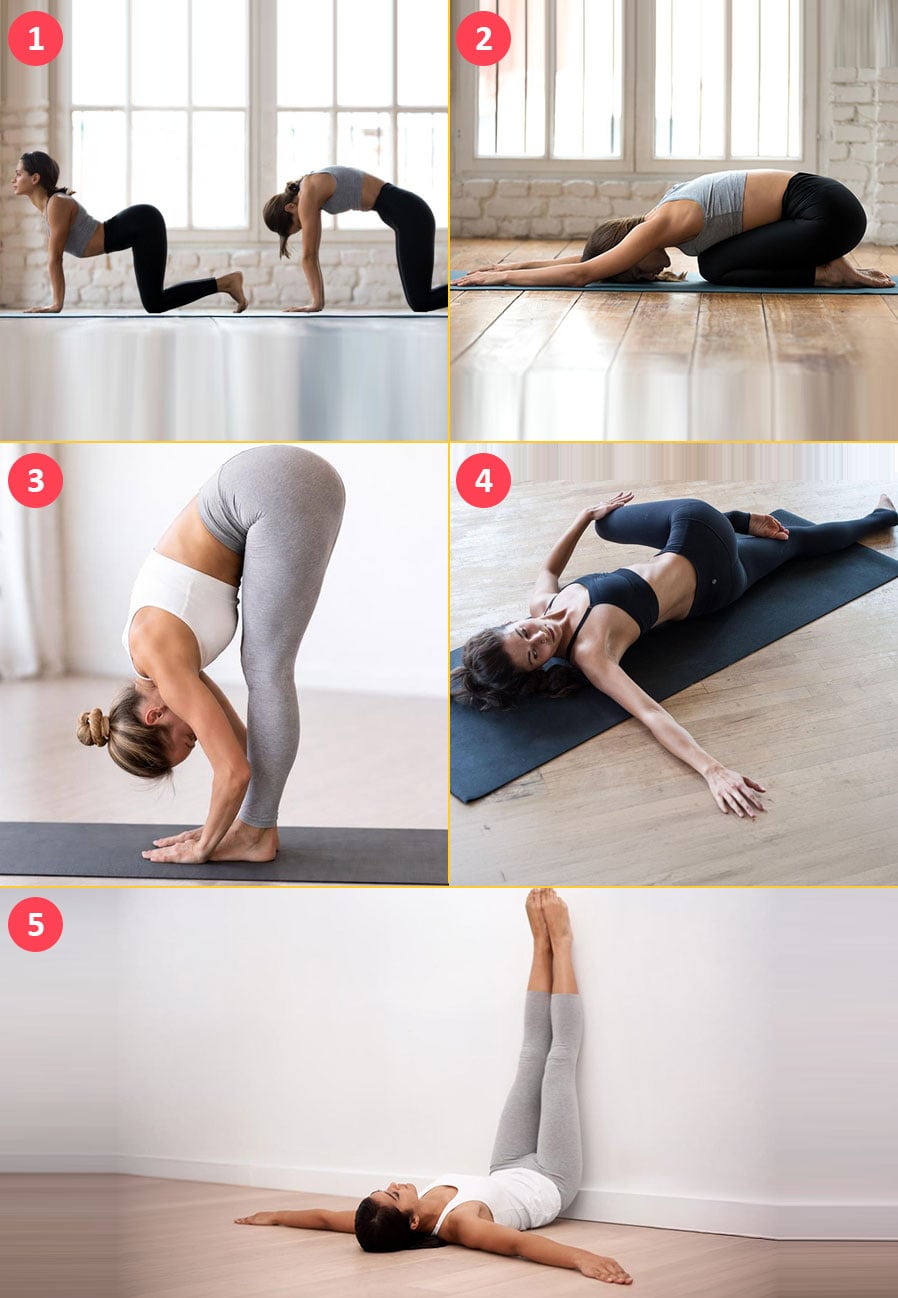
5 Best Yoga Poses For Jet Lag Recovery
Cat-Cow Pose (Marjaryasana-Bitilasana)
Start on your hands and knees with your wrists beneath your shoulders and knees beneath your hips. As you inhale, gently lower your abdomen, lift your chest and look slightly forward. As you exhale, round your spine and gently bring your chin towards your chest. Continue for 6–10 slow rounds, coordinating the movement with your breathing.
Benefits:
Cat-Cow gently mobilises the spine and can help ease stiffness caused by prolonged sitting during travel. Slow, coordinated breathing also encourages mindful movement.
Child's Pose (Balasana)
Kneel on your mat and sit back towards your heels. Slowly fold your upper body forward and extend your arms in front of you or alongside your body. Rest your forehead on the mat or a cushion. Hold for 30–60 seconds, breathing slowly and comfortably.
Benefits:
Child's Pose provides a gentle stretch for the back and hips while encouraging relaxation. It can be particularly soothing when you are feeling physically and mentally tired after travelling.
Standing Forward Bend (Uttanasana)
Stand with your feet about hip-width apart. Keeping your knees slightly bent, fold forward from your hips and allow your upper body to relax. Let your arms hang naturally or hold opposite elbows. Stay for 15–30 seconds while breathing normally.
Benefits:
This gentle forward fold stretches the back of the legs and back and may help release tension after sitting for extended periods.
Supine Spinal Twist (Supta Matsyendrasana)
Lie on your back with your knees bent. Bring your knees towards your chest and slowly lower them towards your right side while keeping your shoulders relaxed on the floor. Extend your arms comfortably and turn your head gently if it feels comfortable. Hold for 20–30 seconds, then repeat on the other side.
Benefits:
A gentle spinal twist can encourage comfortable movement through the torso and help reduce stiffness following a long flight.
Legs-Up-The-Wall Pose (Viparita Karani)
Sit sideways beside a wall and gently lie back while extending your legs upward against it. Keep your arms relaxed beside your body and close your eyes. Stay for 2–5 minutes, breathing slowly.
Benefits:
This restorative posture provides a calming way to wind down after travelling. Combined with slow breathing, it can become a relaxing part of your pre-bedtime routine.
Other Ways To Reset Your Body Clock
Yoga is just one part of recovering from jet lag. Consider these simple habits:
Get appropriately timed daylight: Light is one of the strongest environmental cues influencing your circadian rhythm.
Follow the local schedule: Try eating and sleeping according to local time rather than continuing your previous schedule.
Stay hydrated: Drink enough fluids during and after your journey.
Keep moving: Take short walks and avoid remaining sedentary for long periods.
Limit caffeine close to bedtime: Late caffeine intake can interfere with sleep.
Create a dark, quiet bedroom: A comfortable sleep environment can make it easier to rest.
Maintain a consistent sleep routine: Going to bed and waking up around the same time can help your body adapt.
Who Can Practise These Yoga Poses?
These gentle poses may be suitable for:
Frequent travellers
Adults experiencing mild jet lag
People recovering from long-haul flights
Individuals experiencing travel-related stiffness
Beginners looking for gentle yoga
Travellers wanting a relaxing bedtime routine
However, individual suitability varies. People with injuries, chronic pain, balance problems or other medical conditions should seek appropriate professional guidance before starting a new exercise routine.
Precautions
Yoga should feel comfortable rather than painful, particularly when you are tired after travelling.
Never force a stretch.
Move slowly between poses.
Keep breathing normally.
Avoid vigorous yoga when you are extremely fatigued.
Use cushions or other supports when needed.
Stop if you feel dizzy or unwell.
Discontinue any pose that causes sharp or worsening pain.
Stay adequately hydrated.
Important: Yoga is a supportive wellness practice and does not replace medical treatment. If significant sleep problems or other symptoms persist, consult a healthcare professional.
Conclusion
Jet lag can temporarily disrupt your sleep cycle, energy levels and concentration while your body adjusts to a new time zone. Although yoga cannot immediately reset your body clock, gentle poses can help you stretch after a long journey, release tension and transition into a The above poses are simple options that can be practised for a few minutes after travelling.
For better jet-lag recovery, combine yoga with appropriate daylight exposure, regular movement, hydration, healthy meals and consistent sleep timing.
After all, sometimes the best way to recover from a long journey isn't an intense workout, it is simply slowing down, breathing deeply and giving your body time to adjust.
References:
1.What Works for Jet Lag? A Systematic Review of Non-Pharmacological Interventions – Sleep Medicine Reviews
Useful for your main discussion of jet lag, circadian misalignment, light exposure, physical activity and other non-drug approaches. The review notes that appropriately timed light/dark exposure is a commonly recommended strategy, while evidence for several other interventions remains mixed.
PubMed – What works for jet lag?
2.How to Manage Travel Fatigue and Jet Lag in Athletes? A Systematic Review of Interventions
A comprehensive review of exercise, sleep, light, nutrition and other strategies used to manage travel fatigue and jet lag after long-haul travel.
PubMed – Travel fatigue and jet lag interventions
3.Circadian Disruption and Remedial Interventions: Effects and Interventions for Jet Lag
Particularly useful for your section “Other Ways To Reset Your Body Clock.” It discusses light, exercise, meal timing and melatonin as potential circadian-adjustment strategies, while emphasising that timing is important.
PubMed – Circadian disruption and jet lag
4.Exercise as a Synchroniser of Human Circadian Rhythms
Useful for supporting the discussion around physical activity and the circadian clock. Importantly, the review notes that evidence for exercise specifically treating jet lag remains uncertain, so it supports keeping your article's claim that yoga may complement recovery rather than directly “reset” the body clock.
PubMed – Exercise and circadian rhythms
5.The Effect of Yoga on Sleep Quality and Insomnia in Women With Sleep Problems: Systematic Review and Meta-Analysis
This is useful for the “Can Yoga Help With Jet Lag?” and sleep-related sections. The meta-analysis included 19 studies involving 1,832 participants and found improvements in several measures of sleep, although results varied across populations.
PubMed – Yoga, sleep quality and insomnia
6.Physical Exercise as a Therapeutic Approach for Adults With Insomnia: Systematic Review and Meta-Analysis
Supports your broader statement that physical activity, including yoga, may help improve subjective sleep quality and insomnia symptoms.
PubMed – Exercise and insomnia
7.Treatment of Chronic Primary Sleep-Onset Insomnia With Kundalini Yoga: Randomized Controlled Trial
A clinical trial examining yoga and sleep outcomes. It reported improvements in measures including total sleep time, sleep efficiency and sleep-onset latency in the yoga group.
PubMed – Kundalini yoga and insomnia
8.A Systematic Review of Randomised Controlled Trials on the Effects of Yoga on Stress Measures and Mood
Helpful for the claims that gentle yoga and breathing may promote relaxation and reduce perceived stress, which is relevant when discussing a calming post-travel routine.
PubMed – Yoga, stress and mood
9.A Systematic Review of the Amount and Timing of Light in Association With Sleep Outcomes
Excellent reference for your statement that light is one of the strongest environmental cues influencing the sleep-wake cycle. It also explains why the timing of light exposure matters.
PubMed – Light exposure, circadian rhythm and sleep
10.Melatonin and Its Relevance to Jet Lag
Useful background research for explaining how the circadian clock, melatonin and sleep-wake cycle are affected by crossing time zones. It also discusses bright-light exposure and timed interventions in jet lag management.
 Previous