When you buy medicine, you may observe that generic medicines cost significantly less than their branded counterparts. And this huge price difference often raises doubts about whether generic medicines are of poor quality. Why is the price difference so massive?
(Shop From Broad Portfolio of Multivitamins And Mineral Supplements, Right Here!)
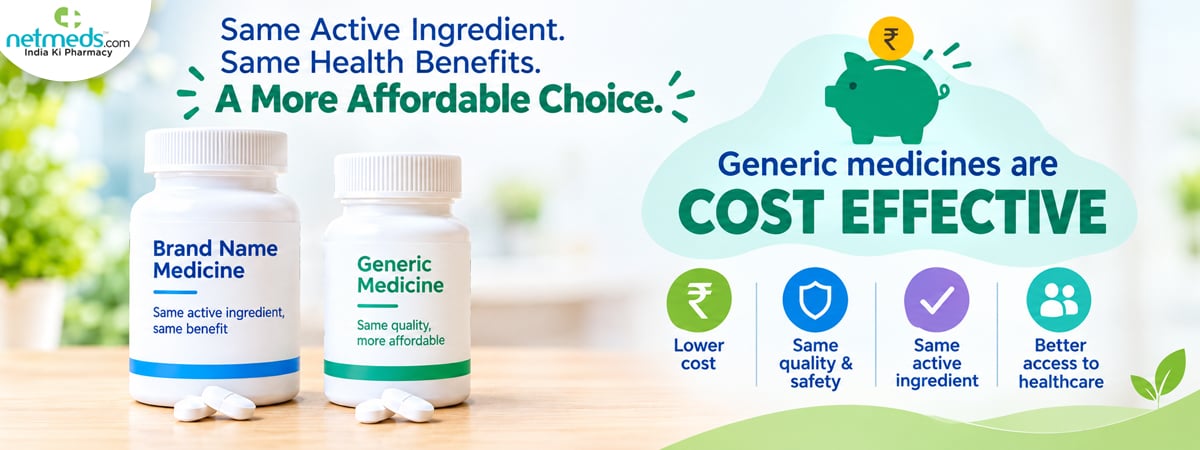
The truth is that generic medicines contain the same active ingredients, strength, dosage form, and route of administration as their branded counterparts and meet the same quality standards. Despite this equality, generic medicines cost about 75-85% less on average than branded ones.
When prescribed appropriately, generic medicines contain the same active ingredient as their corresponding branded medicines and are required to meet regulatory standards for quality, safety and efficacy.
Also Read: What Are Generic Medicines? Benefits, Safety and Common Myths Debunked
What Are Generic Medicines?
Generic medicines are medicines that have the same active ingredient, strength, dosage form and route of administration as an equivalent branded medicine. Generally, they are available in the market after the patent exclusivity period of the original medicine has expired. Typically, generic medicines are sold under the generic name of the active component or under different brand names.
Why Are Generic Medicines Cheaper?
Minimal Research and Development Costs
Manufacturing a new medicinal component requires extensive laboratory research, clinical trials, and regulatory monitoring. The original manufacturer bears the entire costs when introducing a new drug to the market.
Generic manufacturers generally do not need to repeat the entire development process. Instead, they produce a medicine containing an already verified active component, subjected to all applicable regulatory measures. This can significantly lower development costs.
Less Spending on Drug Discovery
Any new medicine component may take several years of extensive research and trials before it reaches users. Pharma companies invest largely in discovering powerful drug molecules, testing them and determining their safety and efficacy. Generic manufacturers enter the market after the active ingredient has already been very well proven. Therefore, they generally do not incur the same drug-discovery costs.
Competition Between Manufacturers
Numerous companies may manufacture generic medicines containing the same active ingredient. Huge competition can cut down pressure on prices and offer consumers more affordable choices.
Low Marketing Costs
Branded medicines may involve considerable spending on marketing, advertising, sales teams, promotional activities and brand building. However, generic medicines may require less investment in creating and maintaining a unique brand identity. Reduced promotional expenditure can contribute to a lower overall price.
Large-Scale Manufacturing
High demand for commonly used generic medicines can allow manufacturers to produce them in large quantities. Huge-scale production can reduce the manufacturing cost per unit, although the final price also depends on factors such as formulation, manufacturing expenses, distribution, taxes and market competition.
Are Generic Medicines Less Effective Than Branded Medicines?
A standardised and approved generic medicine is expected to meet valid regulatory requirements for quality and performance. For medicines that are required to demonstrate bioequivalence, the generic product is evaluated to show that the active ingredient reaches the body in a comparable manner to the reference product.
The active ingredient, strength and dosage form are important factors when comparing a generic medicine with its corresponding branded medicine. At times, inactive components like colours, flavours, preservatives or filters can differ. These differences usually do not impact the therapeutic action of the active ingredient, but those with allergies or sensitivities should seek guidance from a physician.
Also Read: Comparison between generic and brand name drugs for cardiovascular diseases
Are All Generic Medicines the Same?
Not necessarily. Medicines containing the same active ingredient can differ in factors such as:
Manufacturer
Tablet or capsule appearance
Inactive ingredients
Packaging
Price
Availability
Dosage form or formulation
Therefore, patients should not switch between medicines solely based on price without checking with a doctor or pharmacist, particularly for medicines where dose or formulation differences are clinically important.
Can I Swap from A Branded Medicine to a Generic Variant?
In most cases, a healthcare provider may recommend a generic equivalent when an appropriate product is available. However, patients should not stop, replace or change a prescribed medicine without consulting their doctor or pharmacist. This is particularly important for medicines that require careful dose adjustment or monitoring.
A pharmacist can also help identify whether a generic equivalent is available and whether it is suitable for the prescription.
Frequently Asked Questions
Why Are Generic Medicines Cost Effective Than Branded Medicines?
Generic medicines are generally cheaper as their manufacturers do not have to repeat the complete drug-delivery and development process and may have to spend very little on marketing. In addition, competition among huge manufacturers can also reduce prices.
Are Generic Medicines As Effective As Branded Medicines?
Absolutely. Approved generic medicines are required to meet quality and regulatory standards. For medicines where bioequivalence is required, the generic product must demonstrate comparable drug exposure to the reference medicine.
Are Generic Medicines Cheaper Because They Are Inferior Quality?
No. A lower price does not automatically mean lower quality. Approved generic medicines must meet applicable regulatory requirements for quality and performance.
Conclusion
Branded medicines are costlier, and prices have increased over the years due to several reasons. Thus, making informed decisions about medicines is a key part of managing healthcare expenses. However, the suitability of a medicine depends on the individual's condition, prescription and medical needs. Always consult a doctor or pharmacist before changing from a branded medicine to a generic alternative.
References:
A comparative evaluation of price and quality of some branded versus branded–generic medicines of the same manufacturer in India
GL Singal 1, Arun Nanda 1, Anita Kotwani 1
https://pmc.ncbi.nlm.nih.gov/articles/PMC3081449/
King DR, Kanavos P. Encouraging the use of generic medicines: Implications for transition economies. Croat Med J. 2002;43:462–9. [PubMed] [Google Scholar]
Tilyard MW, Dovey SM, Rosentstreich D. General practitioners’ views on generic medication and substitution. N Z Med J. 1990;103:318–20.
Biswas R, Chatterjee P, Mundle M. Prescribing habits of physicians in medical college, Calcutta. Indian J Community Med. 2000;25:161–5.
Hassali MA, Shafie AA, Awaisu A, Ibrahim MI, Ping CC, Jamshed S. Physicians’ views on generic medicines: A narrative review. J Generic Med. 2010;7:30–9. [Google Scholar]
Davit BM, Nwakama PE, Buehler GJ, Conner DP, Haidar SH, Patel DT, et al. Comparing generic and innovator drugs: A review of 12 years of bioequivalence Data from the United States Food and Drug Administration Ann Pharmacother. 2009;43:1583–97. doi: 10.1345/aph.1M141.
Shrank WH, Cox ER, Fischer MA, Mehta J, Choudhry NK. Patients’ perceptions of generic medications. Health Aff (Millwood) 2009;28:546–56. doi: 10.1377/hlthaff.28.2.546.
Hassali A, Stewart K. Quality use of generic medicines. Aust Prescr. 2004;27:80–1.
Joncheere KD, Paal T. Providing affordable medicines in transitional countries. In: Dukes MN, Haaijer-Ruskamp FM, Joncheere CP, Rietveld AH, editors. Drugs and money: Prices, affordability and cost containment. Amsterdam (Netherlands):
Malik V. 19th ed. Lucknow (India): Eastern Book Company; [last accessed on 2010 Jun 13]. Laws relating to Drugs and Cosmetics.
Shafie AA, Hassali MA. Price comparison between innovator and generic medicines sold by community pharmacies in the state of Penang, Malaysia. J Gen Med. 2008;6:35–42.
Figueiras MJ, Marcelino D, Cortes MA. People's views on the level of agreement of generic medicines for different illnesses. Pharm World Sci. 2008;30:590–4. doi: 10.1007/s11096-008-9247-y.
Kjoenniksen I, Morten Lindbaek M, Granas AG. Patients’ attitudes towards and experiences of generic drug substitution in Norway. Pharm World Sci. 2006;28:284–9. doi: 10.1007/s11096-006-9043-5.
Kesselheim AS, Misono AS, Lee JL, Stedman MR, Brookhart MA, Choudhry NK, et al. Clinical equivalence of generic and brand name drugs used in cardio-vascular diseases. JAMA. 2008;300:2514–26. doi: 10.1001/jama.2008.758.
 Previous