Building muscle mass requires more than lifting weights; what you eat is equally important. Your muscles need the right proportion of nutrients that fuel the body to repair, grow and perform. Eating high-quality protein is key to muscle building. Moreover, other nutrients, such as carbohydrates, fats, vitamins, and minerals, also play important roles in maintaining muscle mass.
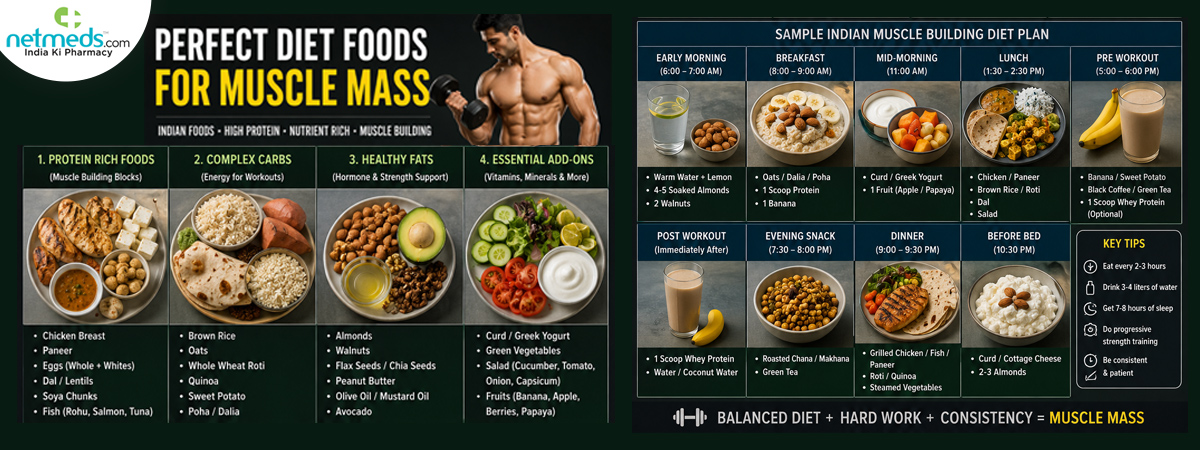
Dive into this article to learn more about what exactly you should eat to build muscle mass, how it works and a sample Indian meal plan that will help.
What Is a Muscle-Building Diet?
A muscle-building diet is often called a bulking diet, which is a structured eating plan designed to provide your body with:
Adequate protein to repair and build muscle fibres.
Sufficient calories to support growth (a caloric surplus).
Quality complex carbohydrates for energy and glycogen replenishment.
Healthy fats for hormonal health and recovery.
Micronutrients and hydration for overall performance.
The primary goal is not to eat everything in a shot. But to create a lean bulk, gaining muscle with minimal fat is the most effective and sustainable approach.
How Diet Helps Muscle Gain: The Science
Protein Builds/ Repairs Muscle
When you engage in strenuous and resistance training exercises, muscle fibres experience microscopic tears. Protein delivers the amino acids your body needs to repair these tears and build thicker, stronger fibres, a process called muscle protein synthesis (MPS).
Recommended protein intake is 1.6–2.2 grams of protein per kilogram of body weight per day.
Example: A 70 kg person should consume 112–154 g of protein daily.
Also Read: 5 Superb Ways To Build Lean Muscle Mass
Caloric Surplus Drives Growth
Muscle tissue cannot be built from a calorie-deficit diet. You need to consume slightly more calories than you burn, typically 250–500 extra calories per day, to give your body the needed raw energy to construct new muscle.
Too few calories, your body may burn muscle for fuel (catabolism).
Too many calories may result in excess fat gain alongside muscle.
Carbohydrates Fuel Performance
Carbohydrates are stored in muscles as glycogen, which is your primary fuel during an intense training session. Without enough carbs, the body goes to fatigue state faster, lifts less, and recovers more slowly. Post-workout carbs also spike insulin, which helps drive amino acids into muscle cells.
Healthy Fats Support Hormones
Dietary fatty acids are important for producing testosterone and growth hormone. These two hormones are the key anabolic hormones that support muscle growth and mass. So, it’s important not to eliminate fat from the meal regimen; rather, focus on adding healthy sources.
Timing Matters
Though holistic daily nutrition intake is key, the timing of the meals also influences the outcomes.
Recommended Timings
Pre-workout (1–2 hrs before): Add carbs and protein for energy and muscle protection.
Post-workout (within 1–2 hrs): Include protein and carbs for recovery and glycogen replenishment.
Before bedtime: Have slow-digesting protein such as casein, paneer or curd to prevent overnight muscle breakdown.
Key Macronutrients for Muscle Gain
Macronutrient Role Daily Target (per kg body weight)
Protein for muscle repair and growth is 1.6–2.2 g per kg body weight/day
Carbohydrates for energy, glycogen, and recovery are 4–6 g per kg body weight/day
Fats essential for hormone balance and joint health are 0.8–1.2 g per kg body weight/day
Best Foods for Muscle Gain
High-Protein Indian Foods
Add paneer to your regular meal plan, which is rich in casein protein and fat, excellent for muscle mass in your daily meal plan.
Dals and legumes like moong, chana, rajma, and masoor are quality sources of plant-based protein powerhouses.
Eggs are a complete protein with all essential amino acids.
Chicken breast is a lean, high-protein option.
Greek yogurt / thick curd is a source of both protein and probiotics.
Soy chunks are one of the highest plant-based protein sources.
Fish (rohu, pomfret, tuna) lean protein and omega-3 fatty acids.
Milk and whey protein are fast-absorbing proteins ideal for meeting post-workout demands.
Also Read: What Is Hypertrophy? Find Out Here How To Gain Muscle Mass With Exercise
Complex Carbohydrates
Brown rice, oats, whole wheat roti/chapati, sweet potato, banana, makhana, quinoa, bajra, and jowar are quality source of carbs that helps to meet increasing demands for fuel.
Healthy Fats
Ghee in moderation, nuts like almonds, walnuts, and seeds, flaxseed, and chia can be included as standalone snacks.
Peanut butter, coconut, and avocado are other healthy sources of fats.
Micronutrient-Rich Foods
Add a rich array of fresh fruits and vegetables like leafy greens like spinach, methi, tomatoes, and beetroot for their potent antioxidant’s qualities.
Turmeric is valued for its anti-inflammatory traits, and ginger and amla offer vitamin C for collagen production.
Sample Muscle Building Meal Plan
Daily calories: 2,800–3,200 kcal, Protein: ~150–160 g
Calories and protein portions should be adjusted based on your body weight, activity level, and goals.
Morning: 1 glass of smoothie made of banana, milk, oats, nuts, peanut butter and 1 scoop of whey protein.
Breakfast: ½ cup of vegetable poha upma with 2 boiled eggs and 1 katori curd
Lunch: 1 cup of rajma chawal with green vegetables stir fry and a bowl of salad
Evening: 1 cup of roasted makhana and 1 glass of spiced buttermilk
Dinner: 2 multigrain rotis with 1 cup of Palak tofu/paneer curry and 1 bowl of dal soup
Bedtime: 1 cup of warm turmeric milk
Hydration for Muscle Growth
Good hydration is key for proper muscle growth; water is often the most neglected nutrient in you muscle -building diet. Dehydration can reduce stamina, performance and faster recovery.
Aim for 3–4 litres of water per day on training days.
Add electrolytes if you sweat heavily.
Coconut water is an excellent natural source of electrolytes.
Common Mistakes to Avoid
Most Indians mistakenly believe that adding dal and legumes alone provides the needed protein; however, the diet should be supplemented with eggs, paneer, or whey protein.
Skipping post-workout nutrition, the body should be provided with adequate nutrients post-workout, which is critical for the recovery window.
Eating very few calories overall or being on a calorie deficit diet cannot help build muscle mass.
Getting quality sleep is important as muscle repair happens during deep sleep; aim for 7–9 hours of restful sleep daily.
Inconsistency results in poor outcomes, and muscle gain would be slow; follow the same diet regimen over weeks and months to see obvious results.
Conclusion
Building muscle with a customised Indian diet is highly achievable. You don't need exotic superfoods or expensive supplements. Dal, paneer, eggs, chicken, curd, and roti are the key foods required for building blocks and maintaining a powerful physique.
References:
https://pmc.ncbi.nlm.nih.gov/articles/PMC6566799/
Dietary Protein and Muscle Mass: Translating Science to Application and Health Benefit
John W Carbone 1,*, Stefan M Pasiakos 2
https://www.mdpi.com/2072-6643/17/22/3603
https://journals.lww.com/nsca-scj/fulltext/2020/10000/body_recomposition__can_trained_individuals_build.3.aspx
Body Recomposition: Can Trained Individuals Build Muscle and Lose Fat at the Same Time?
Barakat, Christopher MS, ATC, CISSN1; Pearson, Jeremy MS1; Escalante, Guillermo DSc, MBA, ATC, CSCS, CISSN2; Campbell, Bill PhD, CSCS, FISSN3; De Souza, Eduardo O. PhD1
 Previous