If you have ever found yourself scrolling through endless skincare reels featuring glass skin, sheet masks, essences and glowing complexions, chances are you have encountered K-Beauty. But there is another Asian skincare philosophy quietly making waves: J-Beauty.
While both Korean and Japanese skincare focus on healthy, hydrated and radiant skin, their approaches aren't quite the same. K-Beauty tends to embrace layering, customisation and innovative formulations, while J-Beauty is generally more minimalist and prevention-focused.
So, K-Beauty vs J-Beauty: Which is better for your skin?
The answer isn't as simple as picking one. Your skin type, concerns, lifestyle, budget and tolerance for multiple products matter far more than whether a product comes from Korea or Japan.
Let us break down the differences between Korean skincare and Japanese skincare and find out which approach might work best for you.
What Is K-Beauty?
K-Beauty, short for Korean Beauty, refers to skincare products, routines and beauty philosophies originating from South Korea.
Korean skincare has become famous worldwide for its emphasis on hydration, skin-barrier support, gentle formulations and personalised layering. The concept became particularly popular through the much-talked-about "10-step Korean skincare routine."
But here is the catch: you don't need ten products to practise K-Beauty.
A modern K-Beauty routine can be as simple as:
Gentle cleanser
Toner or essence
Serum
Moisturiser
Sunscreen
The idea is to choose products based on what your skin needs rather than blindly following a fixed number of steps.
Popular K-Beauty ingredients include snail mucin, centella asiatica, niacinamide, hyaluronic acid, green tea, propolis and fermented ingredients.
What Is K-Beauty Known For?
Layered hydration
Lightweight textures
Innovative ingredients
Barrier-supporting formulations
Customisable routines
"Glass skin" aesthetic
What Is J-Beauty?
J-Beauty, or Japanese Beauty, takes a somewhat more streamlined approach.
Instead of constantly adding new products or chasing the latest trend, J-Beauty generally focuses on simplicity, consistency, prevention and maintaining healthy skin over the long term.
Japanese skincare traditions often emphasise gentle cleansing, moisturisation and diligent sun protection.
Commonly associated ingredients include:
Rice and rice bran
Camellia oil
Hyaluronic acid
Fermented ingredients
Vitamin C
Botanical extracts
The philosophy is often less about transforming your skin overnight and more about protecting and maintaining it consistently.
What Is J-Beauty Known For?
Minimalist routines
Gentle formulations
Long-term skin maintenance
Hydration
Prevention-focused skincare
Refined textures and formulations
K-Beauty vs J-Beauty: What Is The Difference?
While there is plenty of overlap, several differences stand out.
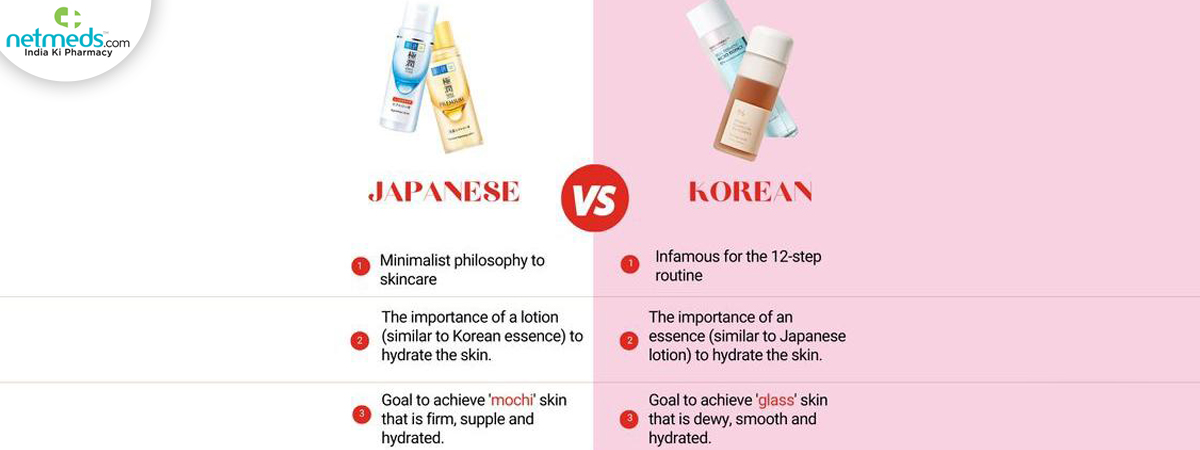
Skincare Philosophy
K-Beauty:
Focuses on hydration, barrier support, customisation and addressing multiple skin concerns through different products.
J-Beauty:
Generally emphasises simplicity, prevention, consistency and preserving healthy skin.
Neither philosophy is inherently better. They are simply different approaches to achieving similar goals, healthy, resilient skin.
Number Of Steps
K-Beauty:
Traditionally associated with multi-step routines involving cleansing, toner, essence, serum, masks, moisturiser and sunscreen.
J-Beauty:
Usually favours fewer products, with each product serving a clear purpose.
However, don't assume every Korean routine has ten steps, or every Japanese routine has only three. Modern skincare routines are increasingly personalised.
The Cleveland Clinic notes that a 10-step K-Beauty routine isn't necessary for everyone and recommends simplifying the routine based on individual needs.
Approach To Hydration
K-Beauty:
Hydration is often built through multiple lightweight layers, such as toners, essences, serums and moisturisers.
J-Beauty:
Hydration remains important but is generally achieved with fewer, carefully formulated products.
Both approaches can work well for dry or dehydrated skin when products are appropriately selected.
Ingredients
K-Beauty:
Often associated with emerging and innovative ingredients such as snail mucin, centella, propolis, fermented extracts and newer cosmetic actives.
J-Beauty:
More commonly associated with traditional ingredients such as rice, green tea and camellia alongside established skincare ingredients.
However, these aren't strict rules. Korean brands can use traditional ingredients, and Japanese brands can also be highly innovative.
Skincare Aesthetic
K-Beauty:
The famous "glass skin" look: smooth, luminous, hydrated and dewy.
J-Beauty:
Often associated with soft, supple and naturally healthy-looking skin, sometimes described as "mochi skin."
It is important to remember that these are beauty ideals rather than medical definitions of healthy skin.
K-Beauty vs J-Beauty: Which Is Better For Different Skin Types?
There is no universal winner. Your skin type and primary concern should guide your choices.
For Dry Skin
A K-Beauty-inspired layered hydration routine may be appealing if your skin feels tight or dehydrated.
Look for ingredients such as:
Hyaluronic acid
Glycerin
Panthenol
Centella asiatica
J-Beauty also offers excellent moisturising and barrier-supporting options, so either approach can work.
For Oily or Acne-Prone Skin
Don't automatically assume that more products mean better results.
A simple routine with a gentle cleanser, appropriate treatment, lightweight moisturiser and sunscreen may be more practical.
If you are acne-prone, look for non-comedogenic products and avoid piling multiple potentially irritating actives onto your skin.
For Sensitive Skin
This is where J-Beauty's minimalist philosophy may appeal to people who prefer fewer products.
However, some K-Beauty products are also specifically formulated for sensitive skin.
The key is to introduce new products gradually and patch-test when appropriate. Even gentle products can cause irritation or allergic reactions in some people.
For Dull or Uneven Skin
K-Beauty offers plenty of products designed around hydration and brightening, while J-Beauty also features established brightening ingredients and antioxidant-rich formulations.
For pigmentation concerns, however, daily sun protection is non-negotiable regardless of which skincare philosophy you choose.
K-Beauty vs J-Beauty: Which Is Better For Indian Skin?
For Indian skin, there isn't a one-size-fits-all answer.
Many people may be concerned about hyperpigmentation, tanning, acne, oiliness, dehydration and sensitivity, but individual skin types vary considerably.
A K-Beauty routine can be useful if you enjoy layered hydration and targeted serums.
J-Beauty may be preferable if you like a simple, low-maintenance routine with fewer products.
And there is absolutely nothing wrong with mixing both.
For example, you could use a Japanese cleansing and moisturising approach while incorporating a Korean essence or serum that targets a specific concern.
The best routine is the one your skin tolerates and that you can consistently follow.
Can You Combine K-Beauty And J-Beauty?
Absolutely. In fact, combining the best elements of both approaches can create a practical skincare routine.
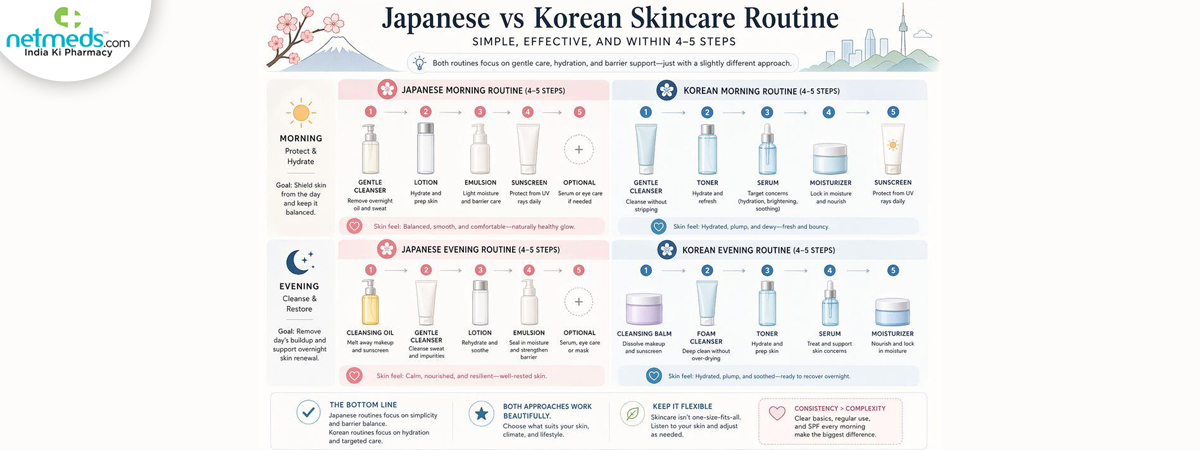
Try this simple hybrid routine:
Morning:
Gentle cleanser
Remove overnight sweat and excess oil without stripping the skin.
Hydrating toner or essence
Choose one based on your skin's hydration needs.
Targeted serum
Use an ingredient suited to your concern, such as niacinamide or vitamin C.
Moisturiser
Choose a lightweight or richer formula depending on your skin type.
Sunscreen
Finish with broad-spectrum sunscreen. The American Academy of Dermatology recommends broad-spectrum SPF 30 or higher as part of daily sun protection.
Night:
Cleanser
Remove sunscreen, makeup, dirt and excess oil.
Hydrating product
Use a toner, essence or serum if desired.
Treatment
Add a targeted active when appropriate.
Moisturiser
Support the skin barrier overnight.
Dermatologists generally recommend applying skincare from lighter products to heavier ones, with treatment products applied after cleansing and moisturiser and/or sunscreen following them as appropriate.
So, Which Skincare Routine Is Better?
The K-Beauty vs J-Beauty debate doesn't really have a winner.
If you love experimenting with lightweight products, layering hydration and targeting several concerns, K-Beauty may suit you.
If you prefer fewer products, simple routines and long-term skin maintenance, J-Beauty may be more your style.
But here is the real secret: you don't have to choose.
A well-designed skincare routine should focus on the fundamentals: gentle cleansing, moisturising, appropriate treatments and consistent sun protection. The American Academy of Dermatology also cautions that using too many products can irritate the skin.
So whether your shelf is filled with Korean essences or Japanese lotions or just one cleanser, moisturiser and sunscreen, the goal remains the same: healthy, comfortable and well-protected skin.
References:
- American Academy of Dermatology Association. Should I apply my skin care products in a certain order? AAD: Skincare Product Order
- Cleveland Clinic. Korean Skin Care Routines: What You Need to Know. Cleveland Clinic: Korean Skincare Routine
- American Academy of Dermatology Association. Skin Care on a Budget. AAD: Skin Care on a Budget
- PubMed – Bioactive Ingredients in Korean Cosmeceuticals: Trends and Research Evidence
Useful for discussing K-Beauty ingredients such as snail mucin, Centella asiatica, plant extracts and other bioactive ingredients, as well as the current scientific evidence surrounding them.
PubMed – Bioactive ingredients in Korean cosmeceuticals
5.British Journal of Dermatology – What Is Really in K-Beauty Serums?
A useful recent dermatology reference for discussing K-Beauty serums, botanical ingredients, fragrance and potential contact allergens. Published in June 2026.
British Journal of Dermatology – K-Beauty serums
6.PubMed – Epidermal Barrier Function in Dry, Flaky and Sensitive Skin
Helpful for explaining why skin-barrier protection, hydration and gentle skincare matter regardless of whether someone follows a Korean or Japanese routine.
PubMed – Epidermal barrier function
7.PubMed – Clinical Significance of Ceramide-Containing Formulations
Supports claims about ceramides, hydration and improving skin-barrier function, which can be particularly relevant when discussing J-Beauty's emphasis on moisturising and barrier care.
PubMed – Ceramide-containing formulations
8.Journal of Drugs in Dermatology / PubMed – Healthy Skin Barrier and Ceramide-Containing Cleansers & Moisturizers
Useful for the section comparing barrier-focused skincare philosophies. The review highlights gentle, near-physiological-pH skincare and ceramides as important components of skin-barrier care.
PubMed – Healthy skin barrier and ceramides
9.Cleveland Clinic – What Do Ceramides Do for Your Skin?
A consumer-friendly medical source explaining how ceramides support the skin barrier and moisture retention.
Cleveland Clinic – Ceramides and skin health
10.American Academy of Dermatology – Facial Masks and Skincare
Particularly useful if your K-Beauty section discusses sheet masks, hyaluronic acid, niacinamide, ceramides, exfoliating acids and mask frequency.
 Previous