Beauty has never belonged to just one country, culture or skincare trend. Long before serums, essences and overnight masks became bathroom staples, communities around the world developed their own traditional skincare rituals using locally available plants, oils, grains and botanical ingredients.
From India's turmeric-infused beauty traditions and Japan's green tea rituals to Morocco's argan oil and the Mediterranean love for olive-derived ingredients, many of these practices have been passed down through generations.
Also Read: J-Beauty Trend: Try These Proven Rituals For A Flawless, Luminous Skin
But here is the interesting part: tradition and modern science don't always tell exactly the same story. Some ingredients have promising evidence for specific skin benefits, while others remain supported mainly by traditional use or laboratory research.
So, rather than calling every ancient remedy a miracle cure, let us take a balanced journey through some of the world's most fascinating global beauty rituals and skincare secrets and explore what science actually says about them.
(Get Glowing, Soft Skin With Our Wide-Range Of Beauty And Makeup Essentials! )
Why Are Traditional Beauty Rituals Still Popular?
Traditional skincare practices often share a few common principles:
Using plant-based or naturally derived ingredients
Keeping routines relatively simple
Protecting and moisturising the skin
Using ingredients available within the local environment
Incorporating beauty into everyday self-care rituals
Modern skincare has certainly evolved, but many popular cosmetic ingredients still have roots in traditional practices.
Turmeric, green tea, aloe vera, honey and argan oil, for example, have all attracted scientific interest for their antioxidant, anti-inflammatory, moisturising or skin-supportive properties.
However, "natural" doesn't automatically mean "safe for everyone." Botanical ingredients can cause irritation or allergic reactions, and evidence for a traditional remedy may be limited.
Also Read: 10 Affordable DIY Beauty Hacks for Glowing Skin and Healthy Hair
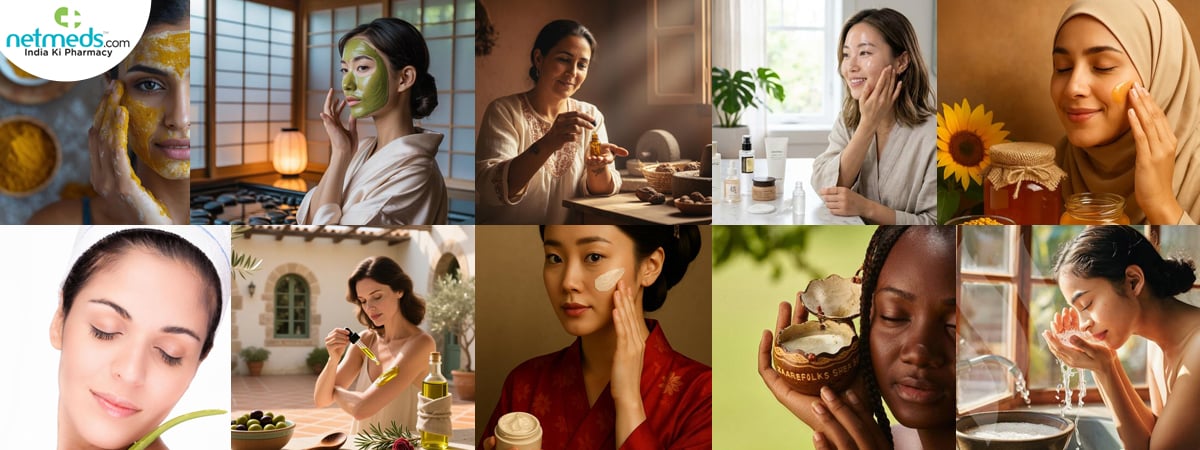
10 Traditional Beauty Secrets From Around the World
India: Turmeric for Healthy-Looking Skin
Turmeric (Curcuma longa) has been used traditionally in Indian beauty rituals for generations, including the famous haldi ceremony.
Its active compound, curcumin, has antioxidant and anti-inflammatory properties and has been studied for various skin conditions. A systematic review found preliminary evidence suggesting potential dermatological benefits, although researchers noted that more high-quality clinical studies are needed.
Beauty takeaway: Turmeric may support healthy-looking skin, but raw turmeric can stain or irritate sensitive skin. Patch-test before use and consider properly formulated skincare products.
Japan: Green Tea for Antioxidant Skincare
Japanese beauty routines often emphasise gentle, consistent skincare. Green tea is another traditional ingredient that has gained global popularity.
Green tea contains polyphenols such as EGCG, which have antioxidant and anti-inflammatory properties. Research has investigated green tea's potential role in protecting skin from oxidative stress and photoageing, although clinical findings have been mixed.
Beauty takeaway: Green tea can be a useful antioxidant skincare ingredient, but it cannot replace daily sunscreen.
Morocco: Argan Oil for Soft, Hydrated Skin
Known as "liquid gold," argan oil has a long history of use in Moroccan skin and hair care. It contains fatty acids and other compounds that give it moisturising and emollient properties.
Research suggests argan oil may support skin hydration and barrier function, although more research is needed to establish its broader dermatological benefits.
Beauty takeaway: A few drops of argan oil can be useful for dry skin, particularly when applied as part of a moisturising routine.
Korea: Hydration and Consistency
K-beauty has popularised double cleansing, essences, serums, sheet masks and layered hydration around the world.
However, you don't need a complicated 10-step routine to achieve healthy skin. The most useful lesson from Korean skincare is the importance of consistency.
A simple routine featuring a gentle cleanser, moisturiser and broad-spectrum sunscreen can be more beneficial than constantly changing products.
Beauty takeaway: Focus on consistent, skin-friendly products rather than the number of steps.
Egypt and the Middle East: Honey for Skin Care
Honey has been used traditionally for skin and wound care across several cultures. Modern research has particularly examined medical-grade honey for wound healing.
Evidence suggests potential benefits for certain wounds and burns, although research quality varies.
Beauty takeaway: Medical-grade honey used in clinical settings should not be confused with ordinary kitchen honey. Avoid applying homemade honey preparations to broken or irritated skin without professional advice.
Mexico and Central America: Aloe Vera for Soothing Skin
Aloe vera has traditionally been used to soothe and moisturise the skin. Research has investigated its potential role in burns, wounds, psoriasis and dry skin.
Although some studies suggest benefits, an umbrella review found that much of the available evidence remains weak or inconsistent.
Beauty takeaway: Aloe vera may feel soothing for some people, but choose reputable, minimally fragranced formulations and patch-test before use.
The Mediterranean: Olive Oil and Plant Oils
Olive oil has a long history in Mediterranean food and personal-care traditions. Its fatty acids and antioxidant compounds make it an attractive cosmetic ingredient.
However, pure olive oil isn't suitable for every skin type. Its high oleic-acid content may aggravate some people with sensitive or compromised skin barriers.
Beauty takeaway: A professionally formulated moisturiser containing olive-derived ingredients may be preferable to applying cooking oil directly to the face.
West Africa: Shea Butter for Dry Skin
Shea butter has traditionally been used across West Africa for skin and hair care. Its rich, occlusive texture can help reduce moisture loss and soften dry skin.
It can be particularly useful on dry areas such as the hands, elbows, knees and feet.
Beauty takeaway: Shea butter is primarily valuable as a moisturising and barrier-supportive ingredient.
Asia: Rice-Based Skincare
Rice and rice-derived ingredients have featured in traditional beauty practices across parts of Asia. Rice water has also become a popular DIY skincare trend.
However, evidence supporting claims that homemade rice water dramatically brightens skin, removes pigmentation or reverses ageing is limited.
Beauty takeaway: If you enjoy rice-based skincare, consider professionally formulated products containing rice extract or rice bran rather than relying on homemade preparations.
What Can We Learn From Global Beauty Rituals?
Despite their differences, traditional skincare practices often share several principles:
Moisturisation: Oils and butters can help reduce moisture loss.
Antioxidant care: Ingredients such as green tea and turmeric contain antioxidant compounds.
Gentle routines: Consistency often matters more than using numerous products.
Sun protection: Protecting skin from UV exposure is essential for long-term skin health.
Self-care: Skincare can be a relaxing daily ritual rather than a pursuit of "perfect" skin.
Importantly, natural does not automatically mean safe or effective. Botanical ingredients can cause irritation or allergies, and laboratory findings don't always translate into visible benefits in humans.
How to Safely Try Traditional Skincare Ingredients?
If you want to incorporate global beauty secrets into your routine:
Patch-test new products before applying them extensively.
Avoid harsh DIY combinations, particularly lemon juice and undiluted essential oils.
Don't replace sunscreen with botanical ingredients.
Choose professionally formulated products where possible.
Introduce one new product at a time so you can identify potential irritation.
Consult a dermatologist for persistent acne, pigmentation, eczema or unexplained skin changes.
Frequently Asked Questions
Which country has the best skincare routine?
There is no single best skincare tradition. Japanese, Korean, Indian, Moroccan and other beauty rituals each offer different approaches. The best routine is one that suits your skin type and concerns.
Is turmeric good for glowing skin?
Curcumin in turmeric has antioxidant and anti-inflammatory properties, but evidence for cosmetic benefits remains limited.
Is argan oil good for dry skin?
Yes. Argan oil can act as an emollient and help moisturise dry skin.
Can green tea prevent skin ageing?
Green tea contains antioxidant polyphenols that have been studied for their potential effects on photoageing, but it cannot replace sunscreen or proven anti-ageing treatments.
Is aloe vera safe for everyone?
Not necessarily. Some people may experience irritation or allergic reactions. Patch-testing is recommended before extensive use.
Conclusion
Traditional beauty rituals offer fascinating insights into how different cultures have cared for their skin for generations. Ingredients such as turmeric, green tea, argan oil, aloe vera, honey and shea butter all have interesting properties and varying degrees of scientific support.
However, the best beauty secret isn't necessarily a miracle ingredient. Consistent cleansing, moisturisation, sun protection and choosing products suited to your skin type remain the foundations of healthy skin.
Take inspiration from global beauty traditions, but let science, skin tolerance and professional dermatological advice guide your routine.
 Previous