


As the weather cools down, with warm blankets and shorter days, it can be hard to find the motivation to get out and stay active. But reduced physical activity during winter months can impact overall fitness, flexibility, muscle endurance and well-being. Maintaining an active lifestyle is important even when temperatures drop.
But there is a simple way out: getting moving at home can help support cardiovascular health, strengthen muscles, support joint mobility, and enhance mood.
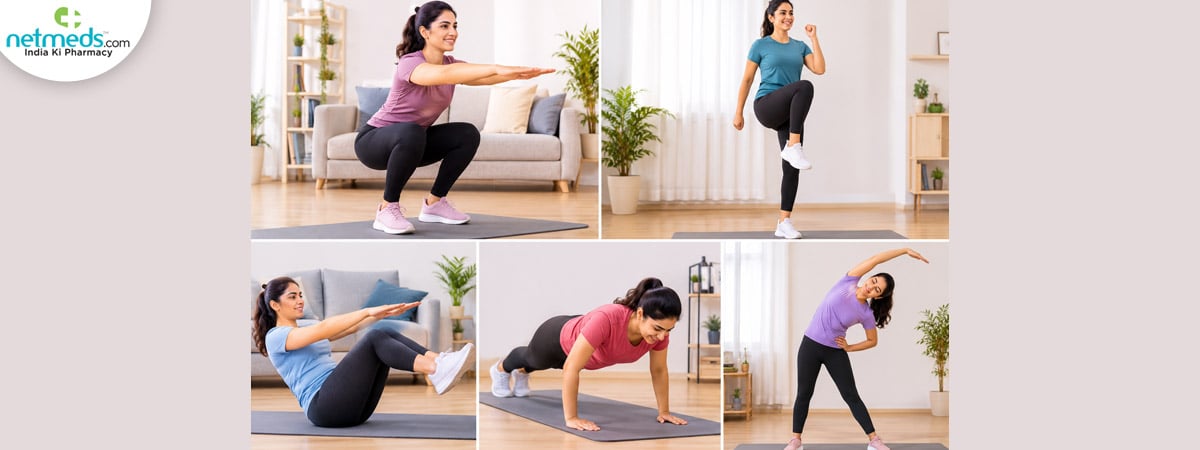
Whether you are a beginner or someone looking to keep up with your regular fitness regimen, here we have curated 5 easy workouts you can do at home this winter to optimise overall health and fitness.
5 Best Indoor Workouts to Stay Active
Marching In Place
Marching in place is an easy, low-impact cardio activity that supports increase your heart rate, promotes blood circulation and warms up the muscles. This exercise is especially valuable during winter when outdoor walking may become a hard task.
How to do it:
Stand straight with your feet hip-width apart.
Lift your right knee towards your chest while swinging your left arm forward.
Lower your leg and repeat with the opposite knee.
Continue alternating legs at a comfortable pace for 3–5 minutes.
Benefits:
Enhances cardiovascular fitness.
Improves blood circulation to the vital organs.
Helps burn calories and maintain a healthy weight.
Maintains coordination and balance.
Squats
Squats are an incredible lower-body strengthening workout that includes the quadriceps, hamstrings, glutes and core muscles. Regularly doing squats can support muscle strength, balance and movement.
How to do it:
Stand straight with your feet shoulder-width apart.
Keep your chest upright and lean your arms forward.
Slowly bend your knees and push your hips backwards as if you are sitting on a chair.
Lower yourself comfortably while keeping your heels on the floor.
Return to the standing position and repeat 10–12 times.
Benefits:
Strengthens and tones the lower-body muscles.
Promotes core balance and stability.
Supports joint mobility and better movement.
Helps maintain functional strength and endurance for daily activities.
Wall Push-Ups
Wall push-ups are a beginner-friendly, easy-to-do alternative to traditional push-ups. This exercise strengthens the upper body muscles without taxing the wrists and shoulders.
How to do it:
Stand facing a wall, approximately an arm's length away.
Place both palms against the wall at shoulder height.
Slowly bend your elbows and lean your chest towards the wall.
Push against the wall to return to the starting position.
Repeat this10–15 times.
Benefits:
Strengthens the chest, shoulders and arm muscles.
Improves upper-body muscular endurance and stamina.
Promotes better posture and gait.
Helps build strength with minimal equipment.
Yoga (Surya Namaskar)
Yoga is a holistic form of practice that combines postures (asanas), breath control(pranayama) and meditation to improve overall well-being. It is an incredible way to support flexibility, balance, muscular strength, and mental relaxation. Surya Namaskar is a sequence of Yoga postures that involves multiple muscle groups and combines movement with controlled and patterned breathing.
How to do it:
Begin by standing straight with your palms joined in front of your chest.
Inhale and raise your arms overhead.
Exhale and bend forward towards your feet.
Go into the plank position as appropriate for your strength.
Complete the sequence with controlled breathing and return to the starting position.
Begin with 2–3 rounds and gradually increase as your fitness improves.
Benefits:
Improves flexibility and mobility.
Strengthens multiple muscle groups in the body.
Supports balance, movement and coordination.
Helps ease stress and promote mental relaxation.
Note: Beginners should learn the correct technique under a qualified yoga instructor and modify postures according to their fitness and mobility.
Stair Climbing
Stair climbing can be a simple yet effective cardio and lower body workout. It engages the leg muscles, improves heart rate and endurance.
How to do it:
Stand at the bottom of a staircase.
Hold the handrail if needed for support.
Climb up one stair at a time at a comfortable pace.
Walk back down slowly and repeat for 2–5 minutes.
Start with a short duration and gradually increase according to your fitness level.
Benefits:
Enhances cardiovascular endurance and stamina.
Strengthens the quadriceps, calves and glutes.
Supports balance, movement and coordination.
Helps improve overall stamina.
Simple Tips to Stay Active And Healthy During Winter
Along with staying active, adopting healthy lifestyle habits can help you maintain overall fitness and well-being during the winter season.
Spend 5–10 minutes warming the body by doing gentle movements to prepare your muscles and joints.
Drink sufficient water throughout the day, even when you do not feel thirsty.
Have a wholesome and balanced diet including seasonal fruits, vegetables, whole grains, lean proteins and healthy fats.
Aim to get 7-9 hours of sound sleep every night.
Always follow a realistic workout schedule rather than exercising intensely on occasional days.
Avoid overexertion and stop exercising if you experience dizziness, chest pain or unusual breathlessness.
Frequently Asked Questions
Which exercise is best to do at home during winter?
Marching in place, squats, yoga, wall push-ups and stair climbing are effective home exercises that support cardiovascular fitness, muscle strength and flexibility.
How long should I exercise at home during winter?
Aim for at least 150 minutes of moderate-intensity physical activity per week, along with muscle-strengthening activities on two or more days, depending on your fitness level.
Is it good to exercise in the morning during winter?
Yes. Exercising in the morning can help boost your energy levels, mood and fitness. However, warm up properly and choose a comfortable indoor environment if it is too cold outside.
Can home workouts help with weight loss during winter?
Yes. Regular home workouts combined with a balanced, calorie-conscious diet can help support weight management and improve overall fitness.
Conclusion
Winter should not become a reason to put your fitness goals on hold. Simple exercises such as marching in place, squats, wall push-ups, yoga and stair climbing can help improve cardiovascular fitness, strengthen muscles and support overall health.
Make physical activity a regular part of your daily routine, eat a nutritious diet and stay hydrated to maintain your health and fitness throughout the colder months.
References:
https://pmc.ncbi.nlm.nih.gov/articles/PMC7429433/
Acute Effects of Winter Sports and Indoor Cycling on Arterial Stiffness
Josef Niebauer 1,✉, Edith E Müller 1, Martin Schönfelder 1,2, Christoph Schwarzl 1,2, Barbara Mayr 1, Julia Stöggl 3, Thomas Stöggl 3
Ashor A. W., Lara J., Siervo M., Celis-Morales C., Mathers J. C. (2014) Effects of exercise modalities on arterial stiffness and wave reflection: a systematic review and meta-analysis of randomized controlled trials. Plos One 9, e110034.
Benjamin E. J., Virani S. S., Callaway C. W., Chamberlain A. M., Chang A. R., Cheng S., Chiuve S. E., Cushman M., Delling F. N., Deo R., de Ferranti S. D., Ferguson J. F., Fornage M., Gillespie C., Isasi C. R., Jimenez M. C., Jordan L. C., Judd S. E., Lackland D., Lichtman J. H., American Heart Association Council on, E., Prevention Statistics, C. and Stroke Statistics, S. (2018) Heart Disease and Stroke Statistics-2018 Update: A Report From the American Heart Association. Circulation 137, e67-e492.
Chirinos J. A., Kips J. G., Jacobs D. R., Jr., Brumback L., Duprez D. A., Kronmal R., Bluemke D. A., Townsend R. R., Vermeersch S., Segers P. (2012) Arterial wave reflections and incident cardiovascular events and heart failure: MESA (Multiethnic Study of Atherosclerosis). Journal of the American College of Cardiology 60, 2170-2177.
Collier S. R., Diggle M. D., Heffernan K. S., Kelly E. E., Tobin M. M., Fernhall B. (2010) Changes in arterial distensibility and flow-mediated dilation after acute resistance vs. aerobic exercise. Journal of Strength and Conditioning Research 24, 2846-2852.
Desch S., Sonnabend M., Niebauer J., Sixt S., Sareban M., Eitel I., de Waha S., Thiele H., Bluher M., Schuler G. (2010) Effects of physical exercise versus rosiglitazone on endothelial function in coronary artery disease patients with prediabetes. Diabetes, Obesity & Metabolism 12, 825-828.
Goto C., Higashi Y., Kimura M., Noma K., Hara K., Nakagawa K., Kawamura M., Chayama K., Yoshizumi M., Nara I. (2003). Effect of different intensities of exercise on endothelium-dependent vasodilation in humans: role of endothelium-dependent nitric oxide and oxidative stress. Circulation 108(5), 530-535 .
Heffernan K. S., Collier S. R., Kelly E. E., Jae S. Y., Fernhall B. (2007a) Arterial stiffness and baroreflex sensitivity following bouts of aerobic and resistance exercise. International Journal of Sports Medicine 28, 197-203.
Heffernan K. S., Jae S. Y., Echols G. H., Lepine N. R., Fernhall B. (2007b) Arterial stiffness and wave reflection following exercise in resistance-trained men. Medicine and Science in Sports and Exercise 39, 842-848.
Krautgasser S., Scheiber P., von Duvillard S. P., Müller E. (2011) Physiological responses of elderly recreational alpine skiers of different fitness and skiing abilities. Journal of Sports Science and Medicine 10, 748-753.
 Previous