Curiosity about alternative proteins and plant-based protein sources continues to grow rapidly owing to their impressive profile of nutrients and sustainability. Microbial protein, or yeast-based protein produced from protein-rich yeast biomass, is now valued in the mainstream of protein innovation. Yeast protein offers a high-quality, complete protein source that meets the demands of those seeking sustainability, high-quality plant-based alternatives, and readily digestible options. It is readily used as an ingredient in food products and protein supplements. Evidence has strongly shown that yeast protein is a sustainable alternative protein source, as it can be produced efficiently by fermentation processes.
(Shop From Our Wide Range Of Nutritional Supplements To Boost Your Physical And Mental Health, Right Here!)
Explore this article to learn more about the nutritional profile of yeast protein, its health benefits, role in a balanced meal regimen, and side effects.
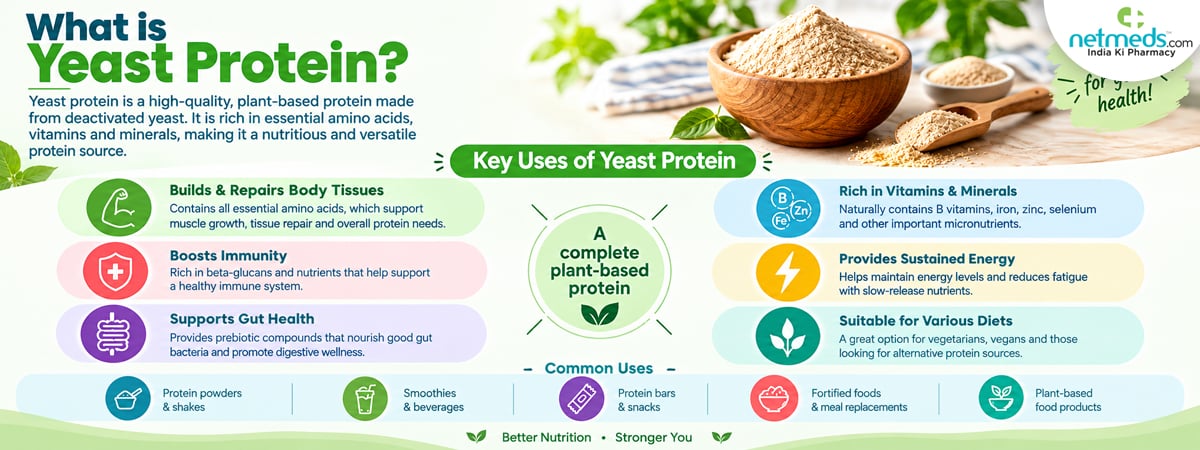
What Is Yeast Protein?
Yeast protein is a protein-packed single-cell biomass obtained from inactive yeast typically grown from strains of Saccharomyces cerevisiae. It is produced through a controlled fermentation method, followed by processing and drying to make a protein-rich food component.
It is largely used in the food industry for its distinct savoury, cheese-like flavour and rich protein profile. High-protein yeast is specially cultivated through a fermentation process that boosts its digestibility and bioavailability, making it a perfect option for those looking for a complete protein source. Depending on the production method, yeast biomass can contain substantial amounts of protein along with amino acids, vitamins, and minerals.
Remember, yeast protein should not be confused with baker’s yeast, which is usually used to make bread rise. Also, it is different from nutritional yeast, which is an inactive form of Saccharomyces cerevisiae commonly used as a food seasoning and is naturally rich in protein and B vitamins.
Nutritional Profile of Yeast Protein
The exact nutritional profile varies depending on the yeast strain, fermentation conditions, and processing method. Generally, yeast protein can provide:
Superior-quality protein
Essential amino acids
B-group vitamins
Minerals
Dietary fibre or other components of the yeast cell, depending on processing. Moreover, research reveals that yeast-based protein has a favourable amino acid content; however, its digestibility and nutritional value can differ according to the way the protein is processed.
Also Read: Nutritional Yeast: Health Benefits, Uses, And Side Effects Of This Flavourful Superfood
5 Potential Health Benefits of Yeast Protein
Protein for Muscle Health
Protein is a key element for building and repairing muscles, maintaining tissues and supporting several important bodily functions. Yeast protein can improve daily protein intake and may be used as a valuable part of a balanced diet.
Provide Essential Amino Acids
Yeast proteins contain vast reserves of essential branched-chain amino acids (BCAAs), such as leucine, valine, and isoleucine, which are important for muscle synthesis and recovery. In addition, yeast protein contains high levels of glutamic acid and aspartic acid, which promote several important bodily processes, including energy production and neurotransmission.
Offers B Vitamins
Yeast biomass naturally contains a rich array of B-group vitamins, although the exact amount depends on the product. Nutritional yeast products may also be fortified with additional nutrients such as vitamin B12. B vitamins play important roles in energy metabolism, nervous-system function, and red blood cell formation.
Sustainable Protein Choices
One of the primary advantages of yeast-based protein is its potential sustainability. Yeast can be cultivated through fermentation using different renewable or industrial by-product substrates, potentially requiring fewer conventional agricultural resources than some traditional practices.
Alternative Protein Source
Yeast protein can be easily incorporated into different food purposes, including protein-rich foods, meat alternatives, and other formulated products. Researchers are also investigating the potential of yeast-based single-cell protein as a future sustainable food ingredient.
Uses of Yeast Protein
Yeast protein can be used in umpteen ways, depending on the product and processing method:
Protein supplements: It is incorporated into protein powders and formulated nutrition products.
Plant-based foods: It is readily used in vegetarian and vegan food formulations.
Meat alternatives: It can contribute protein and nutritional value to meat analogue products.
Food fortification: It can increase the protein content of certain foods.
Nutritional yeast: It is commonly sprinkled over foods to provide a savoury, umami flavour.
Yeast Protein vs Nutritional Yeast: Are They the Same?
Well, technically they are not necessarily the same.
Yeast protein generally refers to protein-rich yeast biomass or a protein ingredient obtained from yeast.
Nutritional yeast is an inactive form of yeast used as a food ingredient. It naturally contains protein and B vitamins, and many commercial products are fortified with additional vitamins and minerals.
Therefore, those who are using it should check the product label to understand the protein content and whether vitamins or minerals have been added.
Side Effects
Yeast protein is generally safe and well-tolerated and is intended to be consumed as a food ingredient, but it may not be suitable for everyone.
A few people may experience digestive symptoms after consuming yeast-based products, particularly when introducing a new product or consuming large amounts.
People who are sensitive or allergic to yeast proteins may experience an allergic reaction. Although serious reactions appear to be uncommon, individuals with known yeast allergies should avoid these products.
Certain varieties of yeast protein products can contain relatively high amounts of nucleic acids. Their breakdown produces purines, which may be a concern for people with disorders of purine metabolism, including gout.
Nutritional composition varies considerably between yeast-based products. Some may be fortified with vitamins and minerals, while others may not be.
How To Add Yeast Protein to Your Diet?
Depending on the product, yeast protein may be added to:
Smoothies and protein shakes
Soups and stews
Salads
Plant-based meals
Breakfast bowls
Always follow the serving instructions provided on the product label.
Frequently Asked Questions
Is Yeast Protein A Complete Protein?
No, yeast proteins contain several essential amino acids, but their amino acid profile and digestibility vary depending on the yeast species and processing method. Check the product's nutrition information for its specific protein and amino acid profile.
Is Yeast Protein Good For Muscle Building?
Yeast protein can contribute to total daily protein intake, which is important for muscle maintenance and repair. However, muscle development also depends on adequate overall nutrition intake and exercise.
Is Yeast Protein Vegan?
Yeast is a microorganism rather than an animal, so yeast-derived protein can be suitable for vegan diets. However, people following a strict vegan diet should check the complete ingredient list and manufacturing information of the product.
Conclusion
Yeast protein is a high-quality way to maintain your strength during treatment. It provides the building blocks for muscles and helps your immune system stay strong. Since it is easy to digest and full of yeast protein benefits, it is a great choice for many cancer patients.
Yeast protein is a high-quality plant-based alternative that helps to maintain muscle mass and augment overall well-being. Moreover, it offers essential amino acids for muscles and bolsters the immune system. As it is easy to digest and packed with B vitamins and other nutrients, its potential uses range from protein supplements and plant-based foods to meat alternatives.
References;
https://pmc.ncbi.nlm.nih.gov/articles/PMC8780597/
Yeast Protein as an Easily Accessible Food Source
Monika Elżbieta Jach 1,*, Anna Serefko 2, Maria Ziaja 3, Marek Kieliszek 4,*
United Nations World Population Prospects. 2019. [(accessed on 10 November 2021
https://www.un.org/development/desa/en/news/population/world-population-prospects-2019.html.
Ritchie H., Roser M. Meat and Dairy Production. [(accessed on 10 November 2021)]. Available online: https://ourworldindata.org/meat-production.
IARC Monographs on the Evaluation of Carcinogenic Risks to Humans, No. 114. IARC Working Group on the Evaluation of Carcinogenic Risks to Humans. Lyon (FR): International Agency for Research on Cancer. [(accessed on 10 November 2021)]; Available online: https://www.ncbi.nlm.nih.gov/books/NBK507972/
Barnard M., Levin S., Trapp C. Meat consumption as a risk factor for type 2 diabetes. Nutrients. 2014;6:897–910. doi: 10.3390/nu6020897.
Somda M.K., Nikiema M., Keita I., Mogmenga I., Kouhounde S.H.S., Dabire Y., Coulibaly W.H., Taale E., Traore A.S. Production of single cell protein (SCP) and essential amino acids from Candida utilis FMJ12 by solid state fermentation using mango waste supplemented with nitrogen sources. Afr. J. Biotechnol. 2018;17:716–723.
Lee J.Z., Logan A., Terry S., Spear J.R. Microbial response to single-cell protein production and brewery wastewater treatment. Microb. Biotechnol. 2015;8:65–76. doi: 10.1111/1751-7915.12128.
Ritala A., Häkkinen S.T., Toivari M., Wiebe M.G. Single cell protein-state-of-the-art, industrial landscape and patents 2001–2016. Front. Microbiol. 2017;8:2009. doi: 10.3389/fmicb.2017.02009.
Sá A.G.A., Moreno Y.M.F., Carciofi B.A.M. Plant proteins as high-quality nutritional source for human diet. Trends Food Sci. Technol. 2020;97:170–184. doi: 10.1016/j.tifs.2020.01.011.
Cherdthong A., Sumadong P., Foiklang S., Milintawisamai N., Wanapat M., Chanjula P., Gunun N., Gunun P. Effect of post-fermentative yeast biomass as a substitute for soybean meal on feed utilization and rumen ecology in Thai native beef cattle. J. Anim. Feed Sci. 2019;28:238–243. doi: 10.22358/jafs/110992/2019.
Gervasi T., Pellizzeri V., Calabrese G., Di Bella G., Cicero N., Dugo G. Production of single cell protein (SCP) from food and agricultural waste by using Saccharomyces cerevisiae. Nat. Prod. Res. 2018;32:648–653. doi: 10.1080/14786419.2017.1332617.
Meta Description: What is yeast protein? Learn about yeast protein health benefits, nutritional value, uses, side effects, and how it differs from nutritional yeast.
 Previous