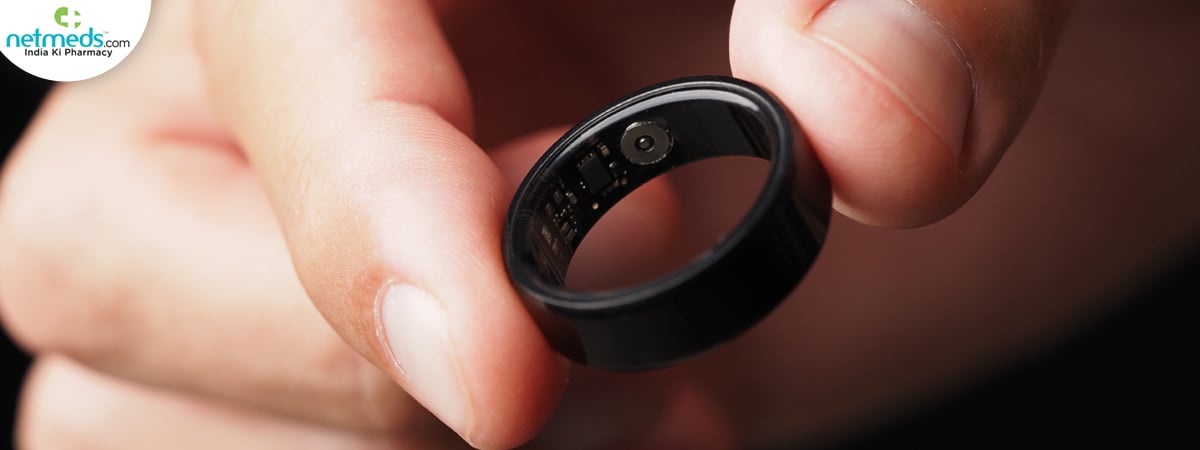
Smart rings are quickly becoming the must-have accessories that hold a key place in our daily lives quite seamlessly. They deliver more than just health merits and go beyond the conventional limits of wearable technology. While smartwatches and fitness brands lead the market, smart rings are emerging as a highly compactable, discreet, and powerful alternative. It is specifically designed to be worn on a finger, just like a regular ring; however, smart rings combine sensors, connectivity, and data analytics to evaluate health, physical activity, and even digital security.
(To Maintain Your Overall Health and Well-being, Shop From Our Wide Range of Health Essentials)
Take this two-minute read to discover more about what smart rings are, how they work, their benefits, practical uses, and precautions.
What Are Smart Rings?
A smart ring is a small wearable device embedded with sensors and electronics that collect and analyse data about the wearer. Unlike bulky wearables, smart rings are lightweight, minimalist, and designed for continuous wear, often all day through.
Most smart rings' key focus areas are:
Health and wellness tracking.
Physical activity and sleep monitoring.
Contactless payments or authentication.
Notifications and smart controls (in some models)
They sync with a smartphone app to display insights and trends.
How Do Smart Rings Work?
Smart rings work through a combination of sensors, processors, and wireless connectivity
Sensors
Depending on the model, smart rings may include optical sensors (PPG) to measure heart rate and blood oxygen, temperature sensors to track body temperature changes, and accelerometers and gyroscopes to detect movement and activity. In addition, advanced models may have skin conductance sensors.
Data Processing
The ring collects raw data continuously and processes it either on the device itself or through a connected smartphone app using algorithms and AI models.
Connectivity
Most smart rings use Bluetooth Low Energy (BLE) to sync data with smartphones. Some also support NFC for payments or authentication.
Power Management
Smart rings use compact rechargeable batteries optimised for low power consumption, typically lasting 4–7 days per charge.
Also Read: First Aid: Do You Have These Essential Items In Your Life Saving Kit?
Benefits of Smart Rings
Discreet and Comfortable
Smart rings are small, lightweight, and unobtrusive, making them easier to wear continuously than watches or bands.
Regular Health Evaluation
As the smart rings are worn all day and night, they provide more consistent health information, especially for sleep and recovery metrics.
Accurate Biometric Tracking
Fingers are known to have strong blood flow, allowing more precise readings for:
Heart rate variability (HRV)
Measuring blood oxygen levels
Skin temperature
Long Battery Life
Compared to smartwatches, smart rings generally require less frequent charging and have a longer battery life.
Less Distraction
Most smart rings focus on data collection rather than constant notifications, encouraging wiser and healthier tech usage.
Uses of Smart Rings
Health/ Wellness Tracking
Smart rings are used largely to determine resting heart rate, sleep stages and sleep quality, stress and recovery levels, daily activity, and calorie expenditure. They are particularly popular among fitness enthusiasts and those focused on preventive health.
Sleep Optimization
Smart rings are good at sleep tracking because they are comfortable to wear overnight and measure even minimal physiological changes that happen during sleep.
Fitness and Recovery
Athletes and fitness enthusiasts use smart rings to monitor recovery readiness, avoid overstraining and adjust workouts based on health biometric feedback.
Medical and Research Applications
A few high-end model smart rings are used in clinical studies to track long-term health trends and early signs of illness through temperature or HRV changes.
Security and Authentication
Certain smart rings support contactless payments, device unlocking, and secure digital identity verification.
Limitations
While smart rings are useful, there are certain limitations.
Not a Medical Device
Smart rings are not authorised medical devices. The data collected should not be used for professional medical advice or diagnosis.
Data Privacy Concerns
Smart rings collect sensitive health data. Hence, users should review privacy policies, use strong app security settings and be cautious about data sharing.
Fit and Comfort Issues
An incorrect ring size can affect sensor accuracy, potentially causing discomfort during sleep or exercise. Hence, proper sizing is essential.
Limited Display and Interaction
Unlike smartwatches, smart rings usually lack screens. All insights must be accessed through a smartphone app.
Cost Considerations
High-end smart rings can be expensive and may require subscription fees for advanced analytics.
Conclusion
Smart rings are rebooting the development of wearable gadgets, combining health-tracking capabilities with a simple and modest design. They deliver powerful health insights in a compact, discreet form, making them perfect for users who want continuous and long-term tracking without the interference of screens.
However, they should be used as wellness tools, not a medical device and stay mindful of privacy and usage limitations. When used and chosen rightly, smart rings can be a highly beneficial tool for optimising overall wellness, improving sleep quality and overall health.
References:
https://www.iosrjournals.org/iosr-jdms/papers/Vol24-issue9/Ser-1/F2409012628.pdf
Smart Rings In Health Monitoring: Technological
Advances And Clinical Applications Of Finger-Worn
Biometric Devices
Harsha S. Krishna1
Lifestyle Modification Using a Wearable Biometric Ring and Guided Feedback Improves Sleep and Exercise Behaviors: A 12-Month Randomized, Placebo-Controlled Study
Jonathan D Browne 1,2, David M Boland 3, Jaxon T Baum 1,4, Kayla Ikemiya 1, Quincy Harris 1, Marin Phillips 1, Eric V Neufeld 1,5, David Gomez 1, Phillip Goldman 6, Brett A Dolezal 1,*
https://pmc.ncbi.nlm.nih.gov/articles/PMC8656237/
 Previous