


With Navratri just around the corner, are you looking to feel fitter, more energetic and confident before the festive celebrations begin? Between colourful outfits, Garba nights, festive feasts and long hours of dancing, Navratri is the perfect excuse to get moving, but you don’t need gym membership or expensive equipment to get started!
If your goal is to burn calories, support healthy weight management and improve stamina before Navratri, simple cardio workouts at home can be a great option. All you need is some space, comfortable clothing and a few minutes of your day. From jumping jacks and high knees to mountain climbers and burpees, these no-equipment cardio exercises can help elevate your heart rate and make your home workout more dynamic.
So, whether you are preparing for those energetic Garba sessions or simply want to kick-start a healthier routine before the festivities, here are 5 effective fat-burning cardio workouts you can do right at home with no gym equipment required!
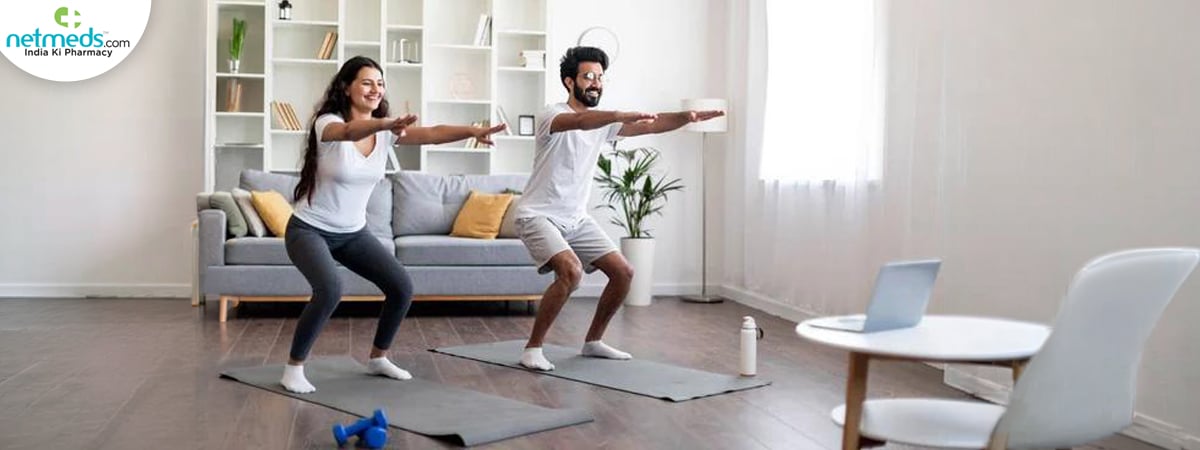
Can You Burn Fat Without Equipment?
Yes! Bodyweight cardio exercises can increase your heart rate and energy expenditure without requiring gym equipment.
However, it is important to understand that you cannot specifically target fat loss from one body part through exercise alone. Regular physical activity can contribute to overall fat loss when combined with an appropriate calorie intake and other healthy lifestyle habits.
The best part? You don't need to start with an intense one-hour workout. Even short sessions can help you become more active, and you can gradually increase their duration and intensity as your fitness improves.
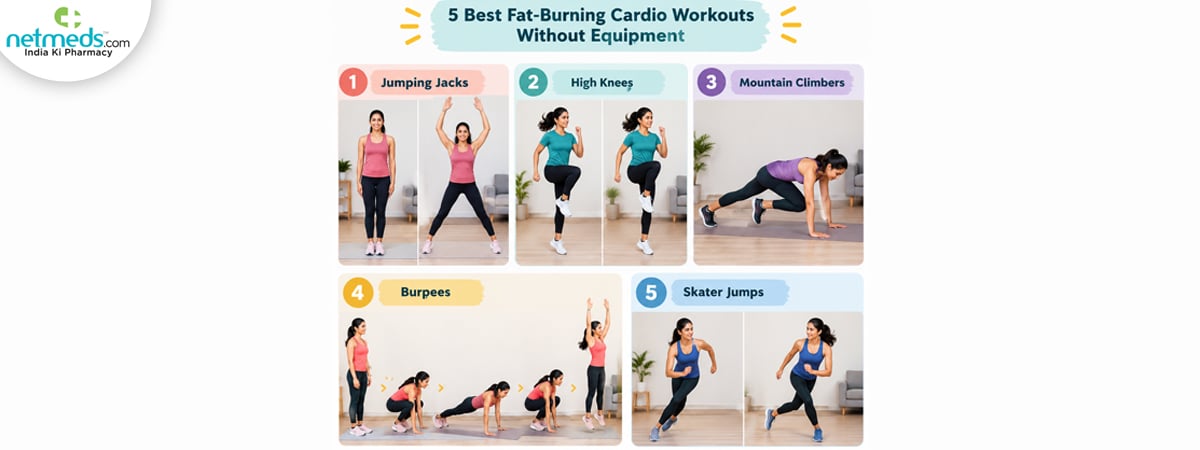
5 Best Fat-Burning Cardio Workouts Without Equipment
Jumping Jacks
A classic for a reason! Jumping jacks are simple, require very little space and work multiple muscle groups while increasing your heart rate.
They primarily engage the legs, shoulders and core and can be incorporated into warm-ups or high-intensity circuits.
How to do jumping jacks?
Stand upright with your feet together and arms beside your body. Jump your feet out while raising your arms overhead. Jump back to the starting position. Continue at a comfortable pace.
Try this: Perform jumping jacks for 20–30 seconds, rest for 20–30 seconds and repeat 3–5 times.
Beginner tip: Step one foot out at a time instead of jumping. Move your arms overhead with each step for a lower-impact version.
High Knees
Looking for an exercise that gets your heart rate up quickly? High knees are a simple cardio movement that can be performed almost anywhere.
This exercise works the legs and core while challenging coordination and cardiovascular endurance.
How to do high knees?
Stand tall with hip-width apart. Lift your right knee towards your chest. Lower it and immediately raise the left knee. Continue alternating between both legs. Move your arms naturally as you increase your pace.
Beginner tip: Beginners can start with 20 seconds of high knees followed by 30–40 seconds of rest.
For a low-impact alternative, perform controlled alternating knee lifts instead of running in place.
Mountain Climbers
Mountain climbers combine a plank position with alternating knee drives, making them a popular full-body cardio exercise. They engage the core, shoulders, arms and legs while increasing workout intensity.
How do mountain climbers?
Start in a high-plank position with your hands beneath your shoulders. Extend both legs behind you. Bring your right knee towards your chest. Return it to the starting position while bringing the left knee forward. Continue alternating.
Beginner tip: Slow the movement down rather than trying to perform it rapidly. Focus on keeping your core engaged and your back stable.
Burpees
Burpees are one of the more challenging no-equipment cardio exercises because they combine several movements into one. A traditional burpee involves squatting, moving into a plank, returning to a standing position and jumping. Because of its intensity, beginners should focus on technique before increasing speed.
How to do a basic burpee?
Stand with your feet hip-width apart. Lower into a squat and place your hands on the floor. Step or jump both feet backwards into a plank. Bring your feet forward. Stand up and jump. Repeat.
Beginner tip: Remove the jump and step your feet backwards and forwards instead.
Start with 5–8 repetitions and take a recovery break. Gradually increase the number as you become fitter.
Skater Jumps
Want to add some side-to-side movement to your home workout? Try skater jumps. This exercise mimics the movement of a speed skater and challenges your legs, glutes, balance and coordination while providing a cardio boost.
How to do skater jumps?
Stand with your feet slightly apart. Bend your knees gently. Push off your right foot and jump towards your left. Land softly on your left foot. Bring your right leg behind you. Push off and repeat on the opposite side.
Perform the movement for 20–30 seconds, followed by a short rest.
Beginner tip: Replace the jumps with controlled side-to-side steps.
Try This 20-Minute No-Equipment Cardio Circuit
Don't know how to put these exercises together? Try this simple circuit:
Exercise
Work
Rest
Jumping jacks
30 sec
30 sec
High knees
30 sec
30 sec
Mountain climbers
30 sec
30 sec
Skater jumps
30 sec
30 sec
Burpees
20 sec
40 sec
Complete 3 rounds to begin with. If you are comfortable and have sufficient fitness, gradually work towards 4 rounds.
Remember, intensity should match your fitness level. You don't have to exercise at maximum speed to make your workout worthwhile.
Tips To Make Your Home Cardio Workout More Effective
Warm Up First
Spend around 5–10 minutes warming up with movements such as walking in place, gentle knee lifts, arm circles and slow squats.
Focus On Form
Speed isn't everything. Poor technique can increase the risk of injury. Perform each movement with control, particularly when you are a beginner.
Increase Intensity Gradually
Once a workout becomes easier, you can increase the duration, repetitions or number of rounds. Avoid suddenly doubling your workout intensity.
Combine Cardio With Strength Training
Cardio is only one part of a balanced fitness routine. Include strength-training exercises such as squats, lunges, push-ups and other resistance exercises to work on muscular fitness as well.
Stay Active Outside Your Workout
Your daily movement matters too. Walking, taking the stairs, household activities and reducing prolonged sitting can help you stay physically active throughout the day.
Support Your Workout With Good Nutrition
A balanced diet containing vegetables, fruits, whole grains, protein-rich foods, healthy fats and adequate fluids can complement your exercise routine.
Is High-Intensity Cardio Suitable For Everyone?
Not necessarily. High-impact movements such as jumping jacks, burpees and skater jumps may not be appropriate for everyone.
If you are new to exercise, have joint or balance concerns, are pregnant, have a chronic health condition or have been physically inactive for a long period, consider speaking with a healthcare professional before beginning vigorous exercise.
Choose low-impact modifications whenever needed. Stop exercising if you experience chest pain, severe breathlessness, fainting, dizziness or unusual pain and seek appropriate medical attention.
Conclusion
You don't need expensive equipment or a gym membership to get your body moving. Jumping jacks, high knees, mountain climbers, burpees and skater jumps are convenient bodyweight cardio exercises that can make a home workout challenging and engaging.
For sustainable fat loss, though, don't chase quick fixes. Combine regular exercise with balanced nutrition, adequate sleep, recovery and an overall active lifestyle.
Start small, stay consistent and gradually challenge yourself. Your home workout space might be all you need to take the first step towards becoming fitter and healthier.
Frequently Asked Questions
Can I lose weight with no-equipment cardio workouts?
Yes. Regular cardio can increase energy expenditure and support weight management. However, sustainable weight loss generally requires a combination of physical activity and appropriate nutrition.
What is the best cardio exercise to burn fat at home?
There is no single “best” exercise for everyone. Burpees, high knees, mountain climbers, jumping jacks and skater jumps can all provide an effective cardio challenge. The right choice depends on your fitness level, preferences and physical limitations.
How long should I do cardio at home?
Start with a duration you can comfortably manage and gradually increase it. Consistency matters more than attempting very long or exhausting workouts.
Can beginners do these cardio exercises?
Yes, but beginners should start slowly and use modifications. Step-based versions of jumping jacks, high knees, mountain climbers and burpees can reduce impact and make the movements easier.
Can I do a no-equipment cardio workout every day?
You can stay physically active daily, but high-intensity workouts may require recovery. Consider alternating vigorous workouts with lower-intensity activities such as walking or gentle mobility exercises.
Do I need to exercise on an empty stomach to burn fat?
No. Exercising on an empty stomach is not essential for fat loss. Your overall dietary pattern, energy balance and physical activity are more important for long-term weight management.
References:
WHO – Physical Activity
Supports the recommendation for regular moderate-to-vigorous physical activity and muscle-strengthening exercises for adults.
CDC – Physical Activity and Your Weight and Health
Useful for the section explaining how physical activity increases energy expenditure and can support weight management when combined with appropriate calorie intake.
CDC – Physical Activity and Your Weight and Health
NIDDK – Eating & Physical Activity to Lose or Maintain Weight
Supports the point that sustainable weight management involves both physical activity and a healthy eating pattern.
NIDDK – Eating & Physical Activity to Lose or Maintain Weight
PubMed – Aerobic Exercise and Weight Loss in Adults: A Systematic Review and Dose-Response Meta-Analysis
A large systematic review of 116 randomised clinical trials examining aerobic exercise and changes in body weight, waist circumference and body fat.
PubMed – Aerobic Exercise and Weight Loss in Adults
PubMed – Effect of High-Intensity Interval Training on Total, Abdominal and Visceral Fat Mass
Reviews evidence on HIIT and reductions in total, abdominal and visceral fat mass.
PubMed – HIIT vs Moderate-Intensity Continuous Training and Body Composition
Compares HIIT and moderate-intensity continuous training and reports improvements in body composition with both approaches.
PubMed – HIIT vs Moderate-Intensity Exercise
PubMed – Effect of HIIT Type on Body Fat Percentage, Fat and Fat-Free Mass
A systematic review and meta-analysis examining different HIIT modalities and their effects on body composition.
PubMed – HIIT and Body Composition
PubMed – Low-Volume HIIT, Body Composition and Cardiorespiratory Fitness
Useful for supporting the idea that shorter, higher-intensity exercise sessions can contribute to improvements in fitness and body composition.
PubMed – Low-Volume HIIT and Fitness
PubMed – Interval Training and Body Composition: Umbrella Review
Reviews multiple systematic reviews and randomised controlled trials examining interval training, body fat and adiposity.
PubMed – Interval Training and Body Composition
WHO – Guidelines on Physical Activity and Sedentary Behaviour
Provides evidence-based recommendations on moderate and vigorous physical activity, strengthening exercises and reducing sedentary behaviour.
WHO – Physical Activity and Sedentary Behaviour Guidelines
 Previous