Whole grains contain vast reserves of dietary fiber, complex carbohydrates, and other key micronutrients that offer numerous health benefits. And when it comes to choosing nutritious whole grains, oats and barley are excellent options. But when comparing oats vs. barley for cholesterol, which one tops the list? And which grain offers more fiber?
(Reduce Your Cholesterol Levels Right Away, Choose From Our Wide Range Of Health Supplements)
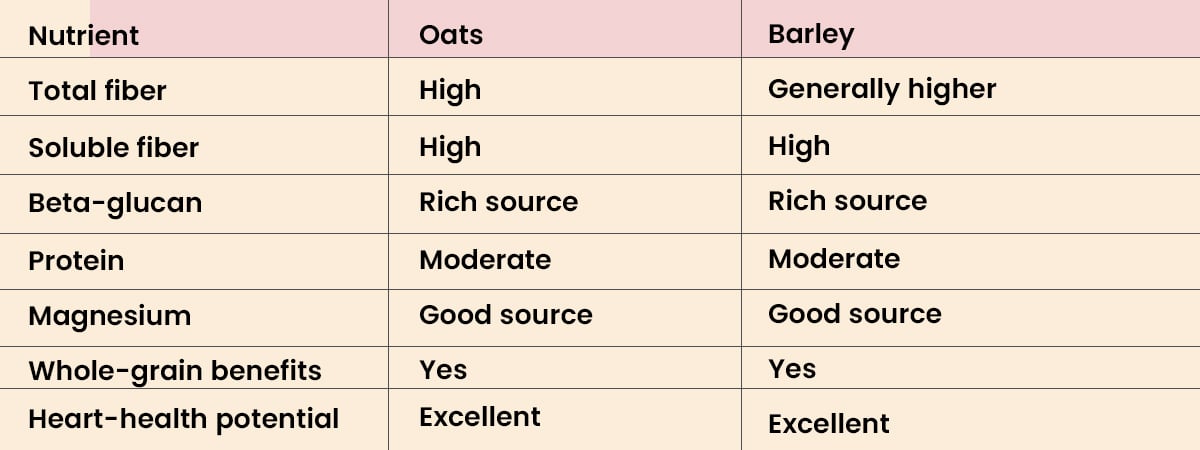
Oats and barley both contain beta-glucan, a type of soluble fiber associated with keeping cholesterol levels in check. However, barley generally gives more total fiber, while oats are specifically known for their cholesterol-friendly beta-glucan content.
Read this article to compare oats and barley based on their nutrition, fiber content, cholesterol-lowering benefits, and the ideal ways to add them to your diet.
Oats vs Barley: Nutritional Comparison
Oats and barley are whole grains that deliver an abundant source of complex carbohydrates, dietary fiber, vitamins, minerals, and beneficial plant compounds. However, the exact amount of nutrients can vary depending on whether the grain is processed, hulled, pearled or prepared in another form.
Which Has More Fibre: Oats or Barley?
Generally, barley contains more total dietary fiber than oats, especially when minimally processed types like hulled barley are used. However, both these grains are abundant sources of soluble fiber, including beta-glucan.
Dietary fibre is known to promote gut health, improve satiety, and help regulate blood glucose and cholesterol levels.
Fiber content differs largely based on the type and processing of the grain. Hulled barley retains more of its fiber-loaded outer layers than refined barley products.
Why Is Beta-Glucan Important for Cholesterol?
Beta-glucan is a type of soluble fiber present mostly in whole grains like oats and barley. Consuming 3 grams or more of beta-glucan fiber per day, either from whole oats or barley, or a combination of both as part of a regular diet regimen as proven to lower LDL cholesterol levels, maintain lipid profile, and reduce the risk of heart disease.
Beta-glucan forms a gel-like substance in the stomach. This action can affect the absorption and reabsorption of bile acids, prompting the body to use cholesterol to produce more bile acids. As a result, incorporating foods containing beta-glucan regularly may help reduce LDL ("bad") cholesterol when consumed in sufficient amounts.
Oats for Cholesterol: Are They Good?
Absolutely. Oats can be included as part of a heart-friendly meal regimen, as they are rich in beta-glucan.
Adding oats to a balanced meal plan daily may help maintain healthy LDL cholesterol levels. Oats are a versatile ingredient that can be readily used in making breakfast cereals, porridge, overnight oats jar, oats idli, oats upma, and baked dishes.
To reap maximum benefit, choose minimally processed types of oats like rolled or steel-cut oats, rather than relying heavily on sugar-loaded sweetened instant oat products.
Barley for Cholesterol: Is It Better Than Oats?
Barley is one of the lesser used whole grains that comes with an impressive profile of nutrients and an excellent option for augmenting heart health. One advantage of barley is its high total fibre content and contains more beta-glucan content, making it a useful whole grain for people looking to increase their intake of soluble fibre.
Both these grains can be valuable when included as part of a balanced and overall heart-healthy meal pattern.
Oats vs Barley for Cholesterol: Which Is Better?
Well, both oats and barley can help maintain cholesterol levels, as they offer beta-glucan, fiber, and other key nutrients. If your preference is to improve overall fiber intake, then barley may be advantageous. On the other hand, if you want an easy, convenient, and versatile breakfast food that is naturally rich in beta-glucan, then oats are a perfect option.
Also Read: Amazing Foods To Reduce LDL Cholesterol - Infographic
Oats may be a good choice if you:
Want a quick and convenient breakfast on the go.
Prefer porridge or overnight oats to boost nutrient intake.
Blend oats to make smoothies or baked foods for flavour and increase fiber content.
Are looking for a familiar source of beta-glucan to improve fiber content.
Barley may be better if you:
Want to increase your total fibre intake.
Enjoy grain bowls, soups or salads that boost nutrient intake.
Prefer a chewy whole grain with a nutty flavour and texture.
Health Benefits of Oats
Promotes Heart Health
The beta-glucan content in oats may help reduce LDL cholesterol levels when consumed regularly as part of a balanced diet. In addition, it also keeps lipid profile under control and decreases the risk of cardiovascular disease.
Digestive Health
The richness of dietary fiber in oats regularises bowel movements, prevents constipation, treats digestive discomforts, and maintains gut microbiome balance.
Manages Weight
The combination of fibre and complex carbohydrates can help you stay satiated longer, reduce overall calorie intake, which may support healthy eating patterns and maintain weight within a healthy range.
Delivers Key Nutrients
Oats provide essential nutrients like magnesium, phosphorus, manganese and iron; they promote overall health and well-being. However, the amounts vary depending on the product and serving size.
Health Benefits of Barley
Loaded with Dietary Fibre
Barley is especially beneficial for increasing overall fibre intake, promoting digestion and maintaining gut microbiome balance.
Improves Heart Health
The beta-glucan content and overall nutrient profile of barley make it a heart-friendly whole grain that manages lipid profile and optimises heart function.
Adds Variety to the Diet
Barley is a versatile whole grain with a nutty flavour that can be used in soups, salads, grain bowls and as an alternative to refined grains.
How to Eat Oats for Better Cholesterol Management
If you are including oats in your meal regimen to support cholesterol management, focus on the overall quality of the meal. Try:
Oatmeal topped breakfast bowls with berries, apple or pear and nuts and seeds.
Overnight oats jar with unsweetened yogurt, nuts and seeds to keep your gut healthy
Savoury oats with vegetables and legumes for flavour and variety.
Oat bran added to meals to increase fiber intake.
Avoid turning oats into a high-sugar meal by adding excessive amounts of refined sugar, sweetened syrups, or highly processed toppings.
How to Eat Barley for Better Heart Health
Barley is easy to incorporate into your meal pattern. Try:
Barley vegetable soup for a nutrient boost and energy.
Barley salad with vegetables and legumes keeps you satiated.
Barley khichdi and grain bowls to boost fiber intake.
Barley as an alternative to refined rice.
For better overall heart health, pair barley with vegetables, legumes, nuts, seeds, and other minimally processed foods.
Can You Eat Oats and Barley Together?
Yes. You can include both oats and barley in your diet. Eating a variety of whole grains can provide different nutrients and help increase overall dietary fibre intake.
However, simply adding oats or barley to a diet does not guarantee lower cholesterol. Overall dietary patterns, physical activity, body weight, smoking, genetics and other health factors also influence cholesterol levels.
Frequently Asked Questions
Is barley better than oats for cholesterol?
Both oats and barley contain beta-glucan, which can help support healthy LDL cholesterol levels. Barley generally provides more total fibre, but both are good choices.
Which has more fibre, oats or barley?
Barley generally contains more total dietary fibre than oats. However, fibre content varies depending on the type and processing.
Can I eat oats every day for cholesterol?
Oats can be eaten regularly as part of a balanced diet. Their beta-glucan content may help support healthy cholesterol levels when consumed in adequate amounts.
Is barley good for high cholesterol?
Conclusion
When comparing oats vs barley, both deserve a place in a healthy, balanced and heart-friendly diet. Oats are well known for their beta-glucan content, while barley generally offers more total dietary fibre. Including either or both along with vegetables, fruits, pulses, nuts and seeds can help create a fibre-rich, heart-friendly eating pattern.
References:
https://pmc.ncbi.nlm.nih.gov/articles/PMC10777247/
Viscous fiber from oats and barley: keep them in your cholesterol-lowering portfolio
https://www.heartuk.org.uk/four-cholesterol-lowering-foods/oats-and-barley
Liana L Guarneiri 1,^, Carol F Kirkpatrick 1,2,^, Kevin C Maki 1
World Health Organization. Cardiovascular diseases (CVDs) [Internet]. World Health Organization; c2023. [Updated 2021, June 11; Cited 2023, August 9]. Available online: https://www.who.int/news-room/fact-sheets/detail/cardiovascular-diseases-(cvds)
Borén J, Chapman MJ, Krauss RM, et al. Low-density lipoproteins cause atherosclerotic cardiovascular disease: pathophysiological, genetic, and therapeutic insights: a consensus statement from the European Atherosclerosis Society Consensus Panel. Eur Heart J 2020;41:2313-30. 10.1093/eurheartj/ehz962
Ference BA, Ginsberg HN, Graham I, et al. Low-density lipoproteins cause atherosclerotic cardiovascular disease. 1. Evidence from genetic, epidemiologic, and clinical studies. A consensus statement from the European Atherosclerosis Society Consensus Panel. Eur Heart J 2017;38:2459-72. 10.1093/eurheartj/ehx144
Cholesterol Treatment Trialists’ (CTT) Collaboration, Baigent C, Blackwell L, et al. Efficacy and safety of more intensive lowering of LDL cholesterol: a meta-analysis of data from 170,000 participants in 26 randomised trials. Lancet 2010;376:1670-81. 10.1016/S0140-6736(10)61350-5
Grundy SM, Stone NJ, Bailey AL, et al. 2018 AHA/ACC/AACVPR/AAPA/ABC/ACPM/ADA/AGS/APhA/ASPC/NLA/PCNA Guideline on the Management of Blood Cholesterol: A Report of the American College of Cardiology/American Heart Association Task Force on Clinical Practice Guidelines. J Am Coll Cardiol 2019;73:e285-350. 10.1016/j.jacc.2018.11.003
Pearson GJ, Thanassoulis G, Anderson TJ, et al. 2021 Canadian Cardiovascular Society Guidelines for the Management of Dyslipidemia for the Prevention of Cardiovascular Disease in Adults. Can J Cardiol 2021;37:1129-50. 10.1016/j.cjca.2021.03.016
Visseren FLJ, Mach F, Smulders YM, et al. 2021 ESC Guidelines on cardiovascular disease prevention in clinical practice. Eur Heart J 2021;42:3227-337. 10.1093/eurheartj/ehab484
Arnett DK, Blumenthal RS, Albert MA, et al. 2019 ACC/AHA Guideline on the Primary Prevention of Cardiovascular Disease: A Report of the American College of Cardiology/American Heart Association Task Force on Clinical Practice Guidelines. Circulation 2019;140:e596-646. 10.1161/CIR.0000000000000678
Lichtenstein AH, Appel LJ, Vadiveloo M, et al. 2021 Dietary Guidance to Improve Cardiovascular Health: A Scientific Statement From the American Heart Association. Circulation 2021;144:e472-87. 10.1161/CIR.0000000000001031
Kirkpatrick CF, Sikand G, Petersen KS, et al. Nutrition interventions for adults with dyslipidemia: A Clinical Perspective from the National Lipid Association. J Clin Lipidol 2023;17:428-51. 10.1016/j.jacl.2023.05.099
 Previous