When hunger strikes between meals, choosing a healthy snack can get a little tricky and can make a huge difference to your weight-loss journey. You want something crunchy and wholesome but, at the same time, want a snack that doesn’t add too many calories to your day. Two of the most popular snacks- makhana and popcorn are considered healthier alternatives to chips and other packaged snacks. But which one should you go for while being on a weight loss diet? Explore this article to learn more about their nutritional breakdown, health benefits, uses and possible side effects.
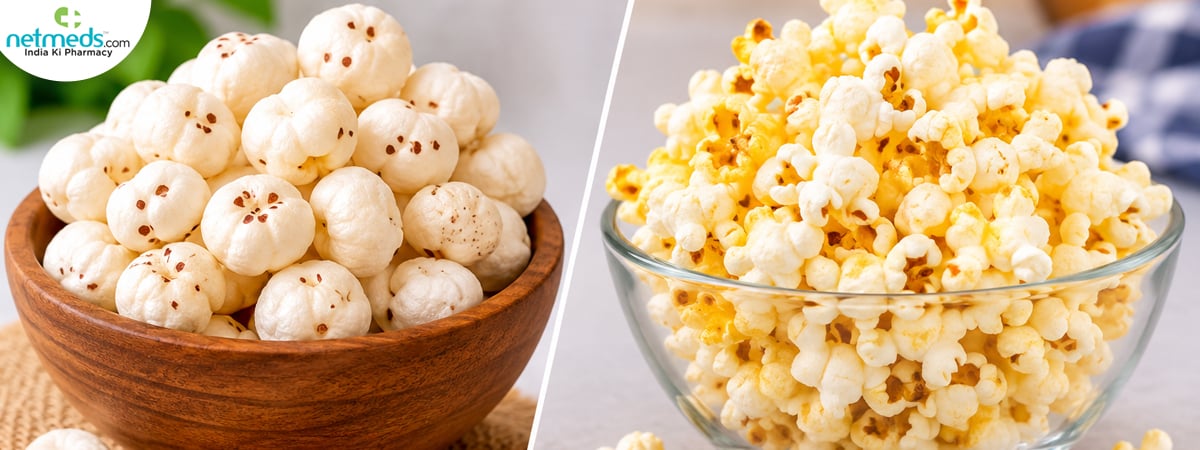
What Are Makhana and Popcorn?
Makhana, also known as fox nuts or lotus seeds, is obtained from the seed of the aquatic plant Euryale ferox. It is naturally low in fat and offers carbohydrates, protein and minerals. It is usually consumed roasted with a little ghee, salt and spices to make a crunchy snack.
Popcorn is a whole-grain snack made from special varieties of corn kernels that expand and become fluffy when heated. Being rich in dietary fiber and other key nutrients, it can be a wholesome snack when air-popped without adding excess butter, salt or sugar.
Makhana vs Popcorn: Nutritional Comparison
Approximate nutritional values per 100 g of plain, air-popped popcorn and plain, dried makhana are shown below.
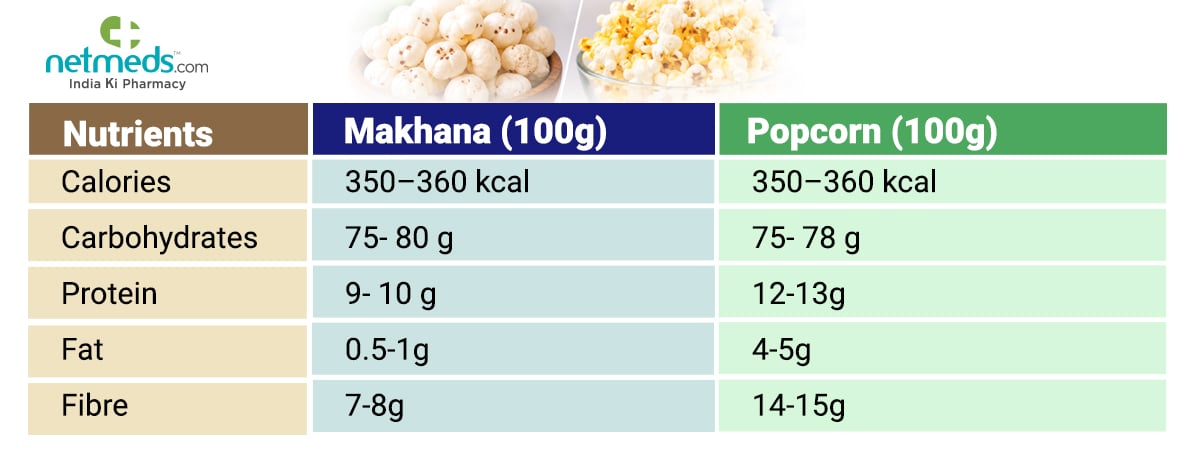
The nutritional values are approximate and can differ based on the variety, processing and preparation method. However, packaged and flavoured products may have considerably different nutritional values. In addition, the calories of your snack largely depend on the portion size and other added ingredients.
5 Health Benefits of Makhana
Promotes Weight Management
Makhana is a wholesome, crunchy, low-fat snack that can replace fried and junk snacks. Being naturally abundant in fiber and other vital nutrients, makhana can promote satiety, control unwanted hunger pangs, reduce overall calorie intake and support weight management when consumed in controlled portions.
Potent Antioxidant Effects
Makhana contains a wealth of plant compounds that possess powerful antioxidant traits, which protect cells against oxidative damage and prevent the risk of chronic health conditions.
Promotes Bone Health
Makhana is endowed with vast reserves of bone-friendly nutrients including calcium, phosphorus and magnesium, that contribute to maintaining stronger bones and muscle function.
Plant-Based Protein
Makhana contains some plant protein, which contributes to tissue maintenance, keeps you satiated, promotes weight loss and supports normal body functions.
Health Benefits of Popcorn
Loaded With Dietary Fiber
Popcorn is a whole grain cereal that offers dietary fiber, which keeps you satiated, regularises bowel movements, supports digestion and overall gut health.
Manages Weight
Air-popped popcorn is relatively low in calories, letting you enjoy a larger quantity of food for fewer calories than most fried snacks.
Provides Antioxidants
Popcorn contains potent polyphenols, plant compounds that help protect cells against oxidative damage, ease inflammation and optimise overall health.
Essential Nutrients
Popcorn delivers fair amounts of magnesium, phosphorus, zinc and B vitamins that support several normal body functions and augment overall well-being.
Makhana vs Popcorn: Which Is Better for Weight Loss?
Does Makhana Help With Weight Loss?
Makhana, being low in fat and provide some plant-based protein and fiber serves a healthy option when you want to crunchy option without added calories. Moreover, it also helps maintain blood glucose levels and keeps you satiated.
Remember, it does not mean that Makhana is perfect for a weight loss diet, as it is energy-dense, so eating it straight from a large bowl can add up. Also, the method of roasting and ingredients like oil or ghee also matter.
Also Read: 7 Best Snacks to Curb Night-time Cravings: Discover Their Nutrition and Health Benefits
Can Popcorn Be A Perfect Snack For Weight Loss
Plain popcorn has a huge advantage over makhana, as it gives you a lot of volume for relatively fewer calories. Popcorn is a whole grain and contains fiber, which makes it more filling than usual processed snacks. The fiber and complex carbohydrates in plain popcorn slow down gastric emptying time and serve as a perfect snack for those trying to lose weight. Provided you don’t go for heavily buttered versions.
Furthermore, a study found that people who ate popcorn reported greater satiety and lower hunger pangs than those who ate potato chips, while also having fewer calories from the snack and meal combo.
Makhana Or Popcorn: Which Is Better For Weight Loss?
If you want density and fullness for minimal calories, then plain popcorn had an advantage. It is a whole grain and has been studied for its effectiveness on short-term satiety.
Makhana is also a good choice, especially when dry-roasted or made with little oil. It is naturally low in fat and has a low GI, but it should not be considered a free-for-all snack just because it is marketed as healthy; read the nutritional label for any added fat, sugar, salt and calories.
Thus, for weight loss, plain popcorn has a slight edge; mainly, it is lower in calorie density and filling for its volume. But a small portion of roasted makhana also fits into a weight-loss meal regimen.
Note: In both cases, toppings and portion size can completely alter the picture.
Ways To Add Makhana and Popcorn to Your Weight-Loss Diet
Here are some healthy ways to enjoy these snacks:
Healthy ways to eat makhana:
Roast makhana with a small amount of ghee and turmeric.
Prepare pepper and curry-leaf makhana for a flavourful evening snack.
Add roasted makhana to homemade trail mixes with a few nuts and seeds.
Sprinkle roasted makhana over vegetable soups for added crunch.
Healthy ways to eat popcorn:
Prepare plain air-popped popcorn without butter.
Season popcorn with black pepper, turmeric or cinnamon.
Combine popcorn with a small portion of roasted nuts for a satisfying snack.
How Much Should You Eat?
Portion control is very important even when choosing nutritious snacks.
Makhana: Around 20–30 g of plain roasted makhana makes a practical snack portion.
Popcorn: Around 3 cups of plain, air-popped popcorn is a reasonable snack portion.
You can modify portion sizes as per your calorie needs, physical activity levels and overall diet plan.
Potential Side Effects
Makhana:
Eating excess quantities may contribute to bloating or digestive discomfort due to its fiber content.
Excessive salt or ghee can increase sodium or calorie intake.
People with seed or food allergies should be cautious.
Popcorn:
Eating large quantities may cause bloating and digestive discomfort in people sensitive to high-fiber foods.
Excessive butter, cheese, caramel and salt can increase calorie, saturated fat and sodium intake.
Unpopped kernels may pose a choking risk, particularly for young children.
Conclusion
Both makhana and popcorn serve as a wholesome alternative to highly processed, fried snacks and junk foods. However, air-popped popcorn offers more dietary fibre and volume per calorie, making it a beneficial option for those trying to lose weight. Makhana is also an excellent choice because it's naturally low in fat and versatile.
The healthiest choice ultimately depends on process, preparation method, portion size and your overall dietary habits. Include either snack in a balanced diet alongside vegetables, fruits, lean proteins and regular physical activity to support sustainable weight management.
Frequently Asked Questions
Is makhana better than popcorn for weight loss?
Not necessarily. Air-popped popcorn generally contains more fibre and has a lower calorie density, while makhana is naturally lower in fat. Both can support weight management when eaten in controlled portions.
Which has more protein, makhana or popcorn?
Air-popped popcorn generally contains slightly more protein per 100 g than plain dried makhana. However, neither is a particularly high-protein snack.
Can I eat makhana every day for weight loss?
Yes, you can enjoy a moderate portion of plain roasted makhana daily as part of a balanced, calorie-controlled diet.
Is popcorn healthy to eat at night?
Yes, plain air-popped popcorn can be a light evening snack. Avoid butter-coated, caramelised or heavily salted varieties.
Is makhana good for people with diabetes?
Makhana contains carbohydrates and can raise blood glucose levels. People with diabetes should monitor portion sizes, account for its carbohydrate content and combine it with suitable protein- or fibre-rich foods.
References: https://www.researchgate.net/publication/404285406_Overcoming_challenges_Makhana_stands_out_as_a_powerful_medicinal_superfood_A_review
Overcoming challenges, Makhana stands out as a powerful medicinal superfood: A review
April 2026International Journal of Agriculture and Food Science 8(4):438-444
DOI:10.33545/2664844X.2026.v8.i4f.1450
Andrews HC. Anneslea spinosa Andrews. In: The botanist's repository. Vol. 10. 1811. p. t.618.
Cronquist A. An integrated system of classification of flowering plants. New York: Columbia University Press; 1981.
Das S, Der P, Raychaudhuri U, Maulik N, Das D. The effect of Euryale ferox (Makhana) on myocardial ischemic reperfusion injury. Mol Cell Biochem. 2006;289:55-63.
Flora of China. Euryale ferox. eFloras; 2025 [cited 2025 Jan 29]. Available from: https://www.efloras.org
Fuller DQ, Qin L, Zheng Y, Zhao Z, Chen X, et al. The domestication process and domestication rate in rice: spikelet bases from the Lower Yangtze. Science. 2009;323(5921):1607-1610.
Garabal MV, Arévalo RM, Díaz-Palarea MD, Castro R, Rodríguez M. Tyrosine availability and brain noradrenaline synthesis in the fetus: control by maternal tyrosine ingestion. Brain Res. 2018;457(2):330-337.
 Previous