Stronger, healthier bones are vital for mobility, balance, and overall health at every stage of life. These two key nutrients play a vital role in keeping bone health and averting the risk of osteoporosis and other bone-related conditions. Bones are dynamic structures that undergo constant remodelling, with old bone tissue replaced by new bone. To assist this process, the human body needs adequate amounts of calcium and vitamin D. Calcium supports building and maintaining bones and teeth, while vitamin D assists calcium absorption and helps the body use calcium more effectively.
But is calcium more important than vitamin D? Explore this article to understand the difference between these nutrients, make informed dietary choices, and reduce the risk of bone-related health issues.
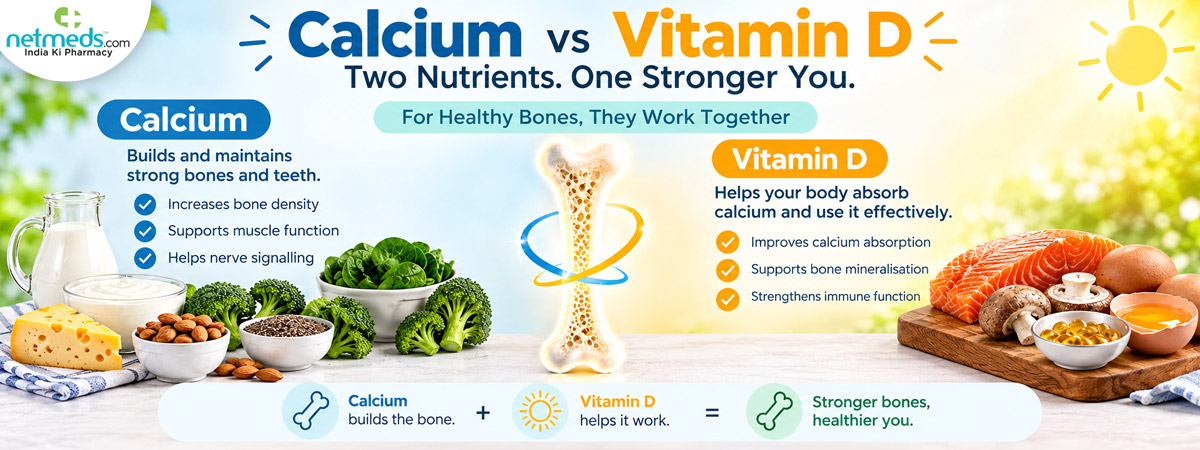
What Is Calcium?
Calcium is one of the most abundant minerals present in the human body, with about 99% of it stored in the bones and teeth. Calcium performs numerous vital bodily functions beyond building bone mass. Calcium is essential for proper muscle contraction, nerve transmission, blood clotting mechanism and the release of hormones and enzymes that are vital for performing several important functions.
(Boost Your Bone Health With Our Top-Selling Calcium And Vitamin-D Supplements!)
The recommended dietary allowance (RDA) for calcium differs depending on age and gender, with adults requiring between 1000 and 1200 mg/ day. Food sources abundant in calcium include dairy products like milk, yogurt, and cheese, green leafy vegetables like moringa, broccoli, and kale, fortified foods such as orange juice and cereals, and fish like sardines and salmon.
However, when you are not taking adequate calcium through diet, it may lead to a decrease in bone density. Over time, this can increase the risk of fractures and osteoporosis, which is characterised by fragile bones. Therefore, ensuring sufficient calcium intake is important for keeping the bones strong and healthier all through the life.
What Is Vitamin D?
Vitamin D is important for preserving bone mass because it helps the body absorb dietary calcium and is vital for maintaining serum calcium and phosphate levels. These are crucial for stronger bone formation. Inadequate vitamin D intake can result in bones becoming thin and deformed.
The main source of vitamin D is sunlight, where the skin produces vitamin D when exposed to UV rays. But due to factors like geographical location, time spent indoors, and use of sunscreen, most people may not get adequate vitamin D from sunlight. In such scenarios, dietary sources become key. Food sources loaded with vitamin D include fatty fish like salmon and mackerel, fortified dairy products, cereals, certain varieties of mushrooms, and egg yolks.
The recommended dietary allowance of vitamin D is 600 to 800 IU for most healthy adults, but higher doses may be required for older adults or those at risk of deficiency. Regular evaluation of vitamin D levels is advisable, particularly for those with limited sun exposure or with certain medical conditions that may impact vitamin D metabolism.
The Interaction of Calcium and Vitamin D
Calcium and vitamin D work synergistically to promote bone health. Vitamin D enhances calcium absorption in the intestines, while calcium is required for vitamin D’s function in maintaining bone mass and integrity. Lack or deficiency of these nutrients can lead to impaired bone health and function.
For optimal bone health, it is important to ensure that both calcium and vitamin D levels are adequate. This can be readily attained by following a healthy lifestyle, including a wholesome diet, sunlight exposure, and, if required, supplements.
A physician can provide guidance on appropriate supplementation and dietary changes based on individual needs.
Also Check out: 5 Effective Ways To Build Healthy Bones - Infographic
Symptoms of Calcium and Vitamin D Deficiency
Common Signs of Inadequate Calcium Intake
Muscle cramps or spasms, particularly in severe calcium deficiency
Tingling or numbness around the mouth or in the fingers in cases of low blood calcium
Weak or brittle bones over time
Risk of bone loss and fractures
Low calcium intake does not necessarily cause low blood calcium because the body can draw calcium from bones to maintain its blood levels.
Common Signs of Vitamin D Deficiency
Bone pain or tenderness
Muscle weakness
Difficulty getting up from a chair or climbing stairs in more severe cases
Increased risk of osteomalacia in adults
Delayed bone development or skeletal abnormalities in children
However, these symptoms have various causes and should not be used alone to diagnose a deficiency. Seek advice from your healthcare provider if you notice persistent bone pain, sudden muscle weakness, or other symptoms that worry you.
How to Get Enough Calcium and Vitamin D Naturally
Add Calcium-Rich Foods
Include a rich array of milk and milk products, ragi, sesame seeds, tofu, fish, and leafy green vegetables in your regular meal regimen. If you avoid dairy products, choose calcium-fortified foods and check their nutrition labels or go for supplements.
Include Vitamin D Sources
Try to incorporate fatty fish, egg yolks, and fortified foods where required. Only a few foods naturally contain substantial amounts of vitamin D. Some people may need vitamin D supplementation; follow a healthcare provider’s advice.
Get Sun Exposure
Sunlight helps the body produce vitamin D, but there is no single exposure duration that works for everyone. Avoid sunburn and follow local sun-protection guidance, especially during periods of strong UV exposure.
Exercise Regularly
Weight-bearing activities such as walking, stair climbing, dancing, and strength training are the best workouts that maintain bone mass and strength. Choose activities suited to your fitness level and health status.
Quit Smoking and Limit Alcohol
Smoking and excessive alcohol consumption can negatively impact bone health. Quitting smoking and restricting alcohol intake can help minimise the risk of bone-related issues.
Also Read: Bone Health And Calcium Deficiency: Causes, Symptoms And Prevention
Should You Take Calcium and Vitamin D Supplements Together?
Calcium and vitamin D supplements may be recommended when dietary intake is inadequate, vitamin D deficiency is diagnosed, or certain medical conditions increase nutritional needs.
Both these supplements can be taken together as advised by your healthcare provider, as vitamin D supports the body absorb calcium. However, not everyone needs supplements, and taking more than the recommended amount does not automatically improve bone health.
Excessive calcium supplementation can cause constipation and may increase the risk of kidney stones in risk group people. Excessive vitamin D can lead to high blood calcium levels and kidney complications.
Before starting supplements, consider the following:
Review your usual diet and total calcium intake.
Consult a healthcare provider if you suspect vitamin D deficiency or have risk factors for osteoporosis.
Do not take high-dose vitamin D or calcium supplements without medical advice.
Discuss with your healthcare provider any existing medications, kidney problems, or a history of kidney stones.
Your physician may recommend a blood test for 25-hydroxyvitamin D when clinically indicated. Calcium blood tests may be useful in specific situations, but they do not reliably measure how much calcium is stored in your bones.
Frequently Asked Questions
Which is more important for bone health: calcium or vitamin D?
Both are essential. Calcium provides the mineral structure of bones, while vitamin D helps the body absorb calcium and supports bone mineralisation.
Can I take calcium without vitamin D?
Yes, but vitamin D is necessary for efficient calcium absorption. If your vitamin D intake or levels are inadequate, calcium alone may not fully support bone health. Discuss your needs with a healthcare professional.
Does vitamin D deficiency cause weak bones?
Yes. Severe or prolonged vitamin D deficiency can impair bone mineralisation, causing rickets in children and osteomalacia in adults. It may also contribute to muscle weakness and increase the risk of falls.
Can sunlight alone provide enough vitamin D?
It may provide a substantial amount for some people, but vitamin D production varies with skin pigmentation, age, season, location, clothing, and sun exposure. Some people may need dietary sources or supplements.
Can calcium and vitamin D prevent osteoporosis?
Adequate calcium and vitamin D help maintain bone health, but they cannot prevent every case of osteoporosis. Exercise, adequate protein intake, avoiding smoking, limiting alcohol, and appropriate medical care are also important.
Conclusion
Calcium and vitamin D hold different but supporting roles in maintaining strong, healthy bones. Calcium supplies the vital mineral structure, while vitamin D helps the body absorb calcium efficiently and promotes bone mineralisation. Getting enough of both nutrients through a balanced diet, sensible sun exposure, regular exercise, and appropriate supplementation when needed can help support bone health throughout life.
References:
https://pmc.ncbi.nlm.nih.gov/articles/PMC9944083/
Vitamin D and Calcium in Osteoporosis, and the Role of Bone Turnover Markers: A Narrative Review of Recent Data from RCTs
Gavriela Voulgaridou 1, Sousana K Papadopoulou 1, Paraskevi Detopoulou 2,3, Despoina Tsoumana 1, Constantinos Giaginis 4, Foivi S Kondyli 1, Evgenia Lymperaki 5, Agathi Pritsa 1,*
https://www.niams.nih.gov/health-topics/calcium-and-vitamin-d-important-bone-health
https://www.sciencedirect.com/science/article/pii/S1530891X25009656
Rossini M., Adami S., Bertoldo F., Diacinti D., Gatti D., Giannini S., Giusti A., Malavolta N., Minisola S., Osella G., et al. Guidelines for the diagnosis, prevention and management of osteoporosis.
Fitzpatrick L.A. Secondary Causes of Osteoporosis. Mayo Clin. Proc. 2002;77:453–468. doi: 10.1016/S0025-6196(11)62214-3. Ribagin S., Roeva O., Pencheva T. Generalized Net model of asymptomatic osteoporosis diagnosing; Proceedings of the 2016 IEEE 8th International Conference on Intelligent Systems (IS); Sofia, Bulgaria. 4–6 September 2016; pp. 604–608.
Kanis J.A., Norton N., Harvey N.C., Jacobson T., Johansson H., Lorentzon M., McCloskey E.V., Willers C., Borgström F. SCOPE 2021: A new scorecard for osteoporosis in Europe. Arch Osteoporos. 2021;16:82. doi: 10.1007/s11657-020-00871-9. Salari N., Ghasemi H., Mohammadi L., Behzadi M.H., Rabieenia E., Shohaimi S., Mohammadi M. The global prevalence of osteoporosis in the world: A comprehensive systematic review and meta-analysis. J. Orthop. Surg. Res. 2021;16:609. doi: 10.1186/s13018-021-02772-0.
Lane N.E. Epidemiology, etiology, and diagnosis of osteoporosis. Am. J. Obstet. Gynecol. 2006;194:S3–S11. doi: 10.1016/j.ajog.2005.08.047.
Fischer V., Haffner-Luntzer M., Amling M., Ignatius A. Calcium and vitamin D in bone fracture healing and post-traumatic bone turnover. Eur. Cell Mater. 2018;35:365–385. doi: 10.22203/eCM.v035a25.
Mithal A., Bansal B., Kyer C.S., Ebeling P. The Asia-Pacific Regional Audit-Epidemiology, Costs, and Burden of Osteoporosis in India 2013: A report of International Osteoporosis Foundation. Indian J. Endocrinol. Metab. 2014;18:449–454. doi: 10.4103/2230-8210.137485.
 Previous