


Ever washed your face after a long day and still wondered whether your skin was actually clean? Between sunscreen, makeup, sweat, pollution and excess sebum, a single cleanse may not always remove everything effectively.
That is where double cleansing comes in. Popularised by Korean and Japanese skincare routines, this two-step method involves using an oil-based cleanser followed by a water-based cleanser.
But is double cleansing necessary for everyone? Not necessarily. When used correctly, it can be a useful way to remove stubborn sunscreen, makeup and oil without excessive scrubbing. However, doing it too often or using harsh cleansers may leave your skin dry and irritated.
Let us explore the benefits of double cleansing, how to double cleanse correctly, suitable products for different skin types and common mistakes to avoid.

What Is Double Cleansing?
Double cleansing is a simple two-step facial cleansing method:
Step 1: Use an oil-based cleanser to dissolve makeup, sunscreen, sebum and oil-soluble impurities.
Step 2: Follow with a gentle water-based cleanser to remove remaining residue, sweat, dirt and other water-soluble impurities.
The idea isn't to scrub your skin until it feels "squeaky clean." Instead, the goal is to remove buildup while preserving the skin barrier.
Also Read: Glass Skin: How to Ace This New Trend In 3 Steps
Get Flawless, Radiant Complexion With Our Wide-Range Of Korean Skincare Essentials!
Why Is Double Cleansing Popular?
Modern skincare routines often involve multiple products, particularly sunscreen and makeup. Some formulas are designed to be long-lasting or water-resistant, making them more difficult to remove with a single gentle cleanser.
Double cleansing can therefore be particularly useful at night if you have worn:
Sunscreen
Waterproof eye makeup
Heavy skincare products
Long-wear cosmetics
However, if you haven't used sunscreen or makeup and your skin isn't particularly oily or dirty, one gentle cleanse may be sufficient.

Benefits Of Double Cleansing
Helps Clear Makeup
Oil-based cleansers can help dissolve makeup pigments and oils, making it easier to remove foundation, concealer and other cosmetics without aggressive rubbing.
Removes Sunscreen
Some sunscreens are water-resistant and designed to remain on the skin for hours. An oil-based first cleanse can help loosen these formulations before the second cleansing step.
Clears Excess Sebum
Oil-based cleansers can interact with excess skin oils, helping lift them from the skin's surface. This can be especially useful for people with oily or combination skin who regularly wear sunscreen or makeup.
Can Leave Skin Feeling Cleaner
Removing layers of makeup, sunscreen and daily buildup can leave the skin feeling fresh and prepared for the rest of your nighttime routine.
May Reduce The Need For Aggressive Scrubbing
Instead of repeatedly rubbing the skin with a single cleanser or makeup wipe, an appropriate cleansing oil or balm can help dissolve stubborn products more gently.
How To Double Cleanse Correctly?
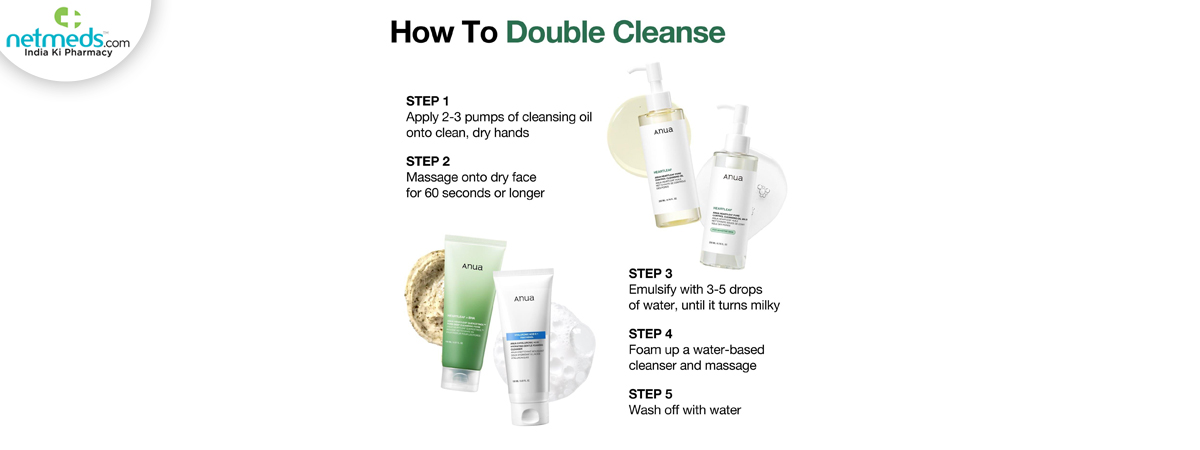
Step 1: Start With An Oil-Based Cleanser
Apply cleansing oil or balm to dry skin using clean hands.
Gently massage it across the face, particularly areas where makeup and sunscreen tend to accumulate.
If the product instructions recommend emulsifying, add a little water and massage until it turns milky. Rinse thoroughly.
Step 2: Follow With A Gentle Water-Based Cleanser
Apply a mild cleanser to damp skin and massage gently.
Rinse with lukewarm water and pat your face dry with a clean towel.
Step 3: Continue With Your Skincare Routine
Once cleansing is complete, apply your usual skincare products, such as:
Serum
Moisturiser
Eye cream, if desired
Since double cleansing is generally intended for the evening, finish with your nighttime moisturiser rather than sunscreen.
How To Double Cleanse According To Your Skin Type?
Oily Skin: Choose lightweight, non-comedogenic cleansing oils or balms followed by a gentle foaming or gel cleanser.
Dry Skin: Opt for a nourishing cleansing oil or balm and a creamy, fragrance-free cleanser.
Combination Skin: Use lightweight cleansing products and avoid excessively drying formulas on oilier areas.
Sensitive Skin: Keep the routine simple and choose gentle, fragrance-free products. Avoid vigorous rubbing.
Acne-Prone Skin: Look for non-comedogenic products and avoid heavy fragrances or ingredients that irritate your skin.
Common Double Cleansing Mistakes
Double Cleansing Twice A Day
Double cleansing is usually most useful at night. Doing it unnecessarily in the morning can contribute to dryness and irritation.
Using Harsh Cleansers
A cleanser that leaves your skin tight or uncomfortable may be too harsh.
Scrubbing Too Hard
Cleansing should involve gentle massage, not aggressive rubbing.
Using Makeup Wipes As Your Main Cleanser
Makeup wipes can be convenient, but they may leave residue and often encourage rubbing. If you use them, consider following with an appropriate cleanser.
Ignoring Your Skin's Response
If your skin becomes excessively dry, flaky, itchy or irritated, reduce cleansing frequency and reconsider the products you're using.
Assuming More Cleansing Means Fewer Breakouts
Over-cleansing doesn't necessarily prevent acne. Excessive cleansing can disrupt the skin barrier and cause irritation, potentially making skin concerns harder to manage.
Who Should Try Double Cleansing?
Double cleansing may be particularly useful for people who:
Wear makeup regularly
Apply water-resistant sunscreen
Have oily or combination skin
Live in areas with significant pollution
Use several occlusive skincare products
If your skin is very dry or sensitive and you don't wear makeup or heavy sunscreen, a single gentle cleanse may be all you need.
Does Double Cleansing Guarantee Clear Skin?
No skincare technique can guarantee completely clear skin.
Double cleansing can help remove makeup, sunscreen, excess oil and daily buildup, but acne and other skin concerns have multiple causes. Hormones, genetics, stress, skincare products and other factors can all contribute.
A simple routine with a gentle cleanser, moisturiser, and broad-spectrum sunscreen can matter more than adding multiple cleansing steps.
Conclusion
Double cleansing for clear skin can be a useful addition to your nighttime skincare routine, particularly if you wear makeup or water-resistant sunscreen.
Start with an oil-based cleanser to dissolve makeup and oil-based residue, followed by a gentle water-based cleanser to remove remaining impurities. Most importantly, avoid harsh products, excessive rubbing and unnecessary cleansing.
Remember, clean skin doesn't have to feel tight or squeaky. The best cleansing routine is one that removes unwanted buildup while keeping your skin comfortable and your protective barrier intact.
References:
1.Chen W, et al. – The Optimal Cleansing Method for the Removal of Sunscreen: Water, Cleanser or Cleansing Oil?
Journal of Cosmetic Dermatology
Particularly relevant to your section on why an oil-based first cleanse can be useful for water-resistant sunscreen. The study found cleansing oil was more effective than water or a conventional cleanser for removing the tested waterproof sunscreen.
PubMed – The optimal cleansing method for sunscreen removal
2.Ananthapadmanabhan KP, et al. – Cleansing Formulations That Respect Skin Barrier Integrity
Dermatologic Therapy
Useful for supporting your discussion of skin-barrier protection, surfactants and avoiding overly harsh cleansing.
PubMed – Cleansing formulations and skin-barrier integrity
3.Ananthapadmanabhan KP, et al. – Cleansing Without Compromise: The Impact of Cleansers on the Skin Barrier
This review discusses how harsh surfactants can contribute to dryness, tightness, irritation and barrier damage, making it useful for your “common mistakes” section.
PubMed – Cleansing and skin-barrier damage
4. Ananthapadmanabhan KP, et al. – Stratum Corneum Fatty Acids: Their Critical Role in Preserving Barrier Integrity During Cleansing
Relevant to your explanation of why excessive cleansing can affect the lipids and protective barrier of the stratum corneum.
PubMed – Stratum corneum fatty acids and cleansing
5.Lodén M. – Role of Mild Cleansing in the Management of Patient Skin
A useful review covering gentle cleansing in people with conditions including acne, rosacea and atopic dermatitis. It supports your recommendation to use mild cleansers and minimise barrier disruption.
PubMed – Role of mild cleansing in skin management
6.Ananthapadmanabhan KP, et al. – Surfactants, Skin Cleansing Protagonists
Reviews how cleansing agents interact with the skin and explains why the choice and formulation of a cleanser can influence hydration and irritation.
PubMed – Surfactants and skin cleansing
7.Ananthapadmanabhan KP, et al. – The Chemistry of Skin Cleansers: An Overview for Clinicians
Helpful for explaining how cleanser ingredients—including surfactants, preservatives and fragrances—can affect the skin barrier.
PubMed – Chemistry of skin cleansers
8.American Academy of Dermatology – Acne: Tips for Managing
This is particularly relevant to your acne-prone skin and over-cleansing sections. AAD recommends gentle, non-abrasive cleansing and warns against scrubbing acne-prone skin.
American Academy of Dermatology – Acne skin-care tips
9.American Academy of Dermatology – 10 Skin Care Habits That Can Worsen Acne
Strong reference for your points about scrubbing, irritation, harsh products and gentle cleansing.
American Academy of Dermatology – Skin-care habits that can worsen acne
10.Surfactant-Containing Detergents: Impacts on Dermal Health – 2025 Review
A newer review examining the relationship between surfactants and skin-barrier disruption, irritation and inflammatory responses. This is useful for adding a recent scientific reference to the article.
PubMed – Surfactant-containing detergents and dermal health
 Previous