


Deciding the tone of your mental, emotional, and physical state for the day begins in the morning. Whether you are a morning person or not, those first waking hours can really determine your entire day. However, you can still function if you're rushed or worried at the start of the day. People who start their day with a fixed morning routine are more likely to stay attentive and productive throughout the day. The best way to optimize your morning routine is to establish a healthy habit.
Simple habits like getting sound sleep, hydrating after waking up, eating a wholesome breakfast, and getting some movement can help you start your day on a healthier note.
You don’t have to create a complicated regimen to feel energised. A few constant healthy morning habits can make your mornings more active, energised and productive.
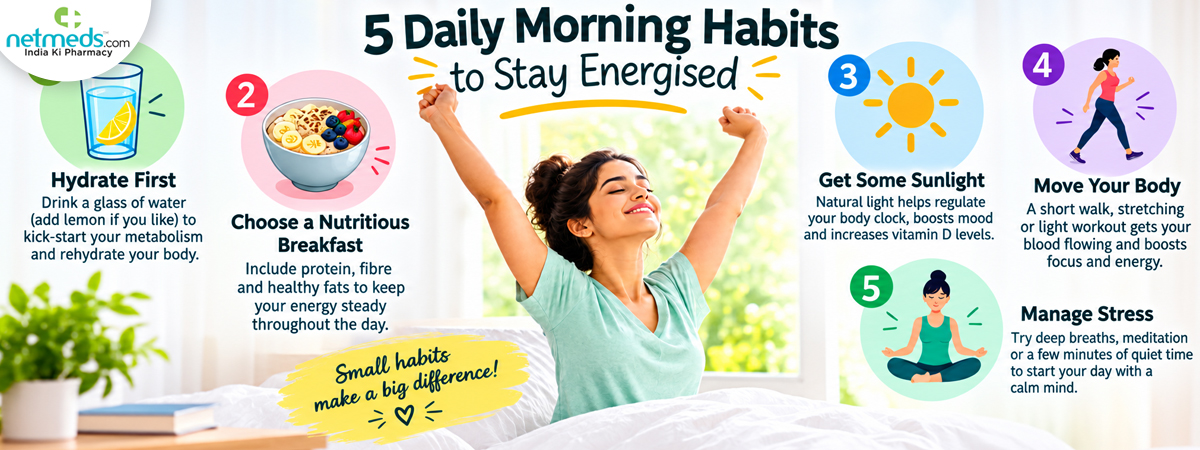
5 Morning Routines To Help You Stay Energised
Start Your Morning With Good Hydration
After long hours of sleep, your body naturally goes without fluids. Drinking water after waking up is an easy way to start your day and promote normal hydration.
Ensure to consume water as your first beverage instead of immediately reaching for sugary drinks or excessive caffeine.
Pro-Tip: Keep a glass or bottle of water beside your bed and drink it after waking up.
Also Read:5 Foods To Fight Fatigue Naturally And Boost Energy Levels -Infographic
Get Morning Sunlight
Getting some natural sunlight in the morning may help regulate your body’s internal clock, known as the circadian rhythm. Maintaining a consistent sleep-wake pattern can promote better sleep and keep you active and alert throughout the day.
Step outside for a few minutes, open your curtains, let sunlight enter your living room or take a short morning walk to get some natural light.
Pro-Tip: The best way is to combine your morning sunlight exposure with a 10–15-minute walk or workout session.
Get Your Body Moving
You don't necessarily need an intense workout schedule first thing in the morning. Instead, simple movement can help you feel more awake and get your body moving after a night of rest. Some of the easiest movements to consider include:
Stretching
Walking
Mobility exercises
Light bodyweight exercises
For those who enjoy morning workouts, you can slowly incorporate moderate-intensity exercise into your regimen.
Pro-Tip: Start with 5–10 minutes of stretching or walking and gradually increase the duration.
Have A Wholesome Breakfast
A balanced and nutritious breakfast can help you meet your daily nutritional needs and offer sustained energy for your morning routines. Instead of mainly relying on simple carbs or sugar-laden foods, ensure you create a varied and nutritious breakfast comprising protein, dietary fibre and healthy fats, along with a source of complex carbohydrates. Some options include:
Vegetable omelette with multi-grain toast
Greek yoghurt with fruit, nuts and seeds
Oats with milk, chia seeds, nuts and fruit
Millet Idli with sambar and vegetables
Moong dal chilla with curd
Paneer or tofu sandwich with vegetables
Also Read: Why Should You Start Your Day With A Protein-Rich Breakfast? Find Out Here
Note: If you are not feeling hungry soon after waking up, you don’t have to force yourself to eat. Instead, focus on consuming a wholesome first meal when you are hungry.
Limit Morning Screen Time
Checking emails, scrolling down social media, and notifications as soon as you wake up can make your morning feel rushed and distracted. Instead, spend a few minutes planning what needs to be accomplished during the day. Identify your most important tasks and create a realistic checklist or a day’s planner.
Pro-Tip: Ensure to spend the first 20-30 minutes of your morning without scrolling through social media and use the time for stretching, planning, reading or making breakfast.
Other Habits That Can Help You Feel Energised
Your energy levels are influenced by more than your morning routine. Consider these habits throughout the day:
- Get sound quality sleep every night
- Maintain good hydration.
- Have wholesome and balanced meals at regular intervals.
- Stay active and include moderate-intensity activity in your day.
- Take short breaks during prolonged sitting.
- Manage stress through relaxation techniques, breathing, or yoga.
- Eliminate excessive caffeine, especially later in the day.
- Maintain a consistent sleep pattern and wake-up schedule.
When Should You Seek Medical Help?
Feeling exhausted or tired occasionally is quite common, but continuous or unexplained fatigue, despite getting sound sleep and a healthy lifestyle, should not be ignored. There are numerous factors that can result in tiredness, including poor sleep schedule, nutritional deficiencies, stress, certain medications, and underlying medical conditions.
However, if fatigue continues or is accompanied by symptoms like sudden weight changes, breathlessness, dizziness, persistent headaches or other concerning symptoms, seek guidance from your healthcare provider.
Conclusion
A good morning regimen for staying energised and active doesn’t need to be complex. Starting your day with good hydration, natural light, gentle movement, a balanced breakfast and mindful planning can help you build a healthier and more organised start to your day.
The perfect way is to choose habits that can fit your lifestyle and practise them regularly. Making simple changes to your daily morning routine can add up to meaningful improvements in how you approach your day.
References:
https://pmc.ncbi.nlm.nih.gov/articles/PMC9529170/
Using Wake-Up Tasks for Morning Behavior Change: Development and Usability Study
Kyue Taek Oh 1, Jisu Ko 2, Jaemyung Shin 3, Minsam Ko
Elrod H. The Miracle Morning: The 6 Habits That Will Transform Your Life Before 8AM. United Kingdom: John Murray Publishers; 2016.
Spall B, Xander M. My Morning Routine: How Successful People Start Every Day Inspired. United Kingdom: Penguin Books Ltd; 2018.
Küüsmaa-Schildt M, Liukkonen J, Vuong M, Nyman K, Häkkinen K, Häkkinen A. Effects of morning vs. evening combined strength and endurance training on physical performance, sleep and well-being. Chronobiol Int. 2019 Jun;36(6):811–825. doi: 10.1080/07420528.2019.1592184
Souissi H, Chtourou H, Chaouachi A, Dogui M, Chamari K, Souissi N, Amri M. The effect of training at a specific time of day on the diurnal variations of short-term exercise performances in 10- to 11-year-old boys.
Souissi N, Gauthier A, Sesboüé B, Larue J, Davenne D. Effects of regular training at the same time of day on diurnal fluctuations in muscular performance. J Sports Sci. 2002 Nov;20(11):929–937.
Hobson RM, Clapp EL, Watson P, Maughan RJ. Exercise capacity in the heat is greater in the morning than in the evening in man. Med Sci Sports Exerc. 2009 Jan;41(1):174–180.
Gomez AM, Gomez C, Aschner P, Veloza A, Muñoz O, Rubio C, Vallejo S. Effects of performing morning versus afternoon exercise on glycemic control and hypoglycemia frequency in type 1 diabetes patients on sensor-augmented insulin pump therapy. J Diabetes Sci Technol. 2015 May;9(3):619–246. doi: 10.1177/1932296814566233. https://europepmc.org/abstract/MED/25555390 .1932296814566233
Sedliak M, Finni T, Cheng S, Kraemer WJ, Häkkinen K. Effect of time-of-day-specific strength training on serum hormone concentrations and isometric strength in men. Chronobiol Int. 2007 Jul;24(6):1159–1177.
Rothbard NP, Wilk SL. Waking up on the right or wrong side of the bed: start-of-workday mood, work events, employee affect, and performance. Acad Manag J. 2011 Oct;54(5):959–980.
Davis R, Campbell R, Hildon Z, Hobbs L, Michie S. Theories of behaviour and behaviour change across the social and behavioural sciences: a scoping review. Health Psychol Rev. 2015 Aug;9(3):323–344.
 Previous