A heart attack can affect both men and women, but the warning symptoms are not always the same. Heart attacks don’t always look the way we imagine; they don’t always come with pounding chest pain. In fact, some women may not have chest pain at all. Instead, they may experience shortness of breath or unusual tiredness, indigestion, nausea, and dizziness.
To Augment Your Overall Health And Cardiac Well-Being, Shop From Our Broad Spectrum Of Supplements
As these symptoms can at times be mistaken for acidity, indigestion, stress or fatigue, recognising the signs and symptoms of a heart attack in women is crucial. Hence prompt medical care can ease damage to the heart.
What Is A Heart Attack?
A heart attack, medically termed a myocardial infarction, occurs when blood flow to part of the heart muscle becomes blocked or severely reduced. Without adequate oxygen-rich blood, the affected heart muscle can easily get damaged.
If the blockage remains untreated or unattended, it can potentially increase the damage to the heart.
Also Read: Heart Attack Types: Causes, Symptoms, Diagnosis, and Treatment
Signs and Symptoms of a Heart Attack in Women
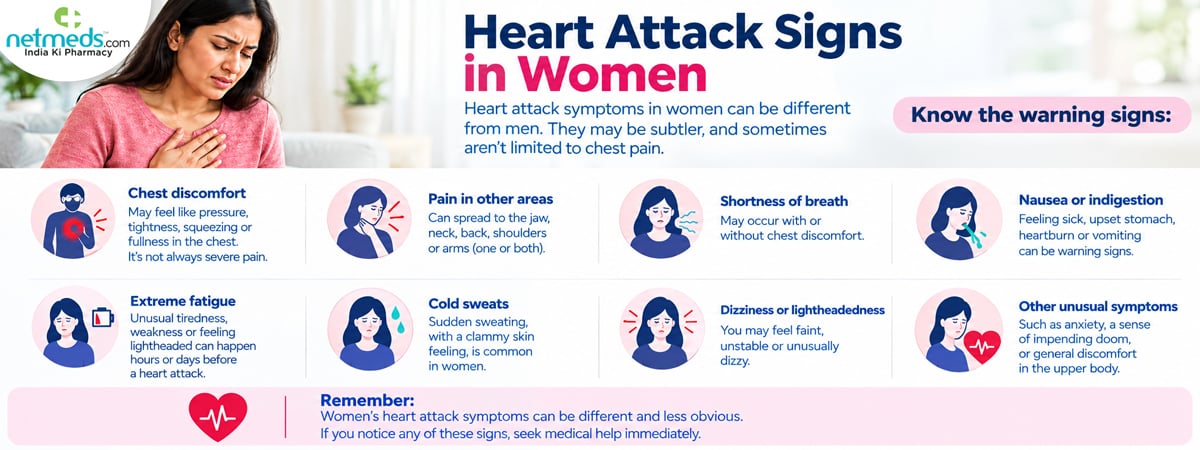
Generally, heart attack symptoms can differ from person to person. Women may notice typical symptoms as well as many less visible warning signs.
Chest Pain/ Pressure
Chest discomfort is still the most common symptom in women. It may feel like pressure, squeezing, fullness, heaviness or pain in the centre of the chest. The discomfort may last for several minutes or disappear and return.
Shortness Of Breath
Breathlessness may develop with or without chest discomfort. It can sometimes start appearing before more evident heart attack symptoms.
Pain In The Back, Neck /Jaw
Women may experience pain or pressure in the upper back, neck, jaw, throat, shoulder or arms. This discomfort may occur even when there is little or no chest pain.
Unusual Or Extreme Tiredness
Sudden, unexplained or unusual fatigue can be a warning sign. Some women may feel extremely tired or weak even without doing strenuous activity or work.
Nausea Or Vomiting
Nausea, vomiting or an upset stomach can occur during a heart attack. These symptoms may be mistaken for a stomach problem or food-related illness.
Indigestion Or Heartburn
Some women may feel indigestion, heartburn or discomfort in the upper stomach. These symptoms should not inevitably be assumed to be acidity, especially when they happen with breathlessness, sweating, chest discomfort or unusual tiredness.
Cold Sweat
A sudden outbreak of unexplained cold sweat can accompany a heart attack and should be taken seriously when it develops with other warning signs.
Dizziness Or Fainting
Feeling lightheaded or dizzy may also occur during a heart attack.
Anxiety
Some women may feel anxiety or a strong intuition that something is not right. However, anxiety alone does not indicate a heart attack; it should not be ignored when accompanied by other warning signs.
Also Read: The Subtle Signs Of A Heart Attack And First Aid Measures
Heart Attack Symptoms in Women vs Men
Chest pain remains a common symptom of a heart attack in both men and women. The difference is that women may be more likely to experience additional symptoms that are not recognised as heart-related.
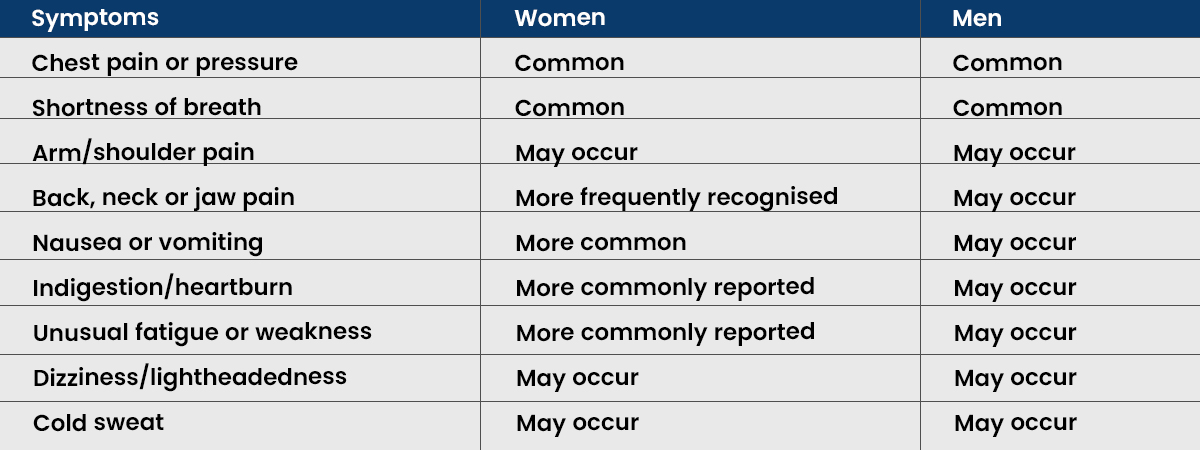
Thus, women may be more likely to infer heart attack symptoms as indigestion, stress, fatigue, or another less serious condition, potentially delaying emergency treatment.
Why Are Heart Attack Symptoms Different in Women?
Heart disease can affect women in ways that are not always identical to men. Women may have problems involving the heart's smaller blood vessels, and some heart conditions can present with symptoms such as nausea, breathlessness, back or jaw discomfort, and unusual fatigue. This does not suggest that every woman will have different symptoms. Chest discomfort is still the most common symptom in women who have a heart attack. The key is to identify that a heart attack does not always cause severe, throbbing chest pain.
What to Do If You Think Someone Is Having a Heart Attack?
A suspected heart attack is a medical emergency. Do not wait for symptoms to become severe or try to determine whether it is definitely a heart attack. Follow these steps: Call emergency medical services immediately.
In India, dial 112, the nationwide emergency response number that provides access to medical and other emergency services.
An ambulance allows emergency personnel to begin assessment and treatment while transporting the person to the hospital.
Stop doing any physical activity and sit or rest in a comfortable position.
If the emergency medical team advises aspirin and it is safe for the person to take it, follow those instructions. Aspirin is not appropriate for everyone, including people with certain allergies or medical conditions, so it should not be taken routinely without appropriate medical advice.
Heart attacks can begin with mild discomfort or symptoms that come and go. Even if you are unsure whether it is a heart attack, seek emergency medical help.
If the person becomes unresponsive and is not breathing normally, begin CPR and use an AED if available.
Follow emergency services' instructions until professional help arrives.
When Should Women Seek Emergency Help?
Seek immediate emergency medical help if you experience chest pressure or discomfort, unexplained shortness of breath, sudden severe weakness or fatigue, cold sweating, nausea, dizziness, or pain spreading to the arm, shoulder, back, neck or jaw, particularly when several symptoms occur together.
Do not assume that symptoms are simply gas, acidity, anxiety, stress or tiredness without medical evaluation.
Can Women Have a Silent Heart Attack?
Yes. Some heart attacks can occur with mild, unusual or barely noticeable symptoms and may not be recognised immediately. Women may be more likely to experience heart attacks without obvious symptoms.
Conclusion
Heart attack symptoms in women can be subtle, but they should never be ignored. Chest pain or pressure remains the most common symptom. Still, women may also experience shortness of breath, unusual fatigue, nausea, indigestion, dizziness, cold sweats, or pain in the back, neck, jaw or arms.
References:
Myocardial Infarction Signs and Symptoms: Females vs. Males
Kyle J Schulte 1, Harvey N Mayrovitz 2,
https://pmc.ncbi.nlm.nih.gov/articles/PMC10182740/
Sex differences in symptom presentation in acute coronary syndromes: a systematic review and meta-analysis. van Oosterhout RE, de Boer AR, Maas AH, Rutten FH, Bots ML, Peters SA. J Am Heart Assoc. 2020;9:0. doi: 10.1161/JAHA.119.014733. [DOI] [PMC free article] [PubMed] [Google Scholar]
Centers for Disease Control and Prevention: About Provisional Mortality Statistics, 2018 through Last Month. [ Mar; 2023 ]. 2023. http://wonder.cdc.gov/mcd-icd10-provisional.html
Sex differences in risk factors for myocardial infarction: cohort study of UK Biobank participants. Millett ER, Peters SA, Woodward M. BMJ. 2018;363:0. doi: 10.1136/bmj.k4247.
Sex differences in ischemic heart disease: advances, obstacles, and next steps. Aggarwal NR, Patel HN, Mehta LS, et al. Circ Cardiovasc Qual Outcomes. 2018;11:0. doi: 10.1161/CIRCOUTCOMES.117.004437.
Age-dependent differences in diabetes and acute hyperglycemia between men and women with ST-elevation myocardial infarction: a cohort study. Otten AM, Ottervanger JP, Timmer JR, et al. Diabetol Metab Syndr. 2013;5:34. doi: 10.1186/1758-5996-5-34.
Are women more susceptible to ischemic heart disease compared to men? A literature overview. Majidi M, Eslami V, Ghorbani P, Foroughi M. J Geriatr Cardiol. 2021;18:289–296. doi: 10.11909/j.issn.1671-5411.2021.04.004.
Typical and atypical symptoms of acute coronary syndrome: time to retire the terms? DeVon HA, Mirzaei S, Zègre-Hemsey J. https://www.ahajournals.org/doi/full/10.1161/JAHA.119.015539?rfr_dat=cr_pub++0pubmed&url_ver=Z39.88-2003&rfr_id=ori%3Arid%3Acrossref.org. J Am Heart Assoc. 2020;9:0. doi: 10.1161/JAHA.119.015539.
Atypical manifestations of women presenting with myocardial infarction at tertiary health care center: an analytical study. Joseph NM, Ramamoorthy L, Satheesh S. J Midlife Health. 2021;12:219–224. doi: 10.4103/jmh.JMH_20_20.
Are there gender differences related to symptoms of acute myocardial infarction? A Norwegian perspective. Løvlien M, Schei B, Gjengedal E. Prog Cardiovasc Nurs. 2006;21:14–19. doi: 10.1111/j.0197-3118.2006.04656.x.
Delays to hospital presentation in women and men with ST-segment elevation myocardial infarction: a multi-center analysis of patients hospitalized in New York City. Weininger D, Cordova JP, Wilson E, et al. Ther Clin Risk Manag. 2022;18:1–9. doi: 10.2147/TCRM.S335219.
 Previous