When you are trying to lose those extra kilos, just adding more protein to your meal regimen is not enough. The total amount of calories and fat in that protein source also matters, particularly if you are having it daily. Among two popular vegetarian protein sources, paneer and soy chunks are nutritious options that often compete for attention. Both are incredible sources of plant-based protein, versatile and easy to add to everyday cuisines. And when it comes to weight loss, which one deserves a place on your plate?
(To Lose Weight And Maintain Overall Health, Shop From Our Best-Selling Protein Supplements)
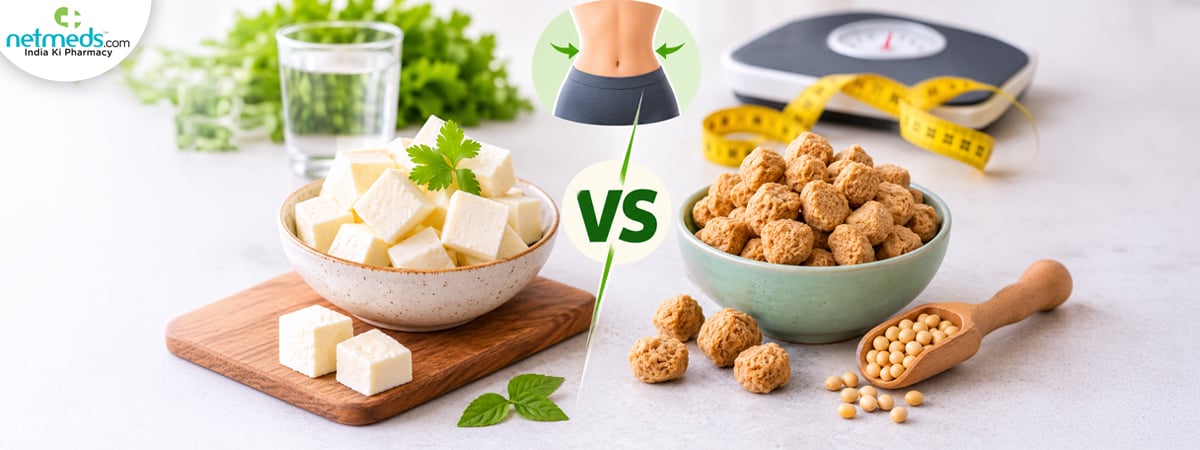
While paneer supplies high-quality dairy protein, soy chunks are a good choice of plant-based protein storehouses that typically offer more protein with fewer calories and less fat. However, the best option depends on your calorie needs, cooking process, serving size, and overall dietary habits.
Dive into this article to explore the nutritional differences between paneer and soy chunks and find out which is better for weight loss.
Paneer vs Soy Chunks: Nutritional Comparison
Paneer is a fresh cottage cheese made by curdling milk, whereas soy chunks are made from defatted soy flour. Both provide protein, but their calorie, fat, and carbohydrate content differ considerably.
Nutritional Values of Paneer vs Soy Chunks (Per 100 g)
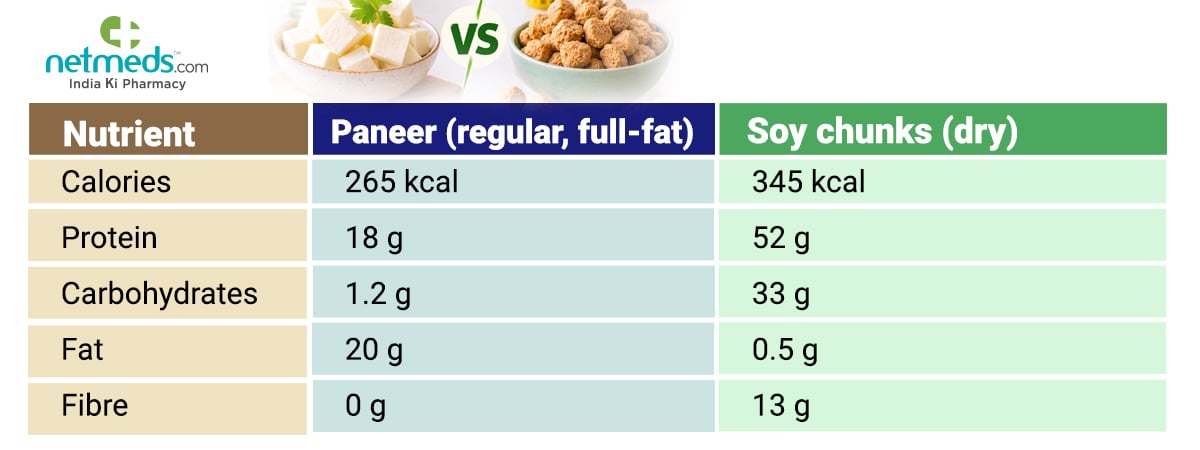
Note: These values are approximate, and actual nutrition varies by brand, preparation and milk fat content. Soy chunk values are for the dry product, before soaking and cooking. As soy chunks absorb water during cooking, their weight increases without adding calories. Thus, 100 g of cooked soy chunks contains fewer calories and less protein than 100 g of dry soy chunks.
Does Paneer Support Weight Loss?
Yes, paneer can be added as part of a weight-loss meal plan. It offers more protein, along with nutrients like calcium and vitamin B 12. But one thing to keep in mind is that regular paneer contains a significant amount of fat too. A review of paneer nutritional content published in the Journal of Food Science and Technology revealed that paneer typically contains around 16-18% protein and 22-25% fat.
However, this does not mean that paneer is a bad choice, but it means the serving size matters. A serving of paneer with ample amounts of vegetables can be a more wholesome and balanced option than a paneer gravy cooked with lots of oil, butter or cream. Paneer is a complete protein source offering all nine essential amino acids and is a perfect choice of protein source, but for weight management, how much you eat and how it fits into your overall meal regimen plays a key role.
Does Soya Chunks Support Weight Loss?
Soya chunks are different in nutrient composition, as they are made from defatted soy flour, a legume variety, which is naturally loaded with protein while being relatively low in fat. Their exact nutritional values may differ based on processing method.
Studies on textured soy proteins reveal that they contain more than 50% protein on a dry basis. Soya chunks are a complete source of protein and offer dietary fibre, making them a beneficial option for those who wish to boost their protein intake and support weight loss as well.
A small clinical study found that soy-based protein worked well when compared to other sources in a calorie-controlled, high-protein diet plan and promoted weight loss, but relying only on soy does not cause weight loss.
Additionally, the way you cook also matters, soya chunks tossed with veggies and a minimal oil are beneficial, then soya cooked in a heavy, oily gravy.
Paneer vs Soy Chunks: Which Is Better for Weight Loss?
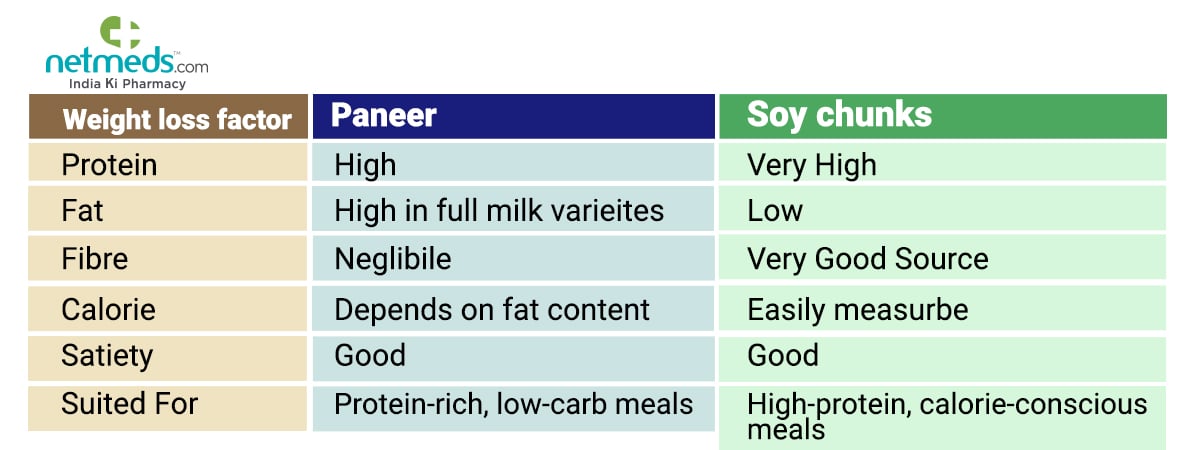
When comparing paneer and soy chunks for weight loss, soy chunks generally have a slight edge because they provide more protein with significantly less fat.
Soy chunks are a better choice for weight loss, owing to their impressive profile of protein, dietary fiber and low-fat content. On the other hand, low-fat paneer is also an excellent choice for those who prefer a dairy-based protein option.
Note: Neither of these protein-laden foods directly burns body fat. Sustainable weight loss depends on maintaining a calorie-deficit diet through balanced eating and regular physical activity.
Ways to Add Paneer and Soy Chunks in Your Weight Loss Diet
Ways to Add Paneer:
Prepare grilled paneer tikka with vegetables.
Add paneer cubes to salads and vegetable stir-fries.
Make low-fat paneer bhurji or other gravies with minimal oil.
Include paneer in whole-wheat wraps with fresh vegetables.
Ways to eat soy chunks:
Prepare soy chunk curry with tomatoes and spices.
Add boiled soy chunks to vegetable pulao.
Make soy chunk stir-fry with broccoli, carrots and capsicum.
Combine soy chunks with cucumber, onions and lemon juice to make a wrap.
For weight management, avoid deep-frying, adding heavy creams, butter or excessive oil. Pair these protein foods with whole grains, vegetables and healthy fat for wholesome and balanced meal ideas.
Can You Eat Paneer and Soy Chunks Every Day?
Yes, most healthy adults can include paneer and soy chunks regularly as part of a balanced diet, provided their portions suit their nutritional requirements.
Paneer: It is better to choose a low-fat option if you are trying to reduce saturated fat and calorie intake.
Soy chunks: Add moderate portions, preferably after soaking, boiling and cooking thoroughly.
Alternate between paneer, soy chunks, lentils, beans, eggs, and other protein sources to obtain a wider variety of nutrients.
People with soy allergies should avoid soy chunks. Those with specific medical conditions or dietary restrictions should seek individualised dietary advice.
Frequently Asked Questions
Are soy chunks better than paneer for weight loss?
Yes. Soy chunks generally provide more protein, fibre, and less fat than regular full-fat paneer, making them a more calorie-conscious protein option.
Which has more protein, paneer or soy chunks?
Soy chunks contain approximately 50–52 g of protein per 100 g dry weight, while regular paneer provides around 18 g per 100 g.
Can I eat paneer at night for weight loss?
Yes. Paneer can be included in dinner as a protein-rich food. Choose a moderate portion and prepare using minimal oil.
Do soy chunks increase belly fat?
No. Soy chunks do not directly increase belly fat. Weight gain generally occurs when calorie intake exceeds calorie expenditure on a regular basis.
Conclusion
Both paneer and soy chunks are nutritious vegetarian protein-rich food sources that can support weight management. However, soy chunks have an edge for people looking to increase protein intake while keeping fat and calorie consumption under control. Paneer, particularly low-fat varieties, is another excellent option that provides protein, calcium, and vitamin B12.
References:
https://pmc.ncbi.nlm.nih.gov/articles/PMC6105701/
Effects of consuming a high‐protein diet with or without soy protein during weight loss and maintenance: a non‐inferiority, randomized clinical efficacy trial
K J Speaker 1, R D Sayer 1, J C Peters 1, H N Foley 1, Z Pan 2, H R Wyatt 1, M R Flock 3, R Mukherjea 4, J O Hill
Kim JE, O'Connor LE, Sands LP, Slebodnik MB, Campbell WW. Effects of dietary protein intake on body composition changes after weight loss in older adults: a systematic review and meta‐analysis. Nutr Rev 2016; 74: 210–224. [DOI] [PMC free article] [PubMed] [Google Scholar]
Leidy HJ, Clifton PM, Astrup A, Wycherley TP, Westerterp‐Plantenga MS, Luscombe‐Marsh ND, Woods SC, Mattes RD. The role of protein in weight loss and maintenance [Internet]. Am J Clin Nutr. 2015. p. ajcn084038. http://ajcn.nutrition.org/content/early/2015/04/29/ajcn.114.084038/nhttp://ajcn.nutrition.org/content/early/2015/04/29/ajcn.114.084038.full.pdf/nhttp://www.ncbi.nlm.nih.gov/pubmed/25926512
Wycherley TP, Moran LJ, Clifton PM, Noakes M, Brinkworth GD. Effects of energy‐restricted high‐protein, low‐fat compared with standard‐protein, low‐fat diets: a meta‐analysis of randomized controlled trials. Am J Clin Nutr 2012; 96: 1281–1298.
Halton TL, Hu FB. The effects of high protein diets on thermogenesis, satiety and weight loss: a critical review. J Am Coll Nutr 2004; 23: 373–385.
Sayer RD, Speaker KJ, Pan Z, Peters JC, Wyatt HR, Hill JO. Equivalent reductions in body weight during the Beef WISE Study: beef's role in weight improvement, satisfaction and energy. Obes Sci Pract [Internet] 2017. Available from: 10.1002/osp4.118.
Greco E, Winquist A, Lee TJ, et al. The role of source of protein in regulation of food intake, satiety, body weight and body composition. J Nutr Heal Food Eng [Internet] 2017; 6 Available from: http://medcraveonline.com/JNHFE/JNHFE-06-00223.php
Li J, Armstrong CLH, Campbell WW. Effects of dietary protein source and quantity during weight loss on appetite, energy expenditure, and cardio‐metabolic responses. Nutrients 2016; 8: 9–12.
 Previous