Salt is an integral part of our daily meal plan. All salt varieties contain minerals like sodium, potassium, magnesium, and iron in small amounts. Depending on the quantity of these trace minerals, the salt can be categorised as advantageous or disadvantageous in different medical conditions. For instance, low-sodium salt is a perfect option for those suffering from hypertension, as it contains better proportions of potassium than regular table salt, which has a higher proportion of sodium chloride. And when it comes to kidney disease, it is essential to have through understanding of different types of salt and its effect on the body.
Read this article to learn more about different types of salts and which are the best salt options for kidney patients.
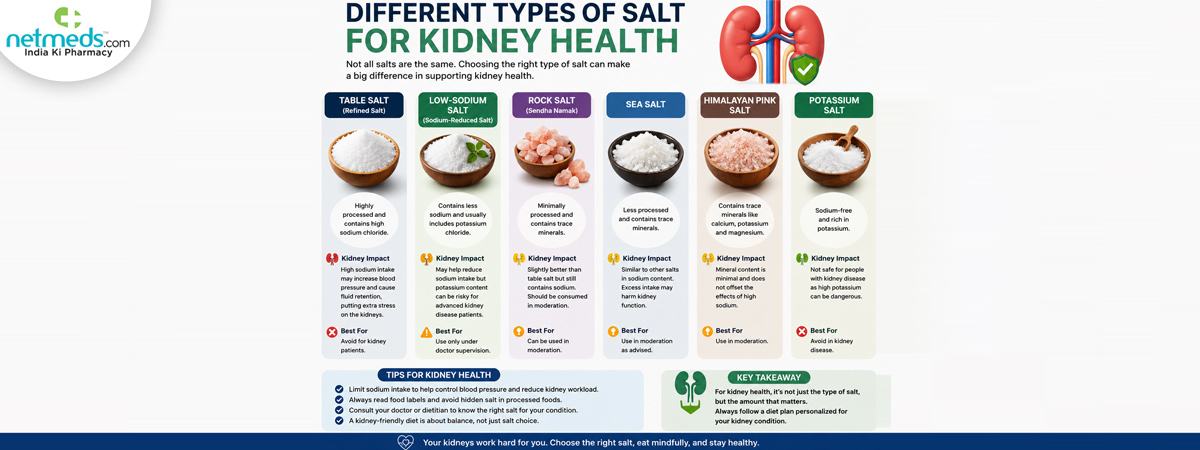
Different Types Of Salt
Sea Salt
Sea salt is obtained from seawater, which comprises sodium chloride and several other vital minerals, but it lacks iodine. It may contain impurities based on the source from which it is produced. Sea salt is available as uneven flakes and may be pink or white in colour. Regular consumption of sea salt is not recommended for renal patients as it lacks iodine and is high in sodium.
Also Read: Kidney Health: Know About 11 Early Warning Signs of Renal Disease
Table Salt
Table salt is the regular salt variety that is commonly used for daily cooking and commercial purposes. It is extracted through mining from salt deposits and then is refined (purified) and processed. During the processing step, the salt is iodised, as iodine is an important mineral needed by the body. It plays a vital role in regulating thyroid hormone and thyroid gland functions.
The World Health Organisation (WHO) recommends the addition of iodine to table salt to prevent conditions like goitre. In addition, WHO recommends limiting the intake of table salt to 5 grams, i.e. 1 teaspoon per day for adults.
And for those with chronic kidney ailments, table salt is preferred, but in less quantity. The table is rich in sodium chloride, but contains small amounts of potassium, and it is fortified with iodine, which is essential for the body. Table salt is one of the best salt options for renal patients, including those on dialysis or post-kidney transplant.
Kosher Salt
Kosher salt is a granular type of salt which is widely used for making pickles or brines as well as smoking meat. This salt variety is obtained from salt mines, and it is larger and coarser in size than table salt. Some people prefer to use this salt as it is less refined, but it lacks iodine. Devoid of iodine, it is also not a good source of other vital minerals. Hence, regular intake of this salt is not recommended.
Himalayan Salt
The name Himalayan salt comes from the Himalayan ranges, where the salt is mainly found. This type of salt is naturally pink in colour; hence, it is also called pink Himalayan salt. It has larger flakes and is typically not iodised, which is its only downside. Hence, before changing to this salt from your regular table salt, you should get the facts checked. When compared to sea salt (0.08%), table salt (0.09%), and kosher salt, this salt contains a slightly higher amount of potassium (0.28%); thus, it is not considered a safe salt for kidney patients.
Rock Salt (Sendha namak)
Rock salt is the residue that is extracted when seawater evaporates and leaves behind its crystals. Himalayan salt is a type of rock salt. Rock salt or sendha namak is largely used in Ayurveda to cure several respiratory conditions as well as to promote digestion. However, this salt also lacks iodine which is its major downside.
Also Read: Sendha Namak: Here Are The Extraordinary Health Benefits Of Rock Salt
This salt is not ideal for renal patients as the exact amount of potassium present in it is not known, and it does not contain iodine.
Low Sodium Salt
Table salt is a regular salt variety that is commonly used, and it contains 100% sodium chloride. Low-sodium salt varieties are salt alternatives, as the name suggests; these are low in sodium but are higher in potassium content. Low-sodium salts are actually rich in potassium, which may be ideal for managing high blood pressure, but not for chronic kidney disease.
However, patients with chronic kidney disease should restrict low-sodium salt as they can increase the levels of potassium in the blood, which may lead to irregular heart rhythms or even cardiac arrest.
Tracking Your Sodium Intake
For people with kidney disease, it is important to track sodium intake. Start with a base of about 500 mg to leave room for the sodium that is naturally present in the foods.
A teaspoon of salt has 2,000 milligrams of sodium, but many foods have “hidden” sodium. It is present in both plant and animal food sources, so calculate about 600 mg of sodium, then start counting the salt added in the cooking.
Reading Labels
Read food labels to track the sodium intake. At the top of the label, you can find the serving size and portions are mentioned by the manufacturer. The sodium content is mentioned on the label and is measured in milligrams.
For most adults, it is advised to consume about 4–6 grams of salt daily, which provides sodium to maintain health while protecting the kidneys from damage. It is not essential to eliminate salt, but to regulate the intake.
How to Reduce Salt Intake Without Losing Taste?
Cooking with minimal salt does not essentially make food tasteless. Smart cooking and choosing ingredients wisely can make meals tasty and healthy for the kidneys.
Tips to Lower Salt Intake:
Use spices and herbs like cumin, turmeric, coriander, garlic, and pepper instead of excess salt.
Add lemon or tamarind juice for a tangy flavour.
Limit processed food intake like chips, salted nuts, sauces, ketchup, pickles, and bread, as they are often high in salt.
Check nutrition labels, choose foods labelled "low sodium" or "no added salt."
Prefer fresh over packaged foods.
Avoid adding salt to curd rice, salads or buttermilk.
Drink adequate water to help the kidneys flush out excess sodium.
References:
Sodium Intake and Chronic Kidney Disease
Silvio Borrelli 1,*,†, Michele Provenzano 2,†, Ida Gagliardi 2, Michael Ashour 2, Maria Elena Liberti 1, Luca De Nicola 1, Giuseppe Conte 1, Carlo Garofalo 1, Michele Andreucci 2
Author information
Article notes
Copyright and License information
https://www.jrnjournal.org/article/S1051-2276(18)30043-8/fulltext
The Importance of Sodium Restrictions in Chronic Kidney Disease
Megan Cobb, BS∗ Send email to cobbmeg1@msu.edu ∙ Dominique Pacitti, BS†
 Previous