Most of us monitor our blood pressure without understanding what the numbers mean exactly. A blood pressure reading can look normal or slightly off; the real scenario lies in how those values eventually change with age. Blood pressure (BP) is one of the most vital indicators of your overall cardiovascular well-being. Understanding blood pressure by age helps you recognise early risks and take care of your heart health.
Buy From Our Best-Selling Blood Pressure Devices To Manage Hypertension Under Control
Explore this guide to learn more about what affects your readings, the normal blood pressure range for various age groups and how to manage hypertension.

What is Blood Pressure?
Blood pressure displays the force of blood as it moves through your arteries. As the heart beats, it pushes blood out and when it rests between beats, pressure falls. The balance between these two phases gives your blood pressure reading.
How Is Blood Pressure Measured?
Blood pressure monitors record two numbers, and it is recorded as the force of blood pushing against artery walls.
Systolic pressure: Pressure when the heart beats.
Diastolic pressure: Pressure when the heart relaxes.
A reading showing 120 over 80 means systolic is 120 and diastolic is 80.
Also Read: Waking Up with High Blood Pressure? Try These 6 Effective Tips to Lower It
How Age Affects Blood Pressure?
As you age, your blood vessels naturally undergo structural and functional changes:
Some of the key physiological changes include arteries stiffen that reduces elasticity, plaque build-up increases and narrows blood vessels in the arteries. This makes the heart work harder, increasing systolic pressure. Aside from this, hormonal imbalance affects fluid and salt balance.
Systolic BP tends to rise with age. Whereas diastolic BP may be controlled or even decreased after 60. The risk of hypertension increases remarkably after 40.
Healthy Blood Pressure Range by Age
Children and Teens Up to 18 years
The blood pressure values vary based on the height, age and gender of the children.
Typically, it is around 900/60 to 120/80 mmHg
Adults 18–39 years
The ideal value is < 120/80 mmHg
Elevated: 120–129 / <80 mmHg
Hypertension starts from 130/80 mmHg
Middle Age 40–59 years
As you age, the blood vessels are prone to stiffness, which may increase blood pressure. Also, work stress, poor sleep, being overweight, and lifestyle behaviour influence the readings. A healthy target range is <130/80 mmHg, and many people develop stage 1 hypertension.
Older Adults 60 Plus
Arteries become stiffer with age, and this can push numbers higher. Staying within a steady range is key. Systolic pressure often increases to 130–140 mmHg
Acceptable range under supervision: <140/90 mmHg
Blood Pressure Classification (Standard)
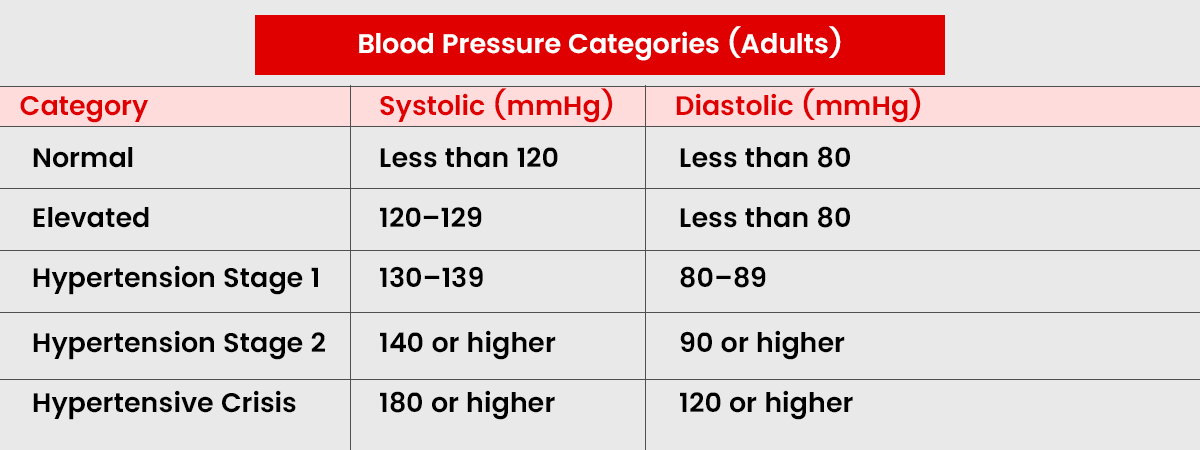
Note these values are guides and not medical cut-offs. They just show how blood pressure changes naturally.
Why Blood Pressure Increases with Age?
Loss of arterial elasticity.
Increased salt sensitivity.
Reduced kidney efficiency.
Sedentary lifestyle.
Weight gain and metabolic changes.
Symptoms to Watch
High BP is called a “silent killer” because many people have no symptoms. However, sometimes, you may observe:
Headaches
Dizziness
Blurred vision
Chest discomfort
In most cases, high blood pressure shows no warning signs at all.
Tips to Manage Blood Pressure Naturally
Follow a Heart-Healthy Diet
Eat a nutritious diet including a colourful array of fruits, vegetables, whole grains and healthy proteins. Include potassium-rich foods such as bananas, spinach, and sweet potatoes that may help stabilise blood pressure.
Reduce salt intake to less than 5 grams per day.
Also Read: Hypertension Nutrition: Common FAQ’s Answered About DASH Diet
Stay Physically Active
Engage in regular physical activity at least 30 minutes/day of moderate intensity workouts like walking, cycling, or yoga to improve blood circulation and maintain blood pressure.
Maintain A Healthy Weight
Try to lose weight if you are obese or overweight, as even 5-10% of weight loss can significantly improve your blood pressure.
Restrict Salt, Sugar / Processed Foods
Limit the intake of all processed, packaged, junk, deep-fried and salty foods.
Avoid Smoking / Limit Alcohol
Smoking damages arteries and narrows the blood vessels, impeding the blood flow to the heart and raising blood pressure. Chronic alcohol consumption over time eventually raises blood pressure.
Manage Stress
Stress is one of the key factors that can rise the blood pressure levels. Hence, it is important to ease stress and stay relaxed. Engage in stress-lowering techniques such as meditation, yoga and breathing exercises. Also, get sound quality sleep for 7-8 hours daily.
Regular Medications
Never skip medications prescribed by your doctor or self-adjust doses.
References:
Blood pressure related to age: The India ABPM study
Upendra Kaul 1, Stefano Omboni 2,3, Priyadarshini Arambam 1, Srinivas Rao 4, Sunil Kapoor 5, Jitendra P S Swahney 6, Kamal Sharma 7, Tiny Nair 8, Manoj Chopda 9, Jagdish Hiremath 10, Chandrashekhar K Ponde 11, Abraham Oomman 12, Budanur C Srinivas 13, Viraj Suvarna 14, Sanjiv Jasuja 15, Eric Borges 16, Willem J Verberk 17,
https://pmc.ncbi.nlm.nih.gov/articles/PMC8030374/
Age, Blood Pressure Targets, and Guidelines: Rift Between Those Who Preach, Those Who Teach, and Those Who Treat?
Franz H. Messerli, MD messerli.f@gmail.com, Sripal Bangalore, MD, and Adrian W. Messerli, MDAuthor Info & Affiliations
https://www.ahajournals.org/doi/10.1161/circulationaha.118.034390
 Previous