Milk is a staple food in most Indian households, from relishing your morning cup of chai to wholesome glasses for children. Milk offers superior quality protein, calcium, vitamin D, phosphorus and other vital nutrients for proper growth and development. But with the increasing supply of packaged milk that comes pasteurised and sealed, many consumers are worried about its safety. Recent media reports and lab test claims about a leading brand have reignited this debate.
Shop From Our Wide Range Of Milk Based Formulation And Supplements
What Is Pasteurised (Packaged) Milk and Its Benefits?
Packaged milk sold in India is available in pouch and tetra-pack format is usually pasteurised at processing units before sale. Pasteurisation is a process of controlled heating techniques that aims to kill harmful bacteria; it’s not the same as boiling, but it has the potential for maintaining the quality and safety of milk.
Two common processes of pasteurisation include:
HTST (High Temperature Short Time): In this process, milk is heated to about 72 °C for approximately 15 seconds and cooled down immediately.
UHT (Ultra High Temperature): In this process, milk is heated at a higher temperature for a shorter time, thus improving shelf-stable storage.
These processes ensure that packaged milk is safe to be consumed without further boiling, provided it has been properly stored and handled correctly.
Also Read: A2 Milk: Health Benefits, Nutrition and Here’s Why You Should Include It In Regular Diet
Does Boiling for 5 Minutes Improve Safety?
Safety Perspective
Microbiologist experts state that pasteurisation already kills pathogens that cause milk-borne illnesses, such as Salmonella and E. coli. Hence, additional boiling of pasteurised milk does not add significant safety if the milk is fresh, sealed, and refrigerated properly.
However, it is essential to boil raw milk, which is sourced from local vendors or milkmen, as it is unpasteurised. As boiling of milk is necessary to eliminate harmful bacteria and make it safe for consumption.
Nutritional Impact
Researchers agree that extended or repeated boiling of pasteurised milk can deplete certain nutrients, especially those that are heat-sensitive vitamins like B-complex and proteins and change flavour. Heating just enough for warmth or making tea/coffee use is typically sufficient.
What’s Happening Now About Amul Packaged Milk Safety?
Recently, claims circulating on media and lab reports have alleged that Amul Milk pouch and a few other brands have failed certain safety measures, citing the presence of coliform bacteria and high bacterial counts in lab tests.
These posts and news have gone viral, prompting widespread concern and questions, such as if packaged milk fails microbial tests, should we boil milk longer?
Also Read: World Milk Day: 5 Incredible Benefits Of Milk - Infographic
Is Loose Milk Safer?”
Media post or unverified lab results do not constitute official regulatory findings.
Pasteurised milk, if properly sealed, stored, and within expiry, is generally safe without further boiling.
Storage breaks like milk being kept warm for long periods can indeed increase bacterial growth, but that is a storage issue, not a product safety flaw per se.
Always check official food safety advisories if you see reported test failures from recognised authorities rather than social media posts alone.
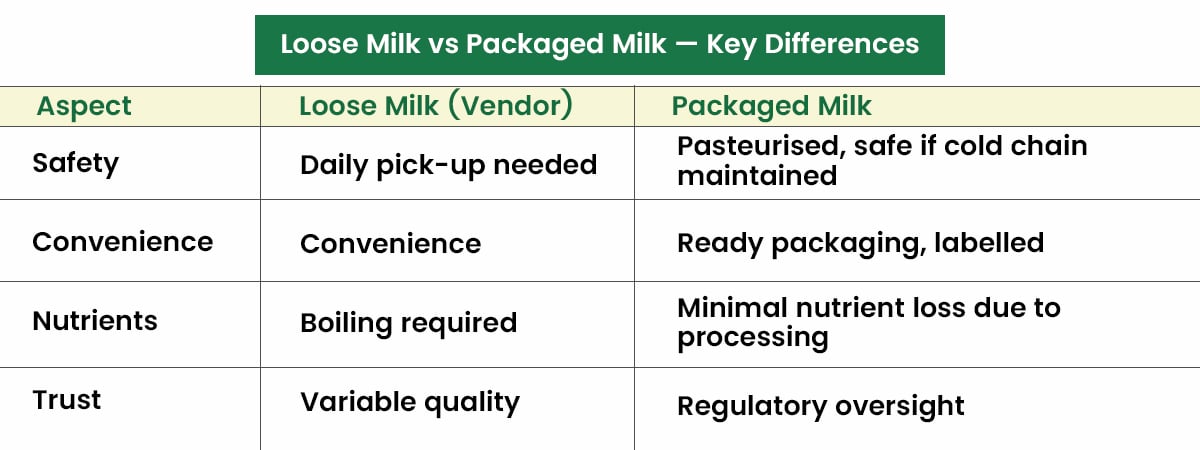
Milk obtained from milkmen or local vendors is lost, though rich in flavour and taste, it carries a higher risk of contamination if not properly boiled. Packaged milk, which is pasteurised and handled correctly, mitigates that risk without any further need for high boiling at home.
Practical Measures
Pasteurisation is a highly recommended process that ensures packaged milk does not need to be boiled for safety if it is fresh, sealed, and cold.
Boiling for 5 minutes won’t make it “safer” but can destroy some nutrients and alter taste.
Boil raw/loose milk, as milk purchased loose is unpasteurised, hence boiling is essential.
Refrigerate properly, as the right temperature control is considered the biggest factor in safety after pasteurisation.
Conclusion
Boiling milk is a traditional practice; however, science and food safety standards tell a more nuanced story. Pasteurised milk is specifically formulated to be consumed without boiling, and any prolonged boiling does not remarkably increase the safety, though proper handling and appropriate storage methods are vital. However, for raw loose milk, boiling continues to be an essential process to ensure safety. Recent controversy around packaged milk safety highlights consumer doubt; however, always rely on verified regulatory reports for health guidelines.
References:
Effect of Heat Pasteurisation and Sterilisation on Milk Safety, Composition, Sensory Properties, and Nutritional Quality
Ahmad Rabbani 1, Mutamed Ayyash 1, Crystal D C D’Costa 1, Gang Chen 2, Yajun Xu 3, Afaf Kamal-Eldin 1,4,*
https://pmc.ncbi.nlm.nih.gov/articles/PMC12026572/
https://www.researchgate.net/publication/365166921_Safety_and_Quality_Assessment_of_Milk_Before_and_After_Pasteurization_Collected_from_Different_Regions_of_Punjab
https://publishing.emanresearch.org/CurrentIssuePDF/EmanPublisher_2_7microbbioacts-11001A0616250318.pdf
 Previous