


Cancer is one of the leading causes of mortality among men across the globe. The good news is that regular cancer screening can identify certain types of cancer before symptoms show, which can remarkably optimise treatment outcomes and improve survival rates. As per statistics, more than 46% of cancer deaths in Indian men are directly associated with lifestyle risk factors, mainly tobacco and smoking.

Most types of cancer, such as prostate, colorectal, lung, skin, and oral cancers, can be identified early through routine screening or self-examinations. After the age of 45, the risk of certain cancers increases in men, though they may feel completely fine and show no signs at all. This is why timely cancer screening matters the most.
Explore this article to learn more about the five most important cancer screening tests every man should consider and when to get them.
Why Is Cancer Screening Important?
Cancer screening tests mainly help determine whether you have cancer before visible symptoms develop. Detecting cancer in its earliest stages means:
Increased chances of effective treatment outcomes
Less advanced treatment options
Better survival rates
Lower healthcare expenditures
Enhanced quality of life
Screenings are especially important for men above 40–50 years of age or those with significant risk factors.
Prostate Cancer Screening
Prostate cancer is one of the most common cancers affecting men, particularly after 50 years. As early-stage prostate cancer mostly does not show symptoms, screening can help identify abnormalities before they progress.
Screening Tests
Prostate-Specific Antigen (PSA) blood test
Digital Rectal Examination (DRE)
Who Should Get Tested
Men aged 50 years and above
Men aged 45 years with a family history of prostate cancer
Also Read: Prostate Cancer: Early Warning Signs And Ways To Lower The Risk Of This Deadly Condition
Colorectal Cancer Screening
Colorectal cancer occurs from abnormal polyps’ growth in the colon or rectal area. Screening early can detect and remove these polyps before the cells become cancerous.
Screening Tests
Stool-based FIT (Faecal Immunochemical Test)
Stool DNA test
Flexible sigmoidoscopy
CT colonography (virtual colonoscopy)
Who Should Get Tested?
All men beginning at 45 years
Earlier if there is:
Family history of colorectal cancer
Genetic syndromes
Lung Cancer Screening
Lung cancer remains one of the deadliest cancers among men, as it is identified too late in many cases. Screening is especially beneficial for individuals with a history of chronic smoking.
Screening Test
Low-dose Computed Tomography (LDCT)
Who Should Get Tested?
Generally recommended for adults who:
Are aged 50–80 years
Have a significant smoking history, typically 20 pack-years or more
Currently smoke or quit within the past 15 years
Oral Cancers
Oral cancer prevalence in India is alarmingly high, mainly due to tobacco and betel nut use. It can develop on the tongue, lips, cheeks, gums and the floor of the mouth and can spread quickly if not early identified.
Screening Test
Oral cancer screening is simple: a trained physician examines your mouth, tongue, and throat for any abnormal tissue, sores, patches, or lumps.
Who Should Get Tested?
All men above 45 should get screened; however, it is essential for those who smoke, chew tobacco, use gutka or paan or consume alcohol regularly.
Also Read:8 Signs Of Cancer: Early Detection Saves Lives
Skin Cancer Screening
Skin cancer is among the most common cancers, but it is also highly treatable when detected early.
Screening Methods
Full-body skin examination by a dermatologist
Monthly self-examination
Watch for the ABCDE Warning Signs
A – Asymmetry
B – Border irregularity
C – Colour variation
D – Diameter larger than 6 mm
E – Evolving or changing mole
Higher Risk Individuals
Fair skin
Frequent sun exposure
Family history of melanoma
Multiple moles
At What Age Should Men Start Cancer Screening?
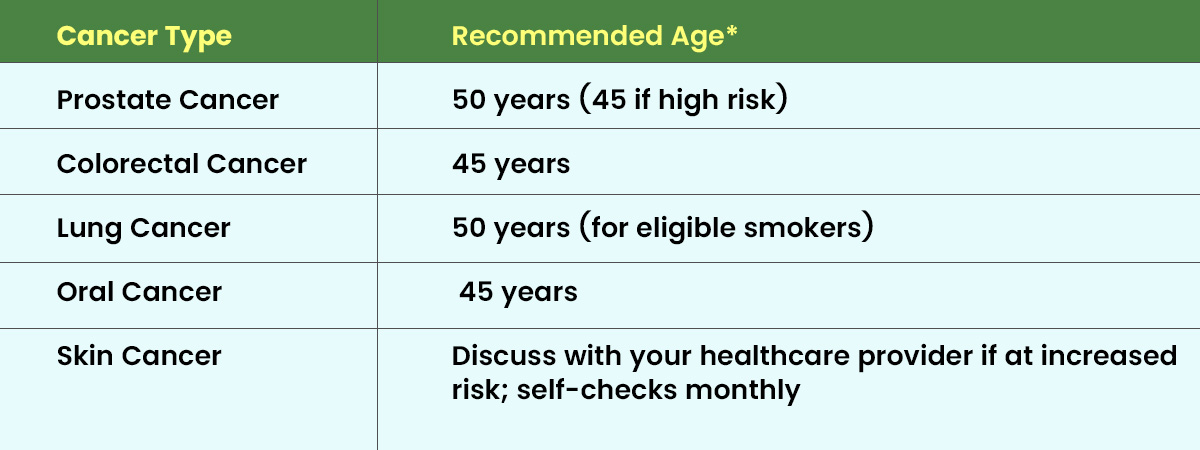
Note: These recommendations usually differ based on personal risk factors and should be discussed with a healthcare provider.
When Should You See A Doctor?
Consult your healthcare provider if you experience:
Sudden weight loss
Blood in urine or stool
A lump anywhere in the body
Persistent cough lasting more than three weeks
Difficulty swallowing
Changes in bowel or bladder habits
New or changing skin lesions
Do not wait for symptoms if you are due for a recommended screening test.
Frequently Asked Questions
Which Cancer Screening Test Should Every Man Have After 50?
Most men should get prostate cancer screening (PSA), colorectal cancer screening, and lung cancer screening, if they have a significant smoking history, with their healthcare provider after age 50.
Is A PSA Test Enough To Diagnose Prostate Cancer?
No. A PSA test is just a screening tool that measures prostate-specific antigen levels. If results are abnormal, additional tests such as a digital rectal exam, MRI, or biopsy may be needed to confirm a diagnosis.
Should Non-Smokers Get Lung Cancer Screening?
Routine lung cancer screening is generally not recommended for non-smokers at average risk. It is primarily advised for adults with a significant smoking history who meet age and eligibility criteria.
Conclusion
Regular cancer screening plays an important role in safeguarding men’s health. Cancer screening can determine certain types of cancer at an early stage, when treatment is most effective. The right screening plan depends on age, medical history, family history and lifestyle risk factors. Discuss with your healthcare provider to identify which tests are right for you and when to begin.
References:
Med Clin North Am. Author manuscript; available in PMC: 2021 Nov 1.
Published in final edited form as: Med Clin North Am. 2020 Sep 16;104(6):1051–1062. doi:
https://pmc.ncbi.nlm.nih.gov/articles/PMC8287565/
Men’s perspectives of prostate cancer screening: A systematic review of qualitative studies
Laura J James 1,2,*, Germaine Wong 1,2,3, Jonathan C Craig 1,2, Camilla S Hanson 1,2, Angela Ju 1,2, Kirsten Howard 2, Tim Usherwood 4,5, Howard Lau 6, Allison Tong 1,2
https://pmc.ncbi.nlm.nih.gov/articles/PMC5705146/
 Previous