




Netmeds First Membership
Description
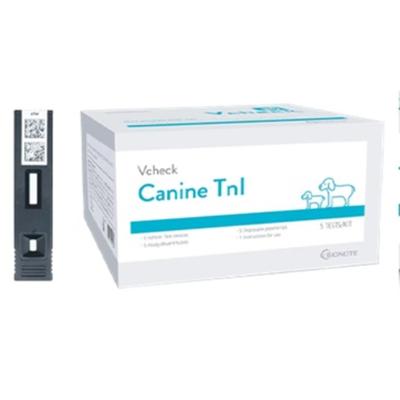
The Bionote Vcheck Canine TnI Test Kit is an in-vitro diagnostic tool for the quantitative measurement of cardiac Troponin I (cTnI) concentration in a dog's serum. Cardiac TnI is a specific marker for cardiac muscle injury in dogs. When the heart muscle is damaged, TnI is released into the bloodstream, and its concentration correlates with the severity of the damage. This test provides veterinarians with diagnostic and prognostic information for dogs with cardiovascular or non-cardiac diseases.
Quantitative Measurement: This test kit quantitatively measures the concentration of cardiac Troponin I (cTnI) in canine serum, allowing for a precise assessment of cardiac injury.
Cardiac Injury Marker: cTnI is a sensitive and specific circulating marker for cardiac muscle injury in dogs, making this test a targeted diagnostic tool.
For Use with Vcheck Analyzer: The test is designed to be used with the Bionote Vcheck Analyzer, which reads the test results and provides a numerical concentration of cTnI.
Rapid Results: The test procedure provides results within approximately 10 minutes.
Q: What is the Bionote Vcheck Canine TnI Test Kit used for?
A: This is an in-vitro diagnostic test kit for the quantitative measurement of cardiac Troponin I (cTnI) concentration in a dog's serum or plasma. It is used as a marker to assess cardiac muscle injury.
Q: Who should use this test kit?
A: The Bionote Vcheck Canine TnI test kit is designed to be used exclusively by veterinarians or qualified veterinary professionals in a clinical setting. It is not intended for at-home use by pet owners.
Q: What does an elevated TnI level indicate?
A: An increased level of Troponin I (TnI) can indicate myocardial (heart muscle) injury. This can be associated with primary heart conditions like mitral valve disease or cardiomyopathy, as well as non-cardiac critical illnesses such as systemic inflammation, pancreatitis, or cancer that may affect the heart.
Q: What sample is required for this test?
A: The test requires 100µl of canine serum or plasma to be performed.
Q: How is the test performed and interpreted?
A: The test involves diluting the sample, adding it to the test device, and then inserting the device into the Bionote Vcheck Analyzer. The analyzer provides a quantitative result, which must be interpreted by a veterinarian in conjunction with a full clinical examination and other diagnostic findings.
The Bionote Vcheck Canine TnI Test Kit is an in-vitro diagnostic tool for the quantitative measurement of cardiac Troponin I (cTnI) concentration in a dog's serum. Cardiac TnI is a specific marker ...
Key Benefits
Aids in Diagnosing Cardiac Conditions: Helps in the early detection of conditions like dilated cardiomyopathy (DCM) and assesses the severity of myxomatous mitral valve disease (MMVD).
Prognostic Information: Provides valuable prognostic information for patients with both cardiac and non-cardiac diseases that may cause secondary myocardial injury.
Monitors Myocardial Injury: Elevated TnI levels indicate ongoing heart muscle damage, making it useful for monitoring disease progression and the effectiveness of treatment.
Supports Critical Care Assessment: Measurement of TnI is beneficial in critically ill patients to determine if there is involvement of myocardial injury, even from non-cardiac diseases like pancreatitis or systemic inflammation.
Aids in Diagnosing Cardiac Conditions: Helps in the early detection of conditions like dilated cardiomyopathy (DCM) and assesses the severity of myxomatous mitral valve disease (MMVD).
Prognost...
Direction for Use/Dosage
This test is intended for use by veterinary professionals.
1. Collect a canine serum sample (100 µl).
2. Add 100 µl of the serum sample to the assay diluent tube provided in the kit.
3. Mix the sample with the diluent by pipetting 5-6 times.
4. Add 100 µl of the mixed sample into the sample well of the test device.
5. Insert the device into the Bionote Vcheck Analyzer and press start to begin the analysis.
Results are typically available within 10 minutes.
This test is intended for use by veterinary professionals.
1. Collect a canine serum sample (100 µl).
2. Add 100 µl of the serum sample to the assay diluent tube provided in the kit.
3....
Safety Information/Precaution
For canine use only. Do not use on other animals.
This test kit is designed for use by veterinarians only.
Handle all biological samples (serum) as potentially infectious.
The test device is sensitive to humidity and heat.
Do not use the test kit beyond its expiration date.
Consult a veterinarian for the interpretation of results, as they should be considered alongside other clinical examinations like echocardiography.
For canine use only. Do not use on other animals.
This test kit is designed for use by veterinarians only.
Handle all biological samples (serum) as potentially infectious.
The test devi...
Other Information
Store the test kit at a temperature between 1-30°C.
Do not freeze the kit.
Keep the kit away from direct sunlight.
If samples are not tested immediately after collection, they should be frozen at -20°C or below for storage. Avoid repeated freezing and thawing of samples.
Store the test kit at a temperature between 1-30°C.
Do not freeze the kit.
Keep the kit away from direct sunlight.
If samples are not tested immediately after collection, they should be...