

Netmeds First Membership
Quick Links
Introduction About THEOLATE INJECTION
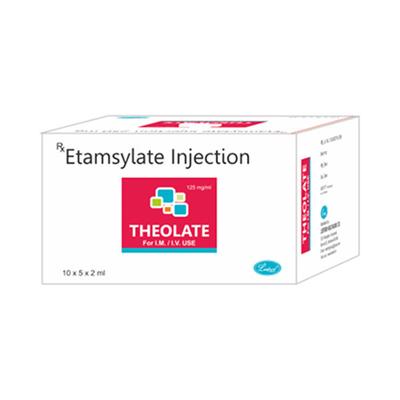
THEOLATE INJECTION is a combination of Ethamsylate and Tranexamic Acid which belongs to the group of medicines called Anti-fibrinolytic agents and Hemostatic agents respectively. It is used for the management of abnormal blood loss due to menorrhagia (heavy or prolonged bleeding during menstrual periods), intra/post operative hemorrhage (during or after a surgical procedure if there is excessive bleeding) and local fibrinolysis (irregular breakdown of blood clots).
Before receiving THEOLATE INJECTION inform your physician if you have previous history of thromboembolic disease, suffer from blood pressure instability or low blood pressure, acute porphyria (rare blood disorders), acquired defective color vision and active intravascular clotting.
THEOLATE INJECTION should be used with caution in pregnant women unless advised by the doctor and it is not recommended for use in breast-feeding women. This medicine should be used with caution in children and elderly individuals.
The most common side effects associated with the use of THEOLATE INJECTION are nausea, vomiting and diarrhea. Inform your doctor immediately if any of the side effect worsens or persist for a long period of time.
Uses Of THEOLATE INJECTION
- Manage abnormal blood loss due to menorrhagia, local fibrinolysis and intra operative/post operative hemorrhage
How THEOLATE INJECTION Works
THEOLATE INJECTION is a combination of ethamsylate and tranexamic Acid. Ethamsylate is a hemostatic agent that works by increasing the ability of platelets to stick together and form blood clots. It also helps to control bleeding from tiny blood vessels (capillaries). Tranexamic acid is an anti-fibrinolytic agent that works by managing the breakdown of blood clots and controlling excessive bleeding. These combined effects of ethamsylate and tranexamic acid helps to decrease abnormal bleeding.
How to use THEOLATE INJECTION
THEOLATE INJECTION will be given to you only by a doctor or a nurse into a vein as an intravenous injection. Your doctor will decide the dose, duration and frequency of THEOLATE INJECTION therapy for you depending on your age, body weight and severity of the condition.
Side Effects Of THEOLATE INJECTION
Common
- nausea, vomiting
- diarrhea
Rare
- stomach pain
Inform your doctor immediately if you experience any of the following side effects while receiving THEOLATE INJECTION:
- serious allergic reactions (signs include lumpy skin rash, difficulty breathing, swelling of the face, mouth, lips or eyelids, unexplained high temperature (fever) and feeling faint)
- symptoms of a blood clot (such as swelling or pain in your legs or chest, headache, weakness of the face and limbs on one side of the body)
How To Manage Side Effects

Diarrhea
Drink lot of fluids such as water to keep yourself hydrated. Avoid eating high-fat or spicy foods. Inform your doctor if the symptom gets worse.

Nausea And Vomiting
Stick to simple meals while receiving THEOLATE INJECTION. Avoid eating oily rich, fried or spicy foods. Do not lie down or sleep immediately after eating. Inform your doctor if the symptom does not improve.

Stomach Pain
Try to rest and relax. Eat and drink slowly or try to have smaller and frequent meals. Keep a heating pad on your stomach. If the symptom does not improve, inform your doctor.
Warning & Precautions

Pregnancy
Monitoring requiredTHEOLATE INJECTION should be used with caution in pregnant women unless considered clearly necessary. Consult your doctor before receiving it.

Breastfeeding
ContraindicatedTHEOLATE INJECTION is not recommended for use in breastfeeding women. Consult your physician before receiving it.

Driving and Using Machines
Use with CautionDo not drive or operate any machines if you experience dizziness after receiving THEOLATE INJECTION.

Kidney
Use with CautionTHEOLATE INJECTION should be used with caution in patients with renal insufficiency. Consult your physician before receiving it.

Allergy
ContraindicatedDo not receive THEOLATE INJECTION if you are allergic to Ethamsylate, Tranexamic acid or other ingredients of this medicine.

Lungs
ContraindicatedTHEOLATE INJECTION is not recommended for use in patients with bronchial asthma. Consult your physician before receiving it.
Others
THEOLATE INJECTION is not recommended for use if you:
- acute porphyria (rare blood disorders)
- acquired defective colour vision
- subarachnoid haemorrhage
- active intravascular clotting
Before receiving THEOLATE INJECTION, inform your physician if you:
- have previous history of thromboembolic disease
- suffer from blood pressure instability or low blood pressure
Use in pediatrics:
THEOLATE INJECTION should be used with caution in children. Consult your child’s doctor for advice.
Use in geriatrics:
THEOLATE INJECTION should be used with caution in elderly patients. Consult your physician before receiving it.
Interactions
A. Drug-Drug interactions:
Before receiving THEOLATE INJECTION, inform your doctor if you are taking any of the following medicines:
- medicine used to manage blood clots (fibrinolytic drugs) (Ex. streptokinase or urokinase)
- thiamine (vitamin B1) (used to manage or manage vitamin B1 deficiency)
Overdosage:
THEOLATE INJECTION will be administered to you only by a doctor or a nurse in a hospital, and so it is unlikely to receive an overdose. However, consult your doctor if you experience any unusual symptoms such as nausea, vomiting, diarrhea, orthostatic hypotension, thromboembolism, visual impairment, convulsions, mental status changes, muscle jerks and rash.
Synopsis
| Drug | : | Ethamsylate, Tranexamic Acid |
| Pharmacological Category | : | Anti-fibrinolytic, Hemostatic agent |
| Therapeutic Indication | : | To stop bleeding |
| Dosage Forms | : | Tablet, Injection |
More Information
- Store THEOLATE INJECTION at a temperature below 25°C
FAQs About THEOLATE INJECTION
Q: What is THEOLATE INJECTION used for?
A: THEOLATE INJECTION is used for the management of abnormal blood loss due to menorrhagia (heavy or prolonged bleeding during menstrual periods), intra/post operative hemorrhage (during or after a surgical procedure if there is excessive bleeding) and local fibrinolysis (irregular breakdown of blood clots).
Q: Can THEOLATE INJECTION be used in pregnant and breastfeeding women?
A: THEOLATE INJECTION should be used with caution in pregnant women unless advised by the doctor and it is not recommended for use in breast-feeding women. Consult your doctor before receiving it.
Q: Does THEOLATE INJECTION cause stomach pain?
A: Yes, THEOLATE INJECTION may cause stomach pain rarely in some individuals. To manage this effect, try to rest and relax. Eat and drink slowly or try to have smaller and frequent meals. Keep a heating pad on your stomach to relieve pain. If the symptom does not improve, inform your doctor.
Q: Is THEOLATE INJECTION safe to use in patients with kidney problems?
A: THEOLATE INJECTION should be used with caution in patients with renal insufficiency. Your doctor may adjust the dose depending upon kidney function. Consult your doctor before receiving it.
Q: How THEOLATE INJECTION is administered?
A: THEOLATE INJECTION will be given to you only by a doctor or a nurse into a vein as an intravenous injection. Your doctor will decide the dose, duration and frequency of THEOLATE INJECTION therapy for you depending on your age, body weight and severity of the condition.
References
1. K.D. Tripathi. Drugs Affecting Coagulation, Bleeding and Thrombosis. Essentials of medical pharmacology. Seventh edition. 2013. Page – 616 & 628
2. Ibrahim I. Abd El Baser, Hanaa M El Bendary, and Ahmad El Derie. The synergistic effects of tranexamic acid and ethamsylate combination on blood loss in pediatric cardiac surgery. Annals of Cardiac Anesthesia. January 2021 [Accessed on 5th July 2022] https://www.ncbi.nlm.nih.gov/pmc/articles/PMC8081143/
3. T Deeksha, M Ashok Kumar, Gouri Suresh. A Comparative Study of Tranexamic Acid and Ethamsylate in Dysfunctional Uterine Bleeding. Indian Journal of Pharmacy Practice. August 2021 [Accessed on 5th July 2022] https://www.ijopp.org/sites/default/files/InJPharPract-14-3-205.pdf
4. Ahmed Alanwar, Marwan M. Gamal. Tranexamic Acid and Ethamsylate for Reducing Blood Loss in Patient Undergoing Lower Segment Cesarean Section at High Risk for Post-Partum Hemorrhage: A Pilot Study. Open Journal of Obstetrics and Gynecology. September 2020 [Accessed on 5th July 2022] https://www.scirp.org/journal/paperinformation.aspx?paperid=103064
5. Tranexamic Acid. US Food and Drug Administration. [Revised in January 2011] [Accessed on 5th July 2022] https://www.accessdata.fda.gov/drugsatfda_docs/label/2011/019281s030lbl.pdf
6. OM Pharma. Dicynone 250 Injection (Etamsylate). [Accessed on 5th July 2022] https://www.e-lactancia.org/media/papers/Etamsylate-DS-Meppo2010.pdf
7. Focus Pharmaceuticals Limited. Electronic Medicines Compendium (EMC). (Revised in May 2018] [Accessed on 5th July 2022] https://www.medicines.org.uk/emc/files/pil.3374.pdf
Author Details