

Netmeds First Membership
Quick Links
Introduction About SUCRAFIL TABLET
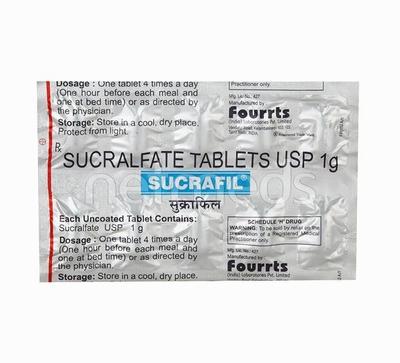
SUCRAFIL TABLET contains Sucralfate, which belongs to the group of medicines called Antiulcer agents. It is used in short-term management (up to 8 weeks) of active duodenal ulcers and maintenance therapy for duodenal ulcer (part of the small intestine) patients at reduced dosage after healing of acute ulcers.
Before taking SUCRAFIL TABLET inform your doctor if you have chronic renal disease, dialysis patients, and impaired swallowing/gag reflex (such as recent or prolonged intubation, tracheostomy, prior history of aspiration, dysphagia, or any other conditions that may alter gag and cough reflexes or diminish oropharyngeal coordination or motility).
SUCRAFIL TABLET should be used with caution among pregnant and breastfeeding women. Consult your doctor before taking it. The safety and effectiveness of SUCRAFIL TABLET for use in children have not been established. SUCRAFIL TABLET should be used with caution in elderly patients above 65 years of age. The most common side effect of taking SUCRAFIL TABLET is constipation. Consult your doctor if any of your symptoms get worse or persist.
Uses Of SUCRAFIL TABLET
- Management of active duodenal ulcer
- Maintenance therapy for duodenal ulcer
How SUCRAFIL TABLET Works
SUCRAFIL TABLET works by forming a protective layer around the ulcer saving it from the further attack of acid, pepsin or bile. It increases growth factor production, promoting tissue growth, regeneration, thereby facilitating repair.
How to use SUCRAFIL TABLET
Take SUCRAFIL TABLET as advised by your physician. Swallow the medicine with water on an empty stomach. Do not crush or chew the medicine. Your physician will decide the correct dose and duration for you depending on your age, body weight, and disease condition.
Side Effects Of SUCRAFIL TABLET
Common
- constipation
How To Manage Side Effects
Constipation:
Eat more fiber-rich foods such as fresh fruits, vegetables, and cereals, and drink more water. Exercise more regularly. Consult your doctor if symptoms don't improve.
Warning & Precautions

Pregnancy
SUCRAFIL TABLET should be used with caution in pregnant women or women planning to have a baby. It will be given to you by the doctor only if clearly needed. Contact your doctor before taking SUCRAFIL TABLET.

Breastfeeding
SUCRAFIL TABLET should be used with caution in breastfeeding women as it is not known whether it passes into breast milk. Contact your doctor before taking SUCRAFIL TABLET.

Kidney
SUCRAFIL TABLET should be used with caution in patients with chronic kidney failure and patients undergoing dialysis. Contact your doctor before taking SUCRAFIL TABLET.

Allergy
Do not take SUCRAFIL TABLET if you are allergic to Sucralfate, or any of the other ingredients of this medicine.
Others
Before taking SUCRAFIL TABLET inform your doctor if you:
- have impaired swallowing/gag reflex (like prolonged intubation, tracheostomy, prior history of aspiration, dysphagia, or other conditions that may alter gag and cough reflexes, diminished oropharyngeal coordination or motility)
Use in pediatrics:
The safety and effectiveness of SUCRAFIL TABLET for use in children have not been established. Contact your doctor before taking SUCRAFIL TABLET.
Use in geriatrics:
SUCRAFIL TABLET should be used with caution in elderly patients aged 65 years or above, especially with decreased liver, kidney, and cardiac function or other diseases. Contact your doctor before taking SUCRAFIL TABLET.
Interactions
A. Drug-Drug interactions:
Before taking SUCRAFIL TABLET, inform your doctor if you are taking any of the following medicine:
- ranitidine, cimetidine (medicine used to manage stomach acidity and peptic ulcer)
- digoxin (a medicine used for heart failure), quinidine (a medicine used to manage irregular heart rate)
- antibiotics like fluoroquinolone, ciprofloxacin, norfloxacin, ofloxacin, ketoconazole, and tetracycline (medicines used to manage bacterial infections)
- l-thyroxine (a medicine used to manage low thyroid hormone)
- phenytoin (a medicine used to manage epilepsy)
- theophylline (medicine used to manage wheezing, shortness of breath, and chest tightness)
- warfarin (to manage blood clots)
Overdosage:
If you or anyone else accidentally took too much of this medicine, consult your physician immediately. The symptoms of overdosage are dyspepsia, abdominal pain, nausea, and vomiting.
Synopsis
| Drug | : |
Sucralfate |
| Pharmacological Category | : |
Anti-ulcer |
| Therapeutic Indication | : |
Duodenal ulcers |
| Dosage Forms | : |
Tablet, Diskettes, Enema, Syrup, Suspension, Cream, Oral solution, Oral suspension, Solution, Syrup, Oral gel, Gel |
More Information
- Keep out of reach from children
- Store at a room temperature of 20 to 25°C
FAQs About SUCRAFIL TABLET
What is SUCRAFIL TABLET used for?
SUCRAFIL TABLET is used in short-term management (up to 8 weeks) of active duodenal ulcer and maintenance therapy for duodenal ulcer (part of the small intestine) patients at reduced dosage after healing of acute ulcers.
Is SUCRAFIL TABLET safe in pregnancy?
SUCRAFIL TABLET should be used with caution in pregnant women or women planning to have a baby. It will be given to you by the doctor only if clearly needed. Contact your doctor before taking SUCRAFIL TABLET.
Can SUCRAFIL TABLET be used in elderly patients?
SUCRAFIL TABLET should be used with caution in elderly patients aged 65 years or above, especially with decreased liver, kidney, and cardiac function or other diseases. your doctor before taking SUCRAFIL TABLET.
How SUCRAFIL TABLET work?
SUCRAFIL TABLET works by forming a protective layer around the ulcer saving it from the further attack of acid, pepsin or bile. It increases growth factor production, promoting tissue growth, regeneration, thereby facilitating repair.
Can SUCRAFIL TABLET be used in patients with kidney problems?
SUCRAFIL TABLET should be used with caution in patients with chronic kidney failure and patients undergoing dialysis. Contact your doctor for more information before taking SUCRAFIL TABLET.
References
1. KD Tripathi. Drug for Peptic Ulcer and Gastroesophageal Reflux Disease. Essentials of medical pharmacology. Seventh edition. 2013. Page – 656.
2. Pujitha Kudaravalli; Savio John. Sucralfate. NIH National Library of Medicine, National center for biotechnology information. [Revised in February 2022] [Accessed on 18th October 2022] https://www.ncbi.nlm.nih.gov/books/NBK551527/
3. A L Blum, H Bethge, J C Bode, W Domschke, G Feurle, K Hackenberg, B Hammer, W Hüttemann, M Jung, G Kachel. Sucralfate in the treatment and prevention of gastric ulcer: multicentre double blind placebo controlled study. Pubmed Central. July 1990. [Accessed on 18th October 2022] https://www.ncbi.nlm.nih.gov/pmc/articles/PMC1378545/
4. Takuya Hayakawa, Shizuka Kawasaki, Yutaka Hirayama, Takuya Tsutsui, Eiji Sugiyama, Kiyo Adachi, Ryo Kon, Makoto Suematsu & Yuki Sugiura. A thin layer of sucrose octasulfate protect the oesophageal mucosal epithelium in reflux oesophagitis. Scientific Reports. March 2019. [Accessed on 18th October 2022] https://www.nature.com/articles/s41598-019-39087-4
5. Aptalis Pharma US, Inc. U.S. Food & Drug Administration. [Revised in March 2013] [Accessed on 18th October 2022] https://www.accessdata.fda.gov/drugsatfda_docs/label/2013/018333s034,019183s016lbl.pdf
6. PLIVA HRVATSKA. Sucralfate. [Revised in November 2021] [Accessed on 18th October 2022] https://dailymed.nlm.nih.gov/dailymed/fda/fdaDrugXsl.cfm?setid=b39f22c8-f224-451a-e053-2995a90aaad7&type=display
7. Drugbank. Sucralfate. [Accessed on 18th October 2022] https://go.drugbank.com/drugs/DB00364
Useful Diagnostic Tests
- Kidney function test
Author Details