




Netmeds First Membership
Description
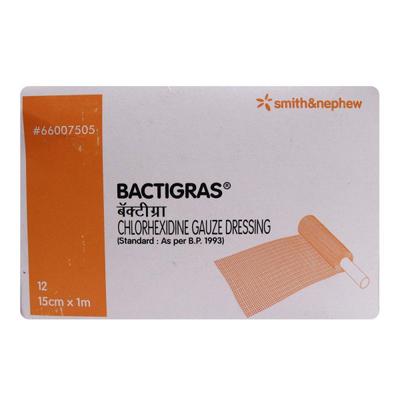
Smith & Nephew Bactigras is a sterile, medicated paraffin gauze dressing designed for a variety of wounds at risk of infection. It is composed of a cotton leno-weave fabric impregnated with soft paraffin and 0.5% Chlorhexidine Acetate. This formulation acts as a soothing, low-adherent barrier between the wound and a secondary dressing, helping to manage conditions like minor burns, scalds, lacerations, and abrasions. It allows wound fluid to drain into an absorbent secondary dressing.
Antiseptic Component: Contains 0.5% Chlorhexidine Acetate, which is active against a wide range of bacteria and helps to reduce the risk of infection in wounds.
Low-Adherent and Soothing: Coated with soft paraffin, the dressing is designed to not stick to the wound bed, which can minimize discomfort during dressing changes.
Open-Weave Gauze: The leno-weave construction allows wound exudate to pass freely into a secondary absorbent dressing, preventing the wound from becoming too moist.
Versatile Application: Suitable for a wide range of wounds including minor burns, cuts, grazes, and donor/recipient graft sites.
Sterile and Ready to Use: Each dressing is individually wrapped and sterilized, making it ready for immediate aseptic application.
Q: Is Bactigras dressing suitable for burns?
A: Yes, Bactigras can be used for a variety of wounds including minor burns and scalds, lacerations, abrasions, and other skin loss wounds.
Q: What is the main component of Bactigras dressing?
A: Bactigras consists of a cotton leno-weave fabric impregnated with white soft paraffin containing 0.5% Chlorhexidine Acetate, which is an antiseptic agent.
Q: How does Bactigras work on a wound?
A: It acts as a soothing, low-adherent barrier that protects the wound and allows it to drain freely into a secondary dressing. The chlorhexidine acetate is slowly released to act against bacteria and help reduce the risk of infection.
Q: How often should the dressing be changed?
A: The frequency of changing the dressing depends on the clinical circumstances, such as the amount of wound exudate, but it can be left in place for up to four days. For wounds at a higher risk of infection, daily changes might be advised.
Q: Are there any situations where Bactigras should not be used?
A: Yes, it should not be used on more than 10% of the body area or if you have a known sensitivity or allergy to chlorhexidine. It is also important to avoid contact with eyes, the middle ear, meninges, and the brain.
Smith & Nephew Bactigras is a sterile, medicated paraffin gauze dressing designed for a variety of wounds at risk of infection. It is composed of a cotton leno-weave fabric impregnated with soft pa...
Key Benefits
Helps in preventing infection in skin loss lesions, minor burns, and ulcers.
Acts as a protective barrier between the wound and a secondary dressing.
Soothes the wound and allows for the free passage of wound fluid into an absorbent secondary dressing.
The dressing's low-adherent quality helps to facilitate comfortable and less painful removal.
Chlorhexidine acetate provides a sustained release of antiseptic, offering prolonged action against various bacteria.
Helps in preventing infection in skin loss lesions, minor burns, and ulcers.
Acts as a protective barrier between the wound and a secondary dressing.
Soothes the wound and allows for the fr...
Direction for Use/Dosage
First, wash your hands and clean the wound and surrounding skin with a sterile solution like normal saline.
Select the appropriate size of the dressing and peel open the sterile pouch.
Using sterile forceps and gloves, remove the protective papers from the dressing.
Apply a single layer of Bactigras directly onto the wound surface.
Cover with a secondary absorbent dressing and secure it in place with tape or a bandage.
The frequency of dressing changes depends on the wound's condition, varying from once a day to twice a week. If the dressing adheres, soak it gently with sterile saline solution before removal.
First, wash your hands and clean the wound and surrounding skin with a sterile solution like normal saline.
Select the appropriate size of the dressing and peel open the sterile pouch.
Usin...
Safety Information/Precaution
For external use only.
Do not use on more than 10% of the body area.
Avoid contact with eyes, the middle ear, meninges, and brain.
It should not be used if you have a known sensitivity or allergy to chlorhexidine.
Do not use with oxidizing cleaning agents like hydrogen peroxide, or with soaps and other anionic materials.
Consult a healthcare professional for all serious wounds and burns, or if redness or discomfort occurs.
Use with care in neonates, particularly premature infants, as it may cause skin burns.
For external use only.
Do not use on more than 10% of the body area.
Avoid contact with eyes, the middle ear, meninges, and brain.
It should not be used if you have a known sensitivity ...
Other Information
Store in a cool place, below 25°C.
Store the dressing flat.
It is intended for use in conjunction with a secondary absorbent dressing.