



Netmeds First Membership
Quick Links
Introduction About RENUM 667 TABLET
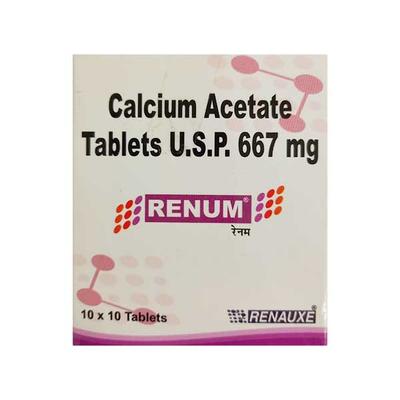
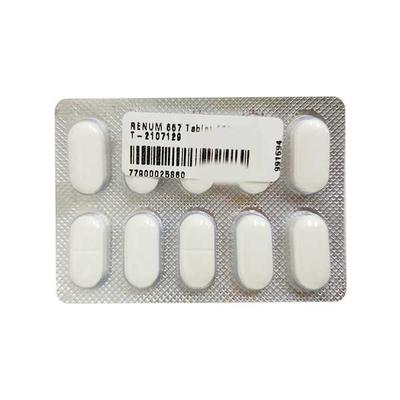
RENUM 667 TABLET contains Calcium acetate, which belongs to the group of medicines called Phosphate binders. It is used to reduce serum phosphorus in patients with end-stage renal disease. End-stage renal disease is a condition in which the gradual loss of kidney function reaches an advanced stage (where the kidney might stop functioning).
Symptoms include fatigue, drowsiness, nausea, headache, loss of appetite, difficulty in urination, swelling of feet or ankles, difficulty sleeping, muscle cramps, metallic taste, chest pain, and shortness of breath.
Prior to the management, your doctor may want you to take certain blood and kidney tests to understand your existing condition to safely use this medicine.
RENUM 667 TABLET is not recommended for use in patients having hypercalcemia (high levels of calcium in blood). RENUM 667 TABLET should be used with caution among pregnant or breastfeeding women; therefore, consult your doctor before taking it.
Safety and effectiveness of RENUM 667 TABLET in pediatric patients have not been established yet. RENUM 667 TABLET should be used with caution in elderly patients (aged 65 years and above). Consult your doctor before taking it.
The most common side effects of taking RENUM 667 TABLET are nausea, vomiting, diarrhea, constipation, and loss of appetite. Consult your doctor if any of the side effects worsen.
Uses Of RENUM 667 TABLET
- Reduces serum phosphorus (high phosphate/phosphorus levels) in patients with end-stage renal disease
How RENUM 667 TABLET Works
RENUM 667 TABLET when taken with the meal, it combines with the dietary phosphate to form an insoluble compound (calcium phosphate complex), which gets excreted in the feces. Hence decreasing the concentration of serum phosphorus in the kidney.
How to use RENUM 667 TABLET
Take RENUM 667 TABLET as advised by your physician. Take it with meals. Swallow the medicine with a glass of water. Do not crush or chew the medicine. Your doctor will decide the correct dose and duration for you depending upon your age, body weight, and disease condition.
Side Effects Of RENUM 667 TABLET
Common
- Nausea
- Vomiting
- Diarrhea
- Constipation
- Loss of appetite
Rare
Stop taking RENUM 667 TABLET and contact your doctor immediately if you experience any of the following side effects:
- Allergic reactions such as rash, swelling, welts on the skin, or breathing difficulties
How To Manage Side Effects

Nausea And Vomiting
Stick to simple meals. Avoid eating oil-rich or spicy foods. Consult your doctor if the symptom does not improve. Sip clear or ice-cold drinks and eat light, bland foods (such as saltine crackers or plain bread). Avoid eating fried, greasy, or sweet foods. Do not mix hot and cold foods. Eat smaller meals slowly and frequently. Consult your doctor if the symptom does not improve.
Warning & Precautions

Pregnancy
Monitoring requiredRENUM 667 TABLET should be used with caution during pregnancy only if considered clearly necessary. Consult your doctor before taking it.

Breastfeeding
Use with CautionRENUM 667 TABLET should be used with caution in breastfeeding women as it may excrete in human milk. Consult your doctor before taking it.

Driving and Using Machines
ContraindicatedDo not drive or operate any machines if you experience confusion, unconsciousness, or delirium.

Allergy
ContraindicatedDo not take RENUM 667 TABLET if you are allergic to calcium acetate or any other ingredients of this medicine.

Use In Pediatrics
Consult your doctorSafety and effectiveness of RENUM 667 TABLET in pediatric patients have not been established yet. Consult your child’s doctor for advice.

Use In Geriatrics
Use with CautionRENUM 667 TABLET should be used with caution in elderly patients (aged 65 years and above) due to the high risk of side effects, especially in patients with impaired heart, liver, or kidney function. Consult your doctor before taking RENUM 667 TABLET.
Others
RENUM 667 TABLET is not recommended for use if you:
- Have hypercalcemia (high levels of calcium), as it may increase the chances of toxicity
Interactions
A. Drug-Drug interactions:
Before taking RENUM 667 TABLET, inform your doctor if you are taking any of the following medicines:
- Ciprofloxacin, tetracyclines (used to manage bacterial infections)
- Digoxin (used to manage heart failure)
- Verapamil (used to manage high blood pressure)
- Vitamin D (used to regulate calcium and phosphorus in the body)
- Antacids containing calcium carbonate or other calcium salts (used to relieve indigestion)
Overdosage:
If you or anyone else accidentally takes too much of RENUM 667 TABLET, consult your doctor immediately or visit the nearby hospital as it may lead to increased levels of calcium in the blood (hypercalcemia) and it may cause symptoms such as constipation, anorexia, nausea, vomiting, confusion, delirium, stupor, and coma.
Synopsis
| Drug | : | Calcium acetate |
| Pharmacological Category | : | Phosphate binder |
| Therapeutic Indication | : | Reduce serum phosphorus in end-stage renal disease |
| Dosage Forms | : | Tablet |
More Information
Storage
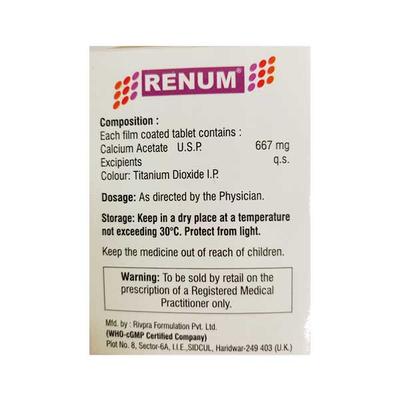
- Keep RENUM 667 TABLET out of reach of children
- Store at room temperature
FAQs About RENUM 667 TABLET
Q: What is RENUM 667 TABLET used for?
A: RENUM 667 TABLET is used to reduce serum phosphorus in patients with end-stage renal disease. End-stage renal disease is a condition in which the gradual loss of kidney function reaches an advanced stage (where the kidney might stop functioning).
Q: How does RENUM 667 TABLET work?
A: RENUM 667 TABLET when taken with the meal, combines with the dietary phosphate to form an insoluble compound (calcium phosphate complex), which gets excreted in the feces. Hence decreasing the concentration of serum phosphorus in the kidney.
Q: Can RENUM 667 TABLET be used with elderly patients?
A: RENUM 667 TABLET should be used with caution in elderly patients (aged 65 years and above) due to the high risk of side effects, especially in patients with impaired heart, liver, or kidney function. Consult your doctor before taking RENUM 667 TABLET.
Q: Can RENUM 667 TABLET be used during pregnancy?
A: RENUM 667 TABLET should be used with caution during pregnancy only if considered clearly necessary. Consult your doctor before taking this medicine if you are pregnant or planning to get pregnant.
Q: What happens if I take more dose of RENUM 667 TABLET?
A: If you or anyone else accidentally takes too much of RENUM 667 TABLET, consult your doctor immediately or visit the nearby hospital as it may lead to increased levels of calcium in the blood (hypercalcemia) and it may cause symptoms such as constipation, anorexia, nausea, vomiting, confusion, delirium, stupor, and coma.
Q: How should I take RENUM 667 TABLET?
A: Take RENUM 667 TABLET as advised by your physician. Take it with meals. Swallow the medicine with a glass of water. Do not crush or chew the medicine. Your doctor will decide the correct dose and duration for you depending upon your age, body weight, and disease condition.
Q: Who should avoid taking RENUM 667 TABLET?
A: Do not take RENUM 667 TABLET if you are allergic to calcium acetate or if you have hypercalcemia (high levels of calcium), as it may increase the chances of toxicity. Consult your doctor before taking it.
Q: What are the side effects of RENUM 667 TABLET?
A: The most common side effects of taking RENUM 667 TABLET are nausea, vomiting, diarrhea, constipation, and loss of appetite. Consult your doctor if any of the side effects worsen.
Q: Can I take other medicines while using RENUM 667 TABLET?
A: Before taking RENUM 667 TABLET, inform your doctor if you are using prescription, non-prescription, or herbal medicines.
Q: Is RENUM 667 TABLET safe for kidneys?
A: Yes, RENUM 667 TABLET is safe for patients with kidney disease as it helps reduce serum phosphorus (high phosphate/phosphorus levels).
References
1. Goodman Gilman’s. Agents affecting mineral ion homeostasis and bone turnover. The Pharmacological Basis of Therapeutics. Twelfth Edition. 2011. Page –1291.
2. Yong Wang, Guoqiang Xie, Yuanhang Huang, Han Zhang, Bo Yang, and Zhiguo Mao. Calcium Acetate or Calcium Carbonate for Hyperphosphatemia of Hemodialysis Patients: A Meta-Analysis. NIH National Library of Medicine, National Center for Biotechnology Information. PubMed Central. March 2015. [Accessed on 11th July 2024] https://www.ncbi.nlm.nih.gov/pmc/articles/PMC4370772/
3. Mark R Kaplan, Cindy L Stashenko, Andra L Bledsoe, and John McGowan. A preference study: calcium acetate tablets versus gelcaps in hemodialysis patients. NIH National Library of Medicine, National Center for Biotechnology Information. PubMed.gov. August 2002. [Accessed on 11th July 2024] https://pubmed.ncbi.nlm.nih.gov/12224369/
4. Fresenius Medical Care North America. U.S. Food & Drug Administration. [Revised in March 2011] [Accessed on 11th July 2024] https://www.accessdata.fda.gov/drugsatfda_docs/label/2011/021160s015lbl.pdf
5. Formulation Technology Inc. Calcium acetate. NIH, National Library of Medicine. Dailymed. [Revised in December 2017] [Accessed on 11th July 2024] https://dailymed.nlm.nih.gov/dailymed/drugInfo.cfm?setid=c095727d-d0cb-448a-9325-d7eac27728a3
Useful Diagnostic Tests
- Complete Blood Count (CBC)/ Hemogram
- Urine Routine & Microscopy
- Kidney Function Test (KFT)
- Creatinine Clearence Test
- Glomerular Filtration Rate (Gfr)
- Advanced Renal Profile
Author Details