




Netmeds First Membership
Introduction About MELACARE CREAM
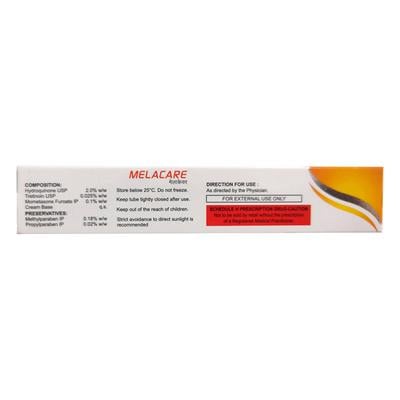
Melacare Cream is commonly selected by individuals looking for dermatologist-recommended solutions to support skin tone correction and help manage areas of darkening on the face. It is generally used in situations where there is uneven pigmentation, patchy skin tone, or spots that appear after long-term sun exposure. The formulation Hydroquinone, Tretinoin, Mometasone furoate which belongs to the group of medicines called Depigmenting agents, Retinoids and Corticosteroids respectively.
The cream is typically applied once daily at night, in a very thin layer on clean, completely dry skin. It should be used only on the affected areas and not on unaffected surrounding skin. Hands should be washed before and after use, and daytime sun protection is essential throughout use, as the skin becomes more sensitive to sunlight. The frequency of application may be adjusted by a healthcare provider depending on skin tolerance. Avoid using other strong skincare products simultaneously unless advised.
Important precautions include avoiding use on broken, sunburned, or irritated skin. The cream should not be used for longer than the prescribed duration. It is not recommended during pregnancy or breastfeeding unless specifically evaluated by a doctor. Safety and efficacy of MELACARE CREAM is not established in children below 12 years of age. Commonly observed side effects include mild redness, dryness, peeling, slight burning, or skin irritation, especially during the first few days.
Uses Of MELACARE CREAM
- Manages moderate to severe melasma (dark spots on the skin) in adults
Benefits of MELACARE CREAM
1. Helps Support an Even-Toned Appearance
The combination of ingredients is commonly used to address uneven skin tone and promote a more uniform look.
2. Enhances Skin Smoothness
Tretinoin supports gentle exfoliation, which may help the skin appear smoother over consistent use.
3. Helps Reduce Visible Dark Spots
Hydroquinone is known for its role in reducing pigment formation, which can help diminish the appearance of dark spots.
4. Supports Skin Renewal
The presence of retinoid (Tretinoin) promotes the natural turnover of skin cells, helping fresh skin come to the surface.
5. Helps Soothe Skin Irritation
Mometasone furoate helps calm irritation, making the formulation more comfortable for the skin.
6. Offers Multi-Action Skincare Support
The triple-combination formula helps users manage uneven tone, texture, and skin discomfort in a single application product.
7. Suitable for Areas Prone to Hyperpigmentation
Commonly used on facial areas where pigmentation tends to appear more prominently.
How MELACARE CREAM Works
1. Hydroquinone – Supports Reduction of Excess Pigment Formation
- Hydroquinone acts on melanocytes (pigment-producing cells).
- It slows down the enzyme tyrosinase, which is central to melanin production.
- Less melanin formation helps reduce the appearance of dark patches and contributes to a more even skin tone.
2. Tretinoin – Promotes Skin Cell Renewal
- Tretinoin is a retinoid that accelerates the natural process of cell turnover.
- It helps remove older, pigment-loaded skin cells from the surface.
- It also enhances penetration of Hydroquinone into deeper layers of the skin.
- This results in better texture and a clearer-looking appearance over time.
3. Mometasone Furoate – Helps Calm Skin Irritation
- This is a mild topical corticosteroid that reduces:
- Redness
- Swelling
- Irritation
- It makes the overall formulation gentler and more tolerable, especially during the first few weeks of use.
How to use MELACARE CREAM
1. Cleanse the Skin First
- Wash your face with a mild, non-irritating cleanser.
- Pat the skin dry completely before application.
- Ensure no moisture remains, as this may increase irritation.
2. Apply a Thin Layer
- Take a small, pea-sized amount of the cream.
- Apply only to the affected pigmented areas, not the entire face.
- Spread a very thin, even layer until fully absorbed.
- Avoid applying near the eyes, nostrils, and mouth.
3. Use Only Once Daily (Usually at Night)
- Most dermatologists recommend nighttime application because:
- Tretinoin is light-sensitive
- The skin renews faster at night
- Do not apply more frequently than advised; excess application increases irritation.
4. Always Use Sunscreen in the Morning
- Sun exposure can worsen pigmentation.
- Apply broad-spectrum sunscreen SPF 30 or higher every morning.
- Reapply if outdoors for long durations.
5. Moisturizer Support (If Needed)
To minimize dryness or peeling:
- Apply a gentle moisturizer 10–15 minutes before Melacare
or - Use moisturizer after Melacare has absorbed.
6. Application Duration
- Should be used only for the duration advised by the dermatologist.
- Long-term or continuous use without supervision is not recommended due to active ingredients like Hydroquinone and corticosteroids.
7. Avoid Certain Practices
- Do not use harsh scrubs, peels, salicylic acid, or other retinoids simultaneously.
- Avoid waxing on areas where the cream is applied.
- Do not use on broken, sensitive, or sunburnt skin.
What if I forgot to take MELACARE CREAM
- Apply it the next night as usual.
- Do not double the amount the next day.
- Maintain consistency instead of increasing quantity.
Overdose
If you or anyone else accidentally ingests or apply too much of MELACARE CREAM, consult your doctor immediately.
Side Effects Of MELACARE CREAM
Common
- Mild burning
- Stinging
- Redness
- Dryness
When to consult a doctor?
- Infraorbital and paranasal fissures
How To Manage Side Effects

Application Site Reactions
- Reduce application frequency temporarily if irritation increases.
- Apply a cool compress for 5–10 minutes to calm redness or burning.
- Avoid applying the cream on broken, irritated, or freshly shaved skin.
- Do not mix with other strong skincare products like AHAs/BHAs or retinoids.
- Keep the quantity limited to a thin, even layer on affected areas only.
- Avoid touching or rubbing the area frequently.
- Pause usage and consult a doctor if swelling, severe redness, or blistering occurs.
Dry Skin
- Reduce application frequency temporarily if irritation increases.
- Apply a cool compress for 5–10 minutes to calm redness or burning.
- Avoid applying the cream on broken, irritated, or freshly shaved skin.
- Do not mix with other strong skincare products like AHAs/BHAs or retinoids.
- Keep the quantity limited to a thin, even layer on affected areas only.
- Avoid touching or rubbing the area frequently.
- Pause usage and consult a doctor if swelling, severe redness, or blistering occurs.
Warning & Precautions

Pregnancy
Consult your doctorThe safety and efficacy of MELACARE CREAM is not being established in pregnant women. Consult with your doctor before using.

Breastfeeding
Use with CautionMELACARE CREAM should be used cautiously in breast feeding women. Consult with your doctor before using.

Allergy
ContraindicatedDo not use MELACARE CREAM if you are allergic to Hydroquinone, Tretinoin, Mometasone or any other constituents of this medicine. Consult your doctor before using.

Use In Pediatrics
Consult your doctorThe safety and efficacy of MELACARE CREAM is not being established in children below 12 years of age. Consult with your child’s doctor before using it for your child.

Use In Geriatrics
Consult your doctorThere is no information on the use of MELACARE CREAM in elderly patients. Consult your doctor before using MELACARE CREAM.
Drug - Drug interaction
1. Interactions With Other Topical Skin Products
- Other skin-lightening creams
Using additional depigmenting agents (like glycolic acid, kojic acid, azelaic acid, or hydroquinone from other brands) may increase irritation and dryness. - Other retinoids (e.g., adapalene, tretinoin from another product)
Increases risk of redness, peeling, burning, or sensitivity. - Topical steroids
Using multiple steroid-based creams can increase the chance of skin thinning or irritation. - Products with alcohol, fragrance, or harsh preservatives
May worsen dryness, burning, or irritation when combined with Melacare. - Benzoyl peroxide or salicylic acid preparations
Can reduce stability of tretinoin and cause excessive peeling or redness.
2. Interactions With Systemic (Oral) Medicines
- Photosensitising medicines
Medicines that increase sun sensitivity (some antibiotics, antifungals, or isotretinoin) may raise the chance of irritation since tretinoin already makes skin sensitive to sunlight. - Oral steroids or immunosuppressants
May further increase skin sensitivity due to the steroid component in Melacare. - Medicines affecting skin barrier
Some oral acne medicines (e.g., isotretinoin) can make skin drier and more sensitive, raising interaction risks when Melacare is applied.
3. Interactions With Cosmetic or Skincare Procedures
- Chemical peels, microdermabrasion, laser treatments
Using Melacare before or after such procedures may cause excessive irritation unless guided by a dermatologist. - Facial waxing or threading
Can irritate skin already sensitized by Melacare.
Synopsis
| Drug | : | Hydroquinone, Tretinoin, Mometasone |
| Pharmacological Category | : | Hypopigmenting agents, Retinoids, Corticosteroids |
| Therapeutic Indication | : | Melasma |
| Dosage Forms | : | Cream, Gel, Ointment, Soap |
More Information
How to Maintain Skin Barrier Health While Using Active Formulations
1. Start Slow and Increase Gradually
- Introduce one active product at a time.
- Use it 2–3 times a week initially to allow skin to adjust.
- Increase frequency only if your skin feels comfortable.
2. Follow the “Sandwich Method” for Strong Actives
- Apply a thin layer of moisturizer,
- Then apply the active formulation,
- Finish with another layer of moisturizer.
This reduces irritation without reducing effectiveness.
3. Keep Your Routine Minimal
- Avoid using too many actives together (e.g., mixing retinoids + exfoliants).
- Stick to a gentle cleanser + moisturizer + sunscreen routine on the days you use actives.
4. Choose a Barrier-Strengthening Moisturizer
Look for ingredients that support the skin barrier:
- Ceramides
- Hyaluronic acid
- Niacinamide (low strength)
- Squalane
- Panthenol (Vitamin B5)
Apply twice daily, even on days you don’t use actives.
5. Use Sunscreen Every Day
Actives such as tretinoin, AHAs, hydroquinone, and benzoyl peroxide can make skin more sensitive to sunlight.
Daily sunscreen helps:
- Reduce irritation
- Minimise redness
- Support overall skin barrier recovery
6. Avoid Harsh Cleansers or Over-Washing
- Use a fragrance-free, gentle cleanser.
- Avoid scrubs, foaming cleansers, and products with alcohol.
- Wash your face only once or twice a day.
7. Keep Active Ingredients Apart
To reduce irritation:
- Avoid layering multiple strong actives at the same time.
- Use products like retinoids at night.
- Use vitamin C or exfoliating acids on separate days.
8. Avoid Over-Exfoliation
Signs of exfoliating too much include:
- Tightness
- Redness
- Peeling
- Stinging
Space exfoliants (AHA/BHA) to 1–2 times a week when using other actives.
9. Add a Skin-Barrier Support Serum (Optional)
Ingredients such as:
- Centella asiatica
- Cholesterol
- Peptides
- Madecassoside
help soothe and strengthen the skin barrier during active use.
10. Take a “Barrier Break” When Needed
If you notice persistent irritation:
- Pause active products for 3–5 days.
- Use only hydrating and barrier-supportive products.
Once the skin feels comfortable, reintroduce actives slowly.
11. Avoid Waxing or Harsh Beauty Treatments
Avoid:
- Waxing
- Laser
- Chemical peels
on areas where actives are applied, unless advised by a doctor.
12. Protect Skin From Environmental Triggers
- Avoid hot showers
- Avoid cold winds directly on the face
- Stay away from strong fragrance or essential oils
These can weaken the barrier while actives are in use.
Common Skincare Routine Mistakes to Avoid
1. Using Too Many Active Ingredients at the Same Time
Layering multiple strong actives (like retinoids, exfoliating acids, and vitamin C) can irritate the skin. Introduce one product at a time and build slowly.
2. Over-Exfoliating the Skin
Exfoliating more than 2–3 times a week can damage the skin barrier, causing redness, peeling, or sensitivity.
3. Skipping Moisturizer Even with Oily Skin
Many people avoid moisturizers thinking they cause greasiness. In reality, skipping moisturization can increase oil production and dryness.
4. Not Wearing Sunscreen Daily
Forgetting sunscreen results in faster barrier damage and reduces the effectiveness of many skincare routines, especially those with active ingredients.
5. Using Harsh Cleansers or Washing Too Often
Overwashing strips natural oils, leading to tightness and irritation. Gentle cleansers are more effective for maintaining skin comfort.
6. Mixing Ingredients That Should Not Be Used Together
Some combinations (such as retinoids with AHAs/BHAs) can cause irritation or reduce product effectiveness. Spacing them out helps.
7. Applying Too Much Product
Using large quantities does not increase benefits. It only increases the chance of irritation and product waste.
8. Ignoring Patch Testing Before Trying New Products
Starting a new product without testing it on a small area may lead to unexpected sensitivity or reactions.
9. Expecting Quick Results and Changing Products Too Often
Skin improvements take time. Switching products frequently disrupts progress and confuses the skin.
10. Not Following a Consistent Routine
Irregular application reduces the expected benefits. A simple, consistent routine works better than a complicated one.
11. Using Very Hot Water on the Face
Hot water weakens the skin barrier and can trigger dryness or redness. Use lukewarm water instead.
12. Applying Skincare in the Wrong Order
Incorrect layering can reduce product absorption. Generally, apply products from thinnest to thickest.
13. Sharing Skincare Products
Sharing increases the risk of contamination and reactions, especially with eye creams or balms.
14. Ignoring Early Signs of Irritation
Symptoms like stinging, peeling, or redness mean the skin needs a break. Adjusting the routine early avoids worsening.
15. Using Expired Products
Old products can lose effectiveness and may cause irritation. Always check expiry dates, especially on sunscreens and creams.
FAQs About MELACARE CREAM
Q: What is Melacare Cream commonly used for?
A: Melacare Cream is generally used as prescribed by a dermatologist for specific skin-related concerns that require targeted topical support.
Q: Who can use Melacare Cream?
A: It is usually recommended for adults who require dermatologist-guided skin care. It is not typically advised for children unless specifically directed.
Q: How should I apply Melacare Cream?
A: Apply a thin, even layer only on the affected area as advised by your dermatologist. Avoid applying more than the recommended amount.
Q: When is the best time to apply Melacare Cream?
A: It is often applied at night, as instructed by a dermatologist, because certain ingredients may increase sensitivity to sunlight.
Q: Can Melacare Cream be used with other skincare products?
A: Only if advised by a dermatologist. Some products, especially those with active ingredients, may increase dryness or irritation when used together.
Q: What should I do if I experience irritation or redness after using Melacare Cream?
A: Reduce the frequency of application and moisturize well. If irritation persists, consult a dermatologist for further guidance.
Q: Can Melacare Cream be used during pregnancy or breastfeeding?
A: Use is generally avoided unless explicitly recommended by a doctor. Always discuss with your healthcare provider before applying any strong topical formulation.
Q: Can I go out in the sun after applying Melacare Cream?
A: Direct sun exposure should be minimized. Using daytime sun protection is important because the skin may become more sensitive.
Q: Is Melacare Cream suitable for long-term use?
A: Long-term use is usually not recommended unless a dermatologist advises otherwise. It is typically prescribed for limited durations.
Q: What should I avoid while using Melacare Cream?
A: Avoid harsh cleansers, scrubs, waxing, and other strong skincare actives on the same area. These may increase dryness or irritation.
References
1. KD Tripathi. Drugs Acting on Skin and Mucous Membranes. Essentials of Medical Pharmacology. Eighth Edition, 2019. Page – 952, 953, 955.
2. Kiran V Godse. Triple combination of hydroquinone, tretinoin and mometasone furoate with glycolic acid peels in melasma. NIH National Library of Medicine, National Centre for Biotechnology. Pubmed Central. Jan 2009. [Accessed 3rd March 2026] 
3. Kowichi Jimbow, HirokoObata, Madhu A.Pathak, Thomas B.Fitzpatrick. Mechanism of depigmentation by hydroquinone. Journal of investigative dermatology. Science Direct. January 2016. [Accessed 3rd March 2026] 
4. Torque pharma. No Scars (Hydroquinone + Tretinoin + Mometasone). [Accessed 3rd March 2026]
5. Leeford Healthcare. Ultrabrite Cream (Hydroquinone + Tretinoin + Mometasone). [Accessed 3rd March 2026]
Author Details