

Netmeds First Membership
Quick Links
Introduction About JUVETRA SYRUP
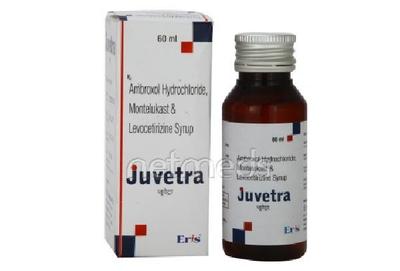
JUVETRA SYRUP is a combination of Ambroxol, Levocetirizine and Montelukast which belong to a group of medicines called Mucolytics, Antihistamines and Leukotriene receptor antagonists respectively. It is used to manage nasal congestion, allergic cough, fever with common cold and rhinorrhea.
Nasal congestion is a condition which occurs when nasal and adjacent tissues and blood vessels becomes swollen with excess fluid that causes stuffy or plugged feeling in nose which is characterized by symptoms such as reduced sense of smell or taste, runny nose, sneezing and or snoring.
Allergic cough is a type of cough that occurs due to swelling or irritation of the airways which is characterized by symptoms such as itchy, stuffy nose, difficulty breathing and wheezing.
Avoid taking JUVETRA SYRUP if you are allergic to Ambroxol, Levocetirizine or Montelukast or suffer from end stage renal disease (kidney disease).
Before taking JUVETRA SYRUP, inform your doctor if you have cough for a long time, asthma, peptic or duodenal ulcers, intolerance to some sugar such as sorbitol, phenylketonuria (birth defect), liver or kidney problems.
JUVETRA SYRUP is not recommended for use during pregnancy especially during the first 3 months of pregnancy which is not recommended for use in breastfeeding women as it can pass through the breast milk.
The medicine is recommended for use in children and adolescents (from 6 to 18 years) which is taken after consulting the doctor.
The most common side effects of taking JUVETRA SYRUP are taste disturbance, numbness in throat, nausea, numbness in mouth and tongue, excessive sleepiness, common cold and fever. Consult and inform your doctor if any of these above side effects gets worse.
Uses Of JUVETRA SYRUP
- Used to manage nasal congestion, allergic cough, fever with common cold and rhinorrhea
How JUVETRA SYRUP Works
JUVETRA SYRUP helps in managing nasal congestion, allergic cough, fever with common cold and rhinorrhea, where Ambroxol provides relief from symptoms of nasal congestion, allergic cough and rhinorrhea by thinning and loosening the mucus in the nose, windpipe and lungs, Levocetirizine provides relief from itching, swelling and rashes by blocking the effects of a chemical messenger called histamine in the body (which is responsible for producing allergic reactions in the body). Montelukast manages allergic rhinitis by blocking leukotriene (a chemical messenger) that results in the reduction of inflammation of the airways which provides relief to the symptoms associated with allergies.
How to use JUVETRA SYRUP
Take JUVETRA SYRUP as advised by your physician. Shake well before use. Your doctor will decide the correct dose and duration for you depending upon your age, body weight and disease condition.
Side Effects Of JUVETRA SYRUP
Common
- taste disturbance
- numbness in throat
- nausea
- numbness in mouth and tongue
- common cold
- fever
- cough
- weakness
- dry mouth
- sore throat
- nosebleed
Uncommon
- diarrhea
- vomiting
- indigestion
- abdominal pain
Rare
- signs of allergic reactions such as abdominal cramping or pain, diarrhea, nausea or vomiting
- itchy, red skin rash
Stop taking JUVETRA SYRUP and contact your doctor if you experience any of the following side effects:
- skin rash, lesions in mouth, throat, nose, eyes and genitals (severe skin reactions)
- excess sleepiness
- weakness
- signs of allergic reactions such as hoarseness, red, itchy skin rash, swelling of the face, eyelids, lips, tongue and/or throat which may cause difficulty in breathing or swallowing
- blistering, peeling or shedding skin
- fever, chills, muscle aches, cough, congestion (flu-like symptoms)
- tingling and numbness sensation in arms or legs
- swelling of the sinuses
- ear pain (in children)
How To Manage Side Effects
Nausea and Vomiting:
Try to take JUVETRA SYRUP with or just after a meal or a snack. Stick to simple meals. Avoid eating rich or spicy food. Consult and inform your doctor if the symptom gets worse.
Diarrhea:
Drink plenty of water and stay hydrated. Try to avoid taking any medicine on your own to manage diarrhea. Consult your doctor and inform them if the symptom gets worse.
Indigestion:
Try to have smaller and more frequent meals and drink slowly. Reduce consumption of coffee, cola, tea or alcohol and lose weight if you are obese. Try to avoid smoking and don’t have rich, fatty or spicy foods. Consult your doctor and inform if the symptom does not improve.
Warning & Precautions

Pregnancy
JUVETRA SYRUP is not recommended for use during pregnancy especially during the first 3 months of pregnancy. Consult your doctor before taking JUVETRA SYRUP.

Breastfeeding
JUVETRA SYRUP is not recommended for use in breast-feeding women as it may pass through the breast milk. Consult your doctor before taking it.

Driving and Using Machines
Do not drive or operate any machines as you may feel reduced mental alertness, dizziness and drowsiness after taking JUVETRA SYRUP.

Alcohol
Avoid consumption of alcohol while taking JUVETRA SYRUP because it may reduce mental alertness.

Kidney
JUVETRA SYRUP is not recommended for use in patients with end-stage renal disease (severe kidney failure) and in patients undergoing hemodialysis. It should be used with caution in patients with kidney problems such as renal impairment. Consult your doctor before taking JUVETRA SYRUP.

Liver
JUVETRA SYRUP should be used with caution in patients with liver problems such as hepatic impairment. Consult your doctor before taking JUVETRA SYRUP.

Allergy
Do not take JUVETRA SYRUP if you are allergic to Ambroxol, Levocetirizine, Montelukast or any of its ingredients or to any of the ingredients of this medicine.

Lungs
JUVETRA SYRUP should be used with caution in patients suffering from serious asthma attack. Consult your doctor before taking JUVETRA SYRUP.
Others
Before taking JUVETRA SYRUP inform your doctor if you:
- have or had a cough
- have asthma or suffer from serious asthma attack
- have peptic or duodenal ulcers
- have intolerance to some sugar (like sorbitol)
- have signs of hereditary fructose intolerance
- have phenylketonuria
Use in Pediatrics:
JUVETRA SYRUP is recommended for use in children and adolescents (from 6 to 18 years of age). Consult your doctor before taking it.
Use in Geriatrics:
JUVETRA SYRUP should be used with caution in elderly patients (aged 65 years or above). Consult your doctor before taking JUVETRA SYRUP.
Interactions
A. Drug - Drug Interactions:
Before taking JUVETRA SYRUP, inform your doctor, if you are taking any of the following medicine:
- amoxicillin, cefuroxime, erythromycin, azithromycin (medicine used to manage bacterial infections)
- codeine (medicine used to manage mild to moderate pain and also to reduce coughing)
- antipyrine (used to decrease pain and inflammation)
- cimetidine (medicine used to manage peptic ulcer and stomach acidity)
- ketoconazole (used to manage fungal infections)
- theophylline (used to manage the symptoms of asthma, bronchitis and other lung diseases)
- pseudoephedrine (medicine used to relieve nasal congestion caused by colds, allergies and hay fever)
- ritonavir (used to manage HIV)
- gemfibrozil (used to reduce cholesterol and triglycerides)
- phenobarbital (used for management of epilepsy)
- rifampicin (medicine used to manage tuberculosis and other infections)
Overdosage:
If you or anyone else accidentally takes too much of JUVETRA SYRUP, consult your doctor immediately or visit the nearby hospital. Symptoms of overdose are drowsiness, agitation, restlessness, stomach pain, sleepiness, thirst, headache, vomiting.
Synopsis
| Drug | : | Ambroxol, Levocetirizine, Montelukast |
| Pharmacological Category | : | Mucolytics, Antihistamines, Leukotriene receptor Antagonists |
| Therapeutic Indication | : | Nasal congestion, Allergic cough, Fever with common cold and Rhinorrhea |
| Dosage Forms | : | Tablet, Capsule, Syrup |
More Information
- Keep the medicine out of reach in children
- Store JUVETRA SYRUP at room temperature
FAQs About JUVETRA SYRUP
Q: What JUVETRA SYRUP is used for and how it is taken?
A: JUVETRA SYRUP is used to manage nasal congestion, allergic cough, fever with common cold and rhinorrhea which should be taken as advised by your physician. Your doctor will decide the correct dose and duration for you depending upon your age, body weight and disease condition.
Q: Who should avoid taking JUVETRA SYRUP ?
A: JUVETRA SYRUP is not recommended for use in patients allergic to Ambroxol, Levocetirizine or Montelukast which is also not recommended for use in breastfeeding women and in patients suffering from end stage renal failure (kidney failure).
Q: What are the common side effects of JUVETRA SYRUP?
A: The most common side effects of taking JUVETRA SYRUP are taste disturbance, numbness in throat, nausea, numbness in mouth and tongue, excessive sleepiness, common cold and fever. Consult and inform your doctor if any of these above side effects gets worse.
Q: What happens if you take more JUVETRA SYRUP than your required dose?
A: If you or anyone else accidentally takes too much of JUVETRA SYRUP, consult your doctor immediately or visit the nearby hospital. Symptoms of overdose are drowsiness, agitation, restlessness, stomach pain, sleepiness, thirst, headache and vomiting.
Q: Is it safe to drive or operate machines while taking JUVETRA SYRUP?
A: Do not drive or operate any machines while taking JUVETRA SYRUP since it might cause reduced mental alertness, dizziness and drowsiness which may affect your ability to drive or operate machines.
References
1. KD. Tripathi. Histamine & Antihistaminics and Drugs for Cough and Bronchial Asthma. Seventh edition, 2013. Page – 167, 219 & 228.
2. Ahmad Kantar, Ludger Klimek, Dorotheea Cazan, Annette Sperl, Ulrike Sent and Margarida Mesquita. An overview of efficacy and safety of ambroxol for the management of acute and chronic respiratory diseases with a special regard to children. NIH National Library of Medicine. National Center for Biotechnology Information. PMC PubMed Central. [Revised in March 2020] [Accessed on 21st June 2022] https://www.ncbi.nlm.nih.gov/pmc/articles/PMC7137760/
3. Harrison R. Wermuth; Talel Badri; Veronica Takov. Montelukast. NIH National Library of Medicine. National Center for Biotechnology Information. StatPearls. [Revised in April 2022] [Accessed on 21st June 2022] https://www.ncbi.nlm.nih.gov/books/NBK459301/
4. Ambroxol hydrochloride. Wuxuwang. [Accessed on 21st June 2022] https://file.wuxuwang.com/hma/CZ_H_0606_002_FinalPL.pdf
5. UCB, Inc. U.S. Food & Drug Administration. [Revised in January 2008] [Accessed on 21st June 2022] https://www.accessdata.fda.gov/drugsatfda_docs/label/2008/022064s009lbl.pdf
6. Montelukast. Medline Plus. NIH National Library of Medicine. [Revised in Dec 2021] [Accessed on 21st June 2022] https://medlineplus.gov/druginfo/meds/a600014.html#precautions
7. Ambolev-LM. Intra Life Pvt Ltd. [Revised in 2018] [Accessed on 21st June 2022] https://intralifeindia.com/product_detail.php?id=19#
Useful Diagnostic Tests
- Sputum test
Author Details