


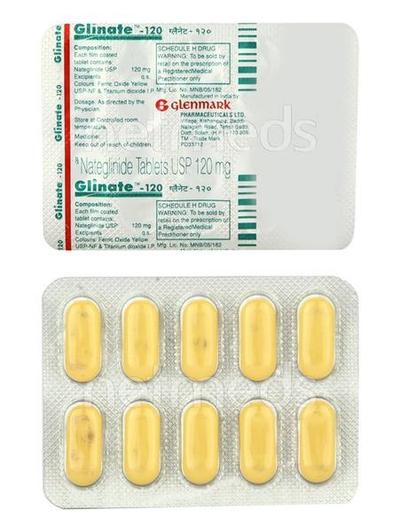


Glinate 120mg Tablet 10'S

Netmeds First Membership
Quick Links
Introduction About GLINATE 120MG TABLET
GLINATE 120MG TABLET contains Nateglinide which belongs to the group of medicines called Antidiabetics. It is used in the management of type 2 diabetes in adult patients.
Type 2 diabetes is a chronic condition that occurs when the body becomes resistant to insulin or when the pancreas cannot produce enough insulin (a hormone that controls blood sugar levels). Symptoms include increased thirst and urination, increased hunger, feeling tired, blurred vision, numbness or tingling in the feet or hands, sores that do not heal, unexplained weight loss.
GLINATE 120MG TABLET is not recommended for use in patients with severe liver problems, type 1 diabetes, diabetic ketoacidosis. Consult your doctor before taking it.
GLINATE 120MG TABLET is not recommended for use in pregnant and breastfeeding women. Consult your doctor before taking it.
GLINATE 120MG TABLET is not recommended for use in children and adolescents (under 18 years of age). It should be used with caution in elderly patients. Consult your doctor before taking it.
The most common side effects of taking GLINATE 120MG TABLET are sweating, dizziness, shaking, weakness, hunger, feeling heartbeat fast, tiredness. Contact your doctor if any of the symptoms worsen.
Uses Of GLINATE 120MG TABLET
- To manage type 2 diabetes mellitus
How GLINATE 120MG TABLET Works
GLINATE 120MG TABLET works by stimulating the pancreas to produce insulin more quickly, which helps to keep blood sugar levels under control after meals.
How to use GLINATE 120MG TABLET
Take GLINATE 120MG TABLET as advised by your physician. It should be taken before meals. Swallow the medicine with a glass of water. Do not crush or chew the medicine.
Your doctor will decide the correct dose and duration for you depending upon your age, body weight and disease condition. Do not stop taking GLINATE 120MG TABLET unless your doctor tells you to.
Side Effects Of GLINATE 120MG TABLET
Common
- sweating
- dizziness
- shaking
- weakness
- hunger
- feeling heartbeat fast
- tiredness
- nausea, abdominal pain, indigestion, diarrhea
Uncommon
- vomiting
Rare
- allergic reactions such as rash and itching
How To Manage Side Effects
Diarrhea
Drink lots of fluids, such as water or fruit juices to keep yourself hydrated. Do not take any medicine on your own for managing diarrhoea. Contact your doctor if your diarrhoea did not improve.

Dizziness Or Drowsiness
Try to rest and relax. Get enough sleep. Avoid driving or operate any machines while you are feeling dizzy. Do not drink alcohol, as it can aggravate your dizziness. Contact your doctor if your dizziness did not improve.
Indigestion
Eat smaller and frequent meals. Eat and drink slowly and exercise regularly. Contact your doctor if indigestion persists.

Nausea And Vomiting
Take GLINATE 120MG TABLET, with or just after a meal. Stick to simple meals. Avoid eating oily or spicy food. Contact your doctor if your nausea and vomiting did not improve.

Skin rash Or Itching
Avoid hot bath because hot water can irritate your skin further. Do not scratch the affected area. Use sunscreen and wear protective clothing while going outside. Use unscented moisturizers to soothe and hydrate the affected area. Contact your doctor if your rashes worsen.

Stomach Pain
Try to rest and relax. Eat small meals but take frequently. Keep a heat pad on your stomach. Contact your doctor if the stomach pain worsens.
Warning & Precautions

Pregnancy
ContraindicatedGLINATE 120MG TABLET is generally not recommended for use in pregnant women or planning to become pregnant. Consult your doctor before taking it. If you become pregnant during management with this medicine. Consult your doctor immediately.

Breastfeeding
ContraindicatedGLINATE 120MG TABLET is not recommended for use in breastfeeding women as it may pass through breast milk. Consult your doctor before taking it.

Driving and Using Machines
Use with CautionDo not drive or operate any machines after taking GLINATE 120MG TABLET as it reduces your ability to concentrate or react due to low blood sugar (hypoglycaemia).

Alcohol
Consult your doctorAvoid consumption of alcohol while taking GLINATE 120MG TABLET as it increases the risk of low blood sugar.

Kidney
Use with CautionGLINATE 120MG TABLET should be used with caution in patients with severe kidney problems. Consult your doctor before taking it.

Liver
Consult your doctorGLINATE 120MG TABLET is not recommended to for use in patients with severe liver problems. Consult your doctor before taking it. GLINATE 120MG TABLET should be used with caution in patients with liver problems. Consult your doctor before taking it.

Allergy
ContraindicatedDo not take GLINATE 120MG TABLET if you are allergic to Nateglinide or any of the other ingredients of this medicine.

Use In Pediatrics
ContraindicatedGLINATE 120MG TABLET is not recommended for use in children and adolescents (under 18 years of age). Consult your doctor before taking it.

Use In Geriatrics
Use with CautionGLINATE 120MG TABLET should be used with caution in elderly patients (aged 65 years and above) due to increased risk of low blood sugar. Consult your doctor before taking it.
Others
GLINATE 120MG TABLET is not recommended for use if you:
- have type 1 diabetes (i.e., your body does not produce any insulin)
- have symptoms of severe hyperglycaemia (very high blood sugar and/or diabetic ketoacidosis) such as excessive thirst, frequent urination, weakness, fatigue, nausea, shortness of breath or confusion
Before taking GLINATE 120MG TABLET, inform your doctor if you:
- have problems with drug metabolism
- are due to have an operation
- have recently suffered a fever, an accident or an infection
- are undernourished
- have another medical condition that may cause low blood sugar (Ex. an under-active pituitary or adrenal gland)
- have intolerance to lactose or other sugars
Interactions
A. Drug-Drug interactions:
Before taking GLINATE 120MG TABLET, inform your doctor if you are taking any of the following medicine:
- non-steroidal anti-inflammatory agents (medicines used to manage muscle and joint pain) Ex. aceclofenac, diclofenac
- salicylates such as aspirin (used to manage pain)
- monoamine oxidase inhibitors (medicines used to manage depression) Ex. isocarboxazid, phenelzine
- beta blockers or ACE inhibitors, diuretics (used to manage high blood pressure and certain heart conditions) Ex. propranolol, captopril, furosemide
- medicines used to manage inflammatory disorders (Ex. corticosteroids such as prednisone and cortisone)
- medicines used to manage fungal infection (Ex. fluconazole)
- medicines used to manage dyslipidemia (Ex. gemfibrozil)
- medicines used to manage chronic gout (Ex. sulfinpyrazone)
- medicines used to manage asthma (Ex. salbutamol)
- anabolic hormones Ex. methandrostenolone (used to manage post-menopausal osteoporosis and pituitary-deficient dwarfism)
- St. John’s Wort, also known as Hypericum perforatum (an herbal medicine used to manage depression)
- somatropin (used to manage growth hormone deficiency)
- medicines used to manage acromegaly (Ex. lanreotide and octreotide)
- medicines used to manage tuberculosis (Ex. rifampin)
- medicines used to manage seizures (Ex. phenytoin)
Overdosage:
If you or anyone else accidentally take too much of GLINATE 120MG TABLET, consult your doctor immediately or visit the nearby hospital. Symptoms of overdose include low blood sugar symptoms such as sweating, dizziness, shaking, weakness, hunger, feeling your heart beating fast, tiredness, nausea, eat or drink something containing sugar.
If you feel as if you are about to have a severe hypoglycaemic attack (which may lead to loss of consciousness or fits), contact your doctor immediately.
Synopsis
| Drug | : | Nateglinide |
| Pharmacological Category | : | Meglitinides |
| Therapeutic Indication | : | Type 2 diabetes mellitus |
| Dosage Forms | : | Tablet |
More Information
- Keep GLINATE 120MG TABLET out of reach of children
- Store GLINATE 120MG TABLET below 30°C
FAQs About GLINATE 120MG TABLET
Q: What happens if you miss a dose of GLINATE 120MG TABLET?
A: If you forget to take a dose of GLINATE 120MG TABLET, simply take the next one before your next meal. Do not take a double dose to make up for a forgotten dose.
Q: How fast does GLINATE 120MG TABLET work?
A: Take GLINATE 120MG TABLET according to the doctor’s advice. GLINATE 120MG TABLET start to act within a very short time after they are swallowed and are eliminated from the body rapidly. Contact your doctor if your symptoms did not improve.
Q: Can GLINATE 120MG TABLET be taken with food?
A: Take GLINATE 120MG TABLET acccording to the doctors advice. It should be taken before meals. The effect of this medicine may be delayed if it is taken during or after meals. Your doctor will decide the correct dose and duration for you depending upon your age, body weight and disease condition.
Q: When is the right time to take GLINATE 120MG TABLET?
A: Take GLINATE 120MG TABLET before the three main meals, usually it is taken 1 dose before breakfast, 1 dose before lunch and another 1 dose before dinner. It is best to take it right before a main meal, but you can take it up to 30 minutes before. Do not take it if you are not going to eat a main meal. If you miss a meal, skip that dose of GLINATE 120MG TABLET and wait until your next meal.
Q: Does GLINATE 120MG TABLET cause low blood sugar?
A: Yes, GLINATE 120MG TABLET may cause low blood sugar levels. You may experience sweating, tremors (feeling shaky), anxiety, difficulty concentrating, confusion, weakness or fainting. If this happens to you, eat or drink something containing sugar and talk to your doctor.
Q: Can I stop using GLINATE 120MG TABLET?
A: Take GLINATE 120MG TABLET as advised by your physician. Continue to take this medicine as long as your doctor prescribes it so that it can continue to control your blood sugar. Do not stop taking GLINATE 120MG TABLET unless your doctor tells you to.
References
1. Alvin C. Powers and David D’Alessio. Endocrine Pancreas and Pharmacotherapy of Diabetes Mellitus and Hypoglycemia. Goodman & Gilman’s: The Pharmacological basics of Therapeutics. 13th Edition. 2018. Page – 863.
2. Nicholas Tentolouris, Christina Voulgari and Nicholas Katsilambros. A review of nateglinide in the management of patients with type 2 diabetes. NIH National Library of Medicine, National Center for Biotechnology Information. PubMed Central. December 2007. [Accessed on 24th May 2022] https://www.ncbi.nlm.nih.gov/pmc/articles/PMC2350129/
3. Carola Saloranta, Kenneth Hershon, Michele Ball, Sheila Dickinson, David Holmes. Efficacy and Safety of Nateglinide in Type 2 Diabetic Patients with Modest Fasting Hyperglycemia. The Journal of Clinical Endocrinology & Metabolism. September 2002. [Accessed on 24th May 2022] https://academic.oup.com/jcem/article/87/9/4171/2846581
4. Novartis Farma S.p.A. Electronic Medicines Compendium (EMC). [Revised in May 2018]. [Accessed on 24th May 2022] https://www.medicines.org.uk/emc/files/pil.1320.pdf
5. Nateglinide. DailyMed: National Library of Medicine: National Institute of Health. [Revised in November 2021] [Accessed on 24th May 2022] https://dailymed.nlm.nih.gov/dailymed/lookup.cfm?setid=f7b28951-76d2-cabd-64a1-b74aa225c6e9
Useful Diagnostic Tests
- Glucose-Fasting Blood
- Glucose-Postprandial Blood
- Glycosylated Hemoglobin
Author Details

