



Netmeds First Membership
Quick Links
Introduction About ETOVA ER 600MG TABLET
Etova ER Tablet contains Etodolac which belongs to the group of medicines called Non-steroidal Anti-inflammatory Drugs (NSAIDs). Etova ER Tablet is used in adults for acute pain management, for relieving pain, stiffness and reducing inflammation associated with conditions such as osteoarthritis and rheumatoid arthritis.
During long term management with Etova ER Tablet, your doctor might order some investigations such as complete hemogram, liver function tests, kidney function tests to ensure better management outcomes.
Avoid consuming alcohol and smoking while taking Etova ER Tablet as it may increase the risk of stomach ulcers and bleeding.
Etova ER Tablet is not recommended for use in patients who experienced allergic reaction, gastrointestinal bleeding, perforation after taking any other NSAID’s such as ibuprofen, aspirin, suffering from stomach ulcers, stomach bleeding or perforation, severe heart failure, liver failure, kidney failure or those who are in setting of coronary artery bypass graft surgery. Consult your doctor before taking.
Etova ER Tablet should be used with caution in patients suffering from high blood pressure, heart disorders (such as myocardial infarction, stroke), patients at risk of developing ulcerative colitis, Crohn’s disease, pre-existing kidney disease, asthma, blood disorders, diabetes, high cholesterol, mixed connective tissue disorder such as lupus and fluid retention (swelling of legs, ankles, feet).
Etova ER Tablet is not recommended for use in pregnant and breastfeeding women unless clearly necessary, therefore, consult your doctor before taking.
Etova ER Tablet is not recommended for use in children and adolescents less than 18 years of age as its safety and effectiveness is not yet established.
The most common side effects after taking Etova ER Tablet are abdominal pain, diarrhoea, dyspepsia, flatulence, bloating, vomiting. Consult your doctor immediately in case any of the side effects worsens or you experience allergic reaction after taking Etova ER Tablet.
Uses Of ETOVA ER 600MG TABLET
- Used to relieve pain and inflammation in patients with rheumatoid arthritis and osteoarthritis
Benefits of ETOVA ER 600MG TABLET
- Provides relief from pain, swelling, and inflammation.
- Helps reduce joint pain and stiffness associated with osteoarthritis and rheumatoid arthritis.
- Can provide relief from acute musculoskeletal pain when prescribed.
- May make movement and routine activities more comfortable by reducing pain and inflammation.
- The extended-release formulation is designed to provide a longer duration of action from a single dose.
- May help improve mobility in patients whose joint pain and stiffness are associated with inflammatory or degenerative joint conditions.
How ETOVA ER 600MG TABLET Works
Etodolac works mainly by reducing the production of prostaglandins, chemical mediators involved in pain and inflammation.
- Etodolac inhibits cyclooxygenase (COX) enzymes, which participate in prostaglandin production.
- Reduced prostaglandin formation decreases the signals responsible for pain, inflammation, and swelling.
- Lower prostaglandin activity in inflamed tissues helps reduce joint pain and stiffness.
- Its anti-inflammatory action can consequently improve comfort and movement in conditions such as osteoarthritis and rheumatoid arthritis.
How to use ETOVA ER 600MG TABLET
- Take Etova ER 600 mg exactly as prescribed by your healthcare professional.
- Swallow the tablet whole with water.
- Do not crush, chew, or break the extended-release tablet, as this can interfere with its intended release characteristics.
- Take it with or after food or with milk, particularly if you are prone to stomach irritation.
- Take it at approximately the same time each day when regular dosing is prescribed.
- Use the lowest effective dose for the shortest duration recommended by your healthcare professional.
- Do not take an additional dose to compensate for a missed dose.
- If you miss a dose, take it when remembered unless the next dose is close; in that case, skip the missed dose.
Overdose
In case you or anybody else accidently takes too much of Etova ER 600 mg then consult your doctor immediately or visit the nearby hospital. Symptoms include lethargy, drowsiness, nausea, vomiting, epigastric pain, gastrointestinal bleeding.
Side Effects Of ETOVA ER 600MG TABLET
Common side effects of Etova ER Tablet
- stomach ulcer
- bleeding and pain
- diarrhoea
- constipation
- indigestion, flatulence
- chills and fever
- nausea, vomiting, bloating
- itching, rashes
- blurred vision, tingling in ears
- infrequent urination
- joint pain
- dizziness, fatigue, nervousness, malaise
- heart burn
When to consult a doctor?
- allergic reaction which causes difficulty breathing, swelling of the face or throat
- cardiovascular problems-symptoms include chest pain, shortness of breath, weakness or slurred speech
- gastrointestinal bleeding and ulcerations symptoms include upper abdominal pain, dyspepsia, melena (black stools due to gastrointestinal bleeding) and hematemesis (vomiting blood)
- liver problems- symptoms include nausea, fatigue, lethargy, pruritus (severe itching), jaundice, right upper quadrant tenderness and flu-like symptoms
- congestive heart failure- symptoms include shortness of breath, unexplained weight gain or oedema (swelling in arms, legs, hands and feet)
- serious skin reactions such as erythema multiforme, steven-Johnson syndrome, drug reaction with eosinophilia and systemic symptoms (dress) symptoms include fever, rashes, swollen lymph nodes, blisters
- aseptic meningitis- symptoms include headache, neck stiffness, fever, disorientation, feeling sick
Warning & Precautions

Pregnancy
Consult your doctorEtova ER 600 mg is not recommended for use in pregnant women unless clearly necessary, therefore, consult your doctor before taking.

Breastfeeding
Consult your doctorEtova ER 600 mg is not recommended for use in breastfeeding women unless clearly necessary as it may pass through breastmilk, therefore, consult your doctor before taking.

Driving and Using Machines
Use with CautionDo not drive or operate machines after taking ETOVA ER 600MG TABLET as it may cause dizziness and vision problems.

Alcohol
ContraindicatedAvoid consuming alcohol while taking Etova ER 600 mg as it might as it may increase the risk of stomach ulcers and bleeding.

Kidney
ContraindicatedEtova ER 600 mg is not recommended for use in patients suffering from kidney failure. Consult your doctor before taking.

Liver
ContraindicatedEtova ER 600 mg is not recommended for use in patients suffering from liver failure. Consult your doctor before taking.

Allergy
ContraindicatedDo not take Etova ER 600 mg if you are allergic to Etodolac or any other ingredients of this medicine.

Lungs
Use with CautionEtova ER 600 mg should be used with caution in patients suffering from asthma or breathing problems, therefore consult your doctor before taking.

Heart Disease
ContraindicatedETOVA ER 600MG TABLET is not recommended for use in patients suffering from severe heart failure, therefore, inform your doctor if you are suffering from heart disorders (such as myocardial infarction, recent stroke) before taking ETOVA ER 600MG TABLET.

Use In Pediatrics
ContraindicatedSafety and effectiveness in pediatric patients below the age of 18 years have not been established. Consult your doctor before giving it to your child.

Use In Geriatrics
Use with CautionEtova ER 600 mg should be used with caution in elderly patients aged more than 65 years, therefore consult your doctor before taking.
Other Warnings for ETOVA ER 600MG TABLET
Before taking Etova ER 600 mg inform your doctor if you have:
- high blood pressure
- urine investigation for urinary bilirubin or ketone bodies
- ulcerative colitis, Crohn’s Disease
- blood disorders
- diabetes
- high cholesterol
- mixed connective tissue diseases such as lupus
- fluid retention (swelling of legs, ankles, feet)
Who should not take ETOVA ER 600MG TABLET
Etova ER 600 mg is not recommended for use if you:
- have experienced allergic reaction, gastrointestinal bleeding, perforation after taking any other NSAIDs such as ibuprofen, aspirin
- are suffering from stomach ulcers, stomach bleeding or perforation
- have been planned for setting of coronary artery bypass graft surgery
Drug - Drug interaction
1. Anticoagulants
Examples: Warfarin, apixaban, rivaroxaban, dabigatran.
- NSAIDs can increase the risk of gastrointestinal and other bleeding.
- The combination with warfarin may have a particularly important bleeding risk.
- Medical supervision and monitoring are recommended.
2. Antiplatelet Medicines
Examples: Aspirin, clopidogrel, ticagrelor.
- Concurrent use may increase the risk of gastrointestinal bleeding.
- Aspirin and etodolac are generally not combined for routine pain relief unless specifically advised.
3. Other NSAIDs
Examples: Ibuprofen, naproxen, diclofenac, ketorolac, meloxicam.
- Taking two NSAIDs together generally does not provide proportionally greater pain relief.
- It can increase the risk of stomach ulceration, bleeding, kidney problems, and other NSAID-related adverse effects.
4. ACE Inhibitors, ARBs and Other Blood-Pressure Medicines
Examples: Enalapril, lisinopril, losartan, valsartan, metoprolol.
- Etodolac may reduce the blood-pressure-lowering effect of some antihypertensives.
- NSAIDs can also increase the risk of kidney impairment, especially in dehydrated patients or those with pre-existing kidney disease.
5. Diuretics
Examples: Furosemide, hydrochlorothiazide.
- Etodolac may reduce the sodium- and fluid-losing effect of diuretics.
- Kidney function and blood-pressure control may require monitoring.
6. Lithium
- NSAIDs can reduce renal clearance of lithium and increase lithium concentrations.
- This can increase the risk of lithium toxicity.
- Lithium levels may need monitoring when etodolac is started, stopped, or its dose is changed.
7. Methotrexate
- Etodolac and other NSAIDs may reduce renal elimination of methotrexate and potentially increase toxicity.
- The risk is particularly important with high-dose methotrexate.
- Blood counts, liver function, and kidney function may require monitoring.
8. Digoxin
- Etodolac may alter renal elimination of digoxin and increase its concentration.
- Patients may require monitoring for digoxin-related adverse effects, particularly if kidney function is impaired.
9. Ciclosporin and Tacrolimus
- Combining NSAIDs with these immunosuppressants can increase the risk of kidney toxicity.
- Kidney function and, where appropriate, drug levels and potassium may need monitoring.
10. Corticosteroids
Examples: Prednisolone, dexamethasone, hydrocortisone.
- Combined use can increase the risk of gastrointestinal ulceration and bleeding.
11. Quinolone Antibiotics
Examples: Ciprofloxacin, norfloxacin, levofloxacin.
- NSAIDs may increase the risk of convulsions associated with quinolone antibiotics in susceptible patients.
12. Mifepristone
- NSAIDs may reduce the effect of mifepristone.
- Product information recommends avoiding NSAIDs for a specified period following mifepristone administration; the treating clinician should provide the exact timing.
13. Antacids
- Antacids do not appear to substantially change the overall absorption of etodolac, although they can reduce its peak concentration by approximately 15–20%.
Synopsis
|
Drug |
Etodolac |
|
Pharmacological Category |
Non-steroidal Anti-inflammatory Drugs (NSAID’s) |
|
Therapeutic Indication |
Relieve pain and inflammation in patients with rheumatoid arthritis and osteoarthritis |
|
Dosage Forms |
Tablet, Gel, Injection |
More Information
1. Extended-Release Formulation Has a Practical Advantage
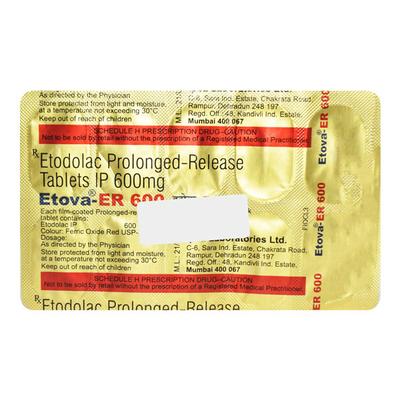
Etova ER is an extended-release preparation of etodolac. It is designed to release the medicine more gradually, allowing a longer duration of action than an immediate-release formulation and supporting convenient dosing. The tablet should therefore be swallowed whole rather than crushed or chewed.
2. Food Helps With Tolerability
Taking Etova ER with food or milk can help reduce stomach discomfort. However, food does not eliminate the possibility of NSAID-related ulceration or gastrointestinal bleeding, particularly during prolonged use.
3. Long-Term Use May Require Laboratory Monitoring
For prolonged treatment, healthcare professionals may periodically check complete blood count, kidney function, and liver function. This is useful because NSAIDs can occasionally cause gastrointestinal blood loss, kidney impairment, or liver-related abnormalities.
4. Blood Pressure Can Change
Etodolac and other NSAIDs can cause fluid retention and may reduce the effectiveness of certain antihypertensive medicines. Patients with hypertension, heart failure, or cardiovascular disease may therefore need closer monitoring.
5. A Painkiller Can Mask Symptoms
Because Etova ER can substantially reduce pain and inflammation, improvement in symptoms does not necessarily mean that the underlying condition has resolved. Persistent, worsening, or recurrent pain should be medically assessed rather than managed indefinitely with an NSAID.
6. Unusual Laboratory Results Are Possible
Etodolac metabolites can interfere with certain urine tests and may produce false-positive results for urinary bilirubin or ketones with some testing methods. Patients undergoing laboratory testing should inform the healthcare professional that they are taking etodolac.
FAQs About ETOVA ER 600MG TABLET
Q: What is Etova ER 600 mg Tablet used for?
A: Etova ER contains etodolac, an NSAID used to relieve pain, stiffness, and inflammation associated with conditions such as osteoarthritis, rheumatoid arthritis, and certain acute painful conditions.
Q: How should Etova ER 600 mg be taken?
A: Take it exactly as prescribed, preferably with food or milk if advised. Swallow the extended-release tablet whole with water and do not crush or chew it.
Q: Can I take ibuprofen or diclofenac with Etova ER?
A: Do not combine Etova ER with other NSAIDs unless specifically prescribed. Using multiple NSAIDs can increase the risk of gastrointestinal, kidney, and other adverse effects.
Q: Can Etova ER be taken with aspirin?
A: Aspirin and etodolac may increase adverse-effect and gastrointestinal bleeding risks when used together. Do not add aspirin for pain relief without medical advice.
Q: Can people with high blood pressure take Etova ER?
A: It may be prescribed in some patients, but NSAIDs can reduce the effect of certain blood-pressure medicines and may cause fluid retention. Patients with hypertension should use it under medical supervision.
Q: Can Etova ER affect the kidneys?
A: Yes. Etodolac can affect kidney function, particularly with prolonged use, dehydration, pre-existing kidney disease, or concurrent use of certain medicines. Kidney function may be monitored when appropriate.
Q: What are the common side effects of Etova ER?
A: Commonly reported effects include nausea, vomiting, stomach pain, indigestion, dizziness, and drowsiness. More serious problems such as gastrointestinal bleeding or kidney complications can occur, particularly in susceptible patients or with prolonged use.
Q: Can Etova ER be used for long-term arthritis pain?
A: It may be prescribed for chronic arthritis, but long-term NSAID therapy should be reviewed periodically because the risks of gastrointestinal, kidney, liver, and cardiovascular complications can increase with prolonged exposure.
Q: What should I do if I miss a dose of Etova ER?
A: Take the missed dose when you remember unless it is almost time for the next dose. In that case, skip the missed dose and continue the regular schedule. Do not take two tablets together.
Q: When should I seek medical attention while taking Etova ER?
A: Seek urgent medical attention for black or bloody stools, vomiting blood, severe stomach pain, chest pain, sudden breathing difficulty, facial swelling, severe rash, marked reduction in urine, or sudden weakness or speech/vision problems. These can indicate serious NSAID-related complications.
References
1. KD Tripathi. Non-steroidal Anti-inflammatory Drugs and Antipyretic-Analgesics. Essentials of Medical Pharmacology, 7th edition 2013. Page-204.
2. Shravan Kumar Tirunagri, Sheena Derry, R Andrew Moore, Henry J McQuay. Single dose oral etoloac for acute postoperative pain in adults. NIH National Library of Medicine, National center for biotechnology information. Cochrane Library. July 2009. [Accessed 1st October 2026] 
3. Sun Pharmaceutical Industries Europe B.V. Electronic Medicines Compendium (EMC). [Revised in February 2018] [Accessed on 1st October 2026] 
4. Wyeth Pharmaceuticals Inc. U.S Food and Drug Administration (FDA). [Revised in March 2021] [Accessed on 1st October 2026]
5. Taro Pharmaceutical Industries Ltd. Etodolac. [Revised in March 2021] [Accessed on 1st October 2026]
6. Taro Pharmaceutical Industries Ltd. Etodolac. Dailymed. [Revised in March 2021] [Accessed on 1st October 2026]
7. AA Pharma Inc. Etodolac. [Revised in January 2018] [Accessed on 1st October 2026]
Useful Diagnostic Tests
Author Details