

Netmeds First Membership
Quick Links
Introduction About ENBIOS 250MG POWDER
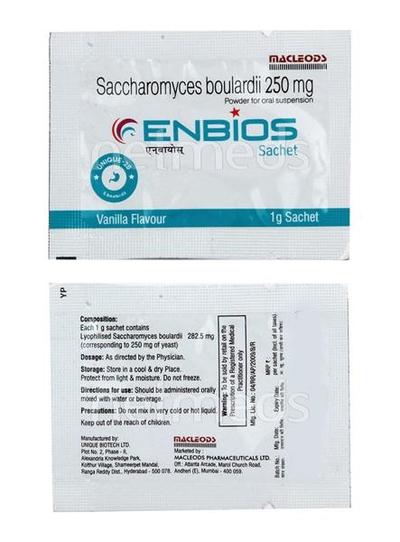
ENBIOS 250MG POWDER contains Saccharomyces boulardi which belongs to the group of medicines called Probiotics. ENBIOS 250MG POWDER is used to manage acute infectious diarrhoea in adults and children. It is also used to manage antibiotic associated colitis and diarrhoea in affected individuals. ENBIOS 250MG POWDER is also used in addition to vancomycin/metronidazole (antibiotic) medicines to manage recurrent Clostridium difficile diseases (colon infection) and manage tube-feeding associated diarrhoea. The medicine is also indicated for use to manage irritable bowel syndrome (intestinal disorder) in affected individuals.
ENBIOS 250MG POWDER is not recommended for use in patients allergic to Saccharomyces boulardii. It is also not recommended for use in patients with central venous catheter (long flexible tube inserted into the vein of neck, chest, arm, and/or groin), and in patients who are immunocompromised/hospitalised (due to serious illness, and/or altered/weakened immune system).
Before taking ENBIOS 250MG POWDER, inform you had undergone liver transplantation. ENBIOS 250MG POWDER is not recommended for use in pregnant and breastfeeding women. ENBIOS 250MG POWDER should be used with caution in children and adolescents (aged below 18 years). It is advised to be used in elderly patients (aged 65 years and above) after consulting the doctor. The most common side effects of taking ENBIOS 250MG POWDER are constipation, bloating, and/or faecal incontinence. Consult your doctor if any of these symptoms worsens.
Uses Of ENBIOS 250MG POWDER
It is used to manage:
- acute infectious diarrhoea in adults and children
- antibiotic associated colitis and diarrhoea
- recurrent Clostridium difficile diseases and manages tube-feeding associated diarrhoea
- irritable bowel syndrome in affected individuals
How ENBIOS 250MG POWDER Works
ENBIOS 250MG POWDER works by inhibiting protease enzyme (responsible for protein breakdown) which helps to manage development of bacterial overgrowth, host cell adherence, and provides a protective effect to the normal healthy gut flora thus managing inflammation of gut and reducing frequency of passing stool and tiredness in individuals affected with diarrhoea.
How to use ENBIOS 250MG POWDER
Always take ENBIOS 250MG POWDER as advised by your physician. Pour the contents of the sachet in a little amount of water/ sweetened drink or mix it with food. Avoid mixing it with very cold/hot liquids/food and consume the medicine. Your doctor will decide the correct dose and duration for you depending upon your age, body weight, and disease condition.
Side Effects Of ENBIOS 250MG POWDER
Common
- constipation
- bloating
- faecal incontinence
Rare
- flatulence
Stop taking ENBIOS 250MG POWDER and contact your doctor if you experience any of the following side effects:
- deterioration of health after 2 days of management
- fever, vomiting
- presence of blood/mucus in stools
- signs of dehydration such as intense thirst, and/or dryness of tongue
How To Manage Side Effects
Constipation
Try to eat high-fiber foods such as vegetables, cereals, fresh fruit, and drink plenty of water. Involve in regular exercise (such as going for a daily walk or run) and if this does not help, consult and inform your doctor for receiving alternate managements for constipation.
Warning & Precautions

Pregnancy
ContraindicatedENBIOS 250MG POWDER is generally not recommended for use during pregnancy. Consult your doctor before taking the medicine.

Breastfeeding
Use with CautionENBIOS 250MG POWDER should be used with caution in breastfeeding women. Consult your doctor before taking the medicine.

Driving and Using Machines
Use with CautionENBIOS 250MG POWDER should be used with caution in patients who had undergone liver transplant. Consult your doctor before taking ENBIOS 250MG POWDER.

Allergy
ContraindicatedDo not take ENBIOS 250MG POWDER if you are allergic to Saccharomyces boulardii, and/or any other ingredients of this medicine.

Use In Pediatrics
Use with CautionENBIOS 250MG POWDER should be used with caution in children and adolescents (aged below 18 years). Consult your doctor before taking the medicine.

Use In Geriatrics
Use with CautionENBIOS 250MG POWDER should be used with caution in elderly patients (aged 65 and above). Consult your doctor before taking ENBIOS 250MG POWDER.
Others
ENBIOS 250MG POWDER is not recommended for use if you:
- have central venous catheter (long flexible tube inserted into the vein of neck, chest, arm, and/or groin to receive drugs, fluids or blood in emergency or long-term management)
- are immunocompromised/hospitalised (due to serious illness, and/or altered/weakened immune system)
- have fructose intolerance
- suffer from congenital galactosemia (inability to break down galactose sugar), glucose and galactose malabsorption syndrome, and/or lactose intolerance
Interactions
A. Drug–Drug interactions:
Before taking ENBIOS 250MG POWDER, inform your doctor if your taking any of the following medicines:
- Antifungal agents (Ex. Ketoconazole, clotrimazole, amphotericin)
B. Drug–Food interactions:
Avoid taking too hot/cold food items while taking ENBIOS 250MG POWDER since it may reduce the effect of medicine.
Overdosage:
If you or anyone else accidentally takes too much of ENBIOS 250MG POWDER, then consult your doctor immediately or visit the nearby hospital to manage overdose symptoms.
Synopsis
| Drug | : | Saccharomyces boulardi |
| Pharmacological Category | : | Probiotics |
| Therapeutic Indication | : | Used to manage acute infectious diarrhoea, recurrent Clostridium difficile diseases, and irritable bowel syndrome, antibiotic associated colitis & diarrhoea, Tube-feeding associated diarrhoea |
| Dosage Forms | : | Capsule, Syrup, Powder, Sachet |
More Information
Storage
- Keep ENBIOS 250MG POWDER out of reach of children
- Do not store ENBIOS 250MG POWDER above 25°C
FAQs About ENBIOS 250MG POWDER
Q: What is ENBIOS 250MG POWDER used for?
A: ENBIOS 250MG POWDER is used to manage acute infectious diarrhoea in adults and children which is also used to manage antibiotic associated colitis and diarrhoea in affected individuals. It is also used in addition to vancomycin/metronidazole medicines to manage recurrent Clostridium difficile diseases and manage tube-feeding associated diarrhoea. The medicine is also indicated for use to manage irritable bowel syndrome in affected individuals.
Q: What are the common side effects of taking ENBIOS 250MG POWDER?
A: The most common side effects of taking ENBIOS 250MG POWDER are constipation, bloating, and/or faecal incontinence. Consult your doctor if any of these symptoms worsens.
Q: How ENBIOS 250MG POWDER should be taken?
A: Always take ENBIOS 250MG POWDER as advised by your physician. Pour the contents of the sachet in a little amount of water/ sweetened drink or mix it with food. Avoid mixing it with very cold/hot liquids/food and consume the medicine. Your doctor will decide the correct dose and duration for you depending upon your age, body weight, and disease condition.
Q: What happens if ENBIOS 250MG POWDER is taken more than its required dosage?
A: If you or anyone else accidentally takes too much of ENBIOS 250MG POWDER, then consult your doctor immediately or visit the nearby hospital to manage overdose symptoms.
Q: How ENBIOS 250MG POWDER works?
A: ENBIOS 250MG POWDER works by inhibiting protease enzyme (responsible for protein breakdown) which helps to manage development of bacterial overgrowth, host cell adherence, and provides a protective effect to the normal healthy gut flora thus managing inflammation of gut and reducing frequency of passing stool and tiredness in individuals affected with diarrhoea.
References
1. K.D Tripathi. Drugs for Constipation and Diarrhoea. Essentials of Medical Pharmacology. Seventh edition. 2013. Page – 683.
2. Karolina Kazmierczak-Siedlecka, Jakub Ruszkowski, Mateusz Fic, Marcin Folwarski, Wojciech Makarewicz. Saccharomyces boulardii CNCM I-745: A Non-bacterial Microorganism Used as Probiotic Agent in Supporting Treatment of Selected Diseases. NIH National Library of Medicine. National center for biotechnology information. PMC PubMed Central. May 2020. [Accessed on 6th January 2023] https://www.ncbi.nlm.nih.gov/pmc/articles/PMC7415030/
3. Ener Cagri Dinleyici, Ates Kara, Metehan Ozen, Yvan Vandenplas. Saccharomyces boulardii CNCM I-745 in different clinical conditions. NIH National Library of Medicine. National center for biotechnology information. PubMed.gov. July 2014. [Accessed on 6th January 2023] https://pubmed.ncbi.nlm.nih.gov/24995675/
4. C. Pothoulakis. Review article: Anti-inflammatory mechanisms of action of Saccharomyces boulardii. NIH National Library of Medicine. National center for biotechnology information. PMC PubMed Central. July 2008. [Accessed on 6th January 2023] https://www.ncbi.nlm.nih.gov/pmc/articles/PMC2761627/
5. S J Lewis, L F Potts, R E Barry. The lack of therapeutic effect of Saccharomyces boulardii in the prevention of antibiotic-related diarrhoea in elderly patients. NIH National Library of Medicine. National center for biotechnology information. PubMed.gov. March 1998. [Accessed on 6th January 2023] https://pubmed.ncbi.nlm.nih.gov/9570649/
6. BIOCODEX. Ghana Food and Drugs Authority. [Revised in January 2019] [Accessed on 6th January 2023] https://fdaghana.gov.gh/img/pils/Bioflor%20250mg%20sachet.pdf
Useful Diagnostic Tests
- Blood culture
- Stool culture
Author Details