






Netmeds First Membership
Quick Links
Introduction About ASPISOL 150MG TABLET
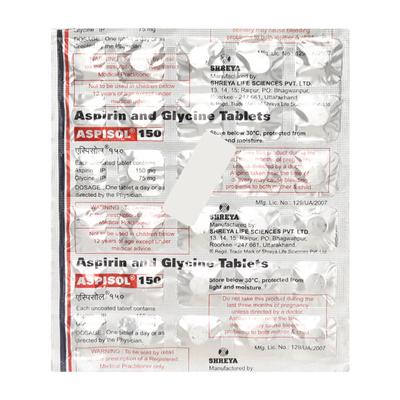
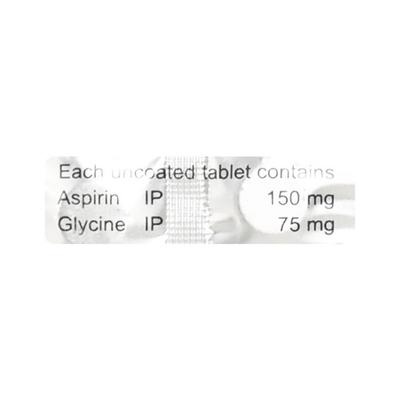
ASPISOL 150MG TABLET is a combination of Aspirin and Glycine which belongs to the group of medicines called Antiplatelets and Amino acids respectively. It is used to manage pain and reduce fever or inflammation, also used to manage or manage heart attack, stroke and chest pain (angina).
Heart attack is a condition that occurs when the flow of blood to the heart is severely reduced or blocked. A stroke is a condition that occurs when a blood vessel in the brain ruptures and bleeds, or when there's a blockage in the blood supply to the brain characterized by symptoms such as trouble walking, understanding or speaking.
Avoid taking ASPISOL 150MG TABLET, if you are allergic to Aspirin or Glycine, have stomach or intestinal bleeding or bleeding disorders such as hemophilia. Before taking ASPISOL 150MG TABLET, inform your doctor if you have stomach ulcers, gout, nasal polyps, asthma, kidney or liver disease.
ASPISOL 150MG TABLET should be used with caution during pregnancy which is not recommended for use in breastfeeding women. ASPISOL 150MG TABLET is not recommended for use in children and adolescents (aged below 16 years) and should be used with caution in elderly patients.
The most common side effects of taking ASPISOL 150MG TABLET are upset stomach, heartburn, drowsiness and mild headache. Consult your doctor if any of the side effects get worse.
Uses Of ASPISOL 150MG TABLET
- Manage pain and reduce fever or inflammation
- Manage or manage heart attacks, strokes and chest pain (angina)
How ASPISOL 150MG TABLET Works
ASPISOL 150MG TABLET helps in managing heart attack, stroke and chest pain (angina), where aspirin reduces the blood clot formation by dissolving the blood clots that results in the seamless and free flow of blood and Glycine lowers the harmful effects of aspirin by managing the damage to the stomach lining and acid build-up thus reducing the side effects of aspirin and acting with aspirin to manage the occurence of heart attack, stroke and chest pain (angina).
How to use ASPISOL 150MG TABLET
Take ASPISOL 150MG TABLET as advised by your physician. Swallow ASPISOL 150MG TABLET with a glass of water and do not chew or crush the medicine. Your doctor will decide the correct dose and duration for you depending upon your age, body weight and disease condition.
Side Effects Of ASPISOL 150MG TABLET
Common
- upset stomach
- heartburn
- drowsiness
- mild headache
Rare
- reye syndrome (a serious condition that causes confusion, swelling in the brain and liver damage)
Stop taking ASPISOL 150MG TABLET and contact your doctor if you experience any of the following side effects:
- ringing in your ears
- confusion, hallucinations
- rapid breathing
- seizure (convulsions)
- severe nausea or vomiting
- stomach pain
- bloody or tarry stools
- coughing up blood
- fever lasting longer than 3 days
- swelling or pain lasting longer than 10 days
How To Manage Side Effects
Headache:
Take rest and drink plenty of fluids. Try to avoid drinking alcohol. Ask your doctor to recommend a painkiller if you have severe headache. It should usually go away after the first week of taking ASPISOL 150MG TABLET. If headaches last more than a week or severe, inform your doctor.
Warning & Precautions

Pregnancy
ASPISOL 150MG TABLET should be used with caution during pregnancy or in women planning to become pregnant. Consult your doctor before taking ASPISOL 150MG TABLET.

Breastfeeding
ASPISOL 150MG TABLET is not recommended for use in breastfeeding women. Consult your doctor before taking ASPISOL 150MG TABLET.

Alcohol
Avoid consumption of alcohol while taking ASPISOL 150MG TABLET.

Kidney
ASPISOL 150MG TABLET should be used with caution in patients with reduced kidney function. Consult your doctor for advice before taking ASPISOL 150MG TABLET.

Liver
ASPISOL 150MG TABLET should be used with caution in patients with reduced liver function. Consult your doctor for advice before taking ASPISOL 150MG TABLET.

Allergy
ASPISOL 150MG TABLET is not recommended for use if you are allergic to Aspirin, Glycine or any other ingredients of this medicine. It should be used with caution in patients with seasonal allergies. Consult your doctor before taking ASPISOL 150MG TABLET.

Lungs
ASPISOL 150MG TABLET should be used with caution in patients with asthma. Consult your doctor before taking ASPISOL 150MG TABLET.

Heart Disease
ASPISOL 150MG TABLET should be used with caution in patients with heart disease or congestive heart failure. Consult your doctor before taking ASPISOL 150MG TABLET.
Others
ASPISOL 150MG TABLET is not recommended for use if you:
- have a recent history of stomach or intestinal bleeding
- have a bleeding disorder such as hemophilia
Before taking ASPISOL 150MG TABLET, inform your doctor if you:
- stomach ulcers
- gout
- nasal polyps
- high blood pressure
Use in Pediatrics:
ASPISOL 150MG TABLET is not recommended for use in children and adolescents (aged below 16 years). Consult your child’s doctor for advice.
Use in Geriatrics:
ASPISOL 150MG TABLET should be used with caution in elderly patients (aged 70 years or above). Consult your doctor before taking ASPISOL 150MG TABLET.
Interactions
A. Drug-Drug Interactions:
Before taking ASPISOL 150MG TABLET, inform your doctor, if you are taking any of the following medicines:
- antidepressant (medicines used to manage depression) such as citalopram, escitalopram, fluoxetine, fluvoxamine, paroxetine, sertraline, trazodone or vilazodone
- blood thinners (medicines used to manage blood clots) Ex. warfarin
- other salicylates (medicines used to manage pain, fever and inflammation) Ex. acetaminophen and magnesium salicylate
- non-steroidal anti-inflammatory drugs (medicines used to relieve pain and reduce inflammation) Ex. ibuprofen, naproxen, ketoprofen, indomethacin, etodolac, diclofenac, ketorolac, meloxicam, nabumetone, piroxicam
Overdosage:
If you or anyone else accidentally takes too much of ASPISOL 150MG TABLET, consult your doctor immediately or visit the nearby hospital.
Synopsis
| Drug | : | Aspirin, Glycine |
| Pharmacological Category | : | Salicylate, Amino Acid |
| Therapeutic Indication | : | Heart attacks, strokes and chest pain;pain and reduce fever or inflammation |
| Dosage Forms | : | Tablet |
More Information
- Keep the medicine out of reach of children
- Store ASPISOL 150MG TABLET at room temperature
FAQs About ASPISOL 150MG TABLET
Q: What is ASPISOL 150MG TABLET used for?
A: ASPISOL 150MG TABLET is used to manage pain and reduce fever or inflammation which is also used to manage or manage heart attack, stroke and chest pain (angina). Consult your doctor for advice before taking it.
Q: Who should avoid taking ASPISOL 150MG TABLET?
A: ASPISOL 150MG TABLET is not recommended for use in patients who are allergic to aspirin or glycine and in patients with stomach or intestinal bleeding or bleeding disorders such as hemophilia. Consult your doctor before taking ASPISOL 150MG TABLET.
Q: What are the side effects of ASPISOL 150MG TABLET?
A: The most common side effects of taking ASPISOL 150MG TABLET are upset stomach, heartburn, drowsiness and mild headache. Consult your doctor if any of the side effect gets worse.
Q: Is ASPISOL 150MG TABLET safe to use in patients with kidney disease?
A: ASPISOL 150MG TABLET should be used with caution in patients with reduced kidney function. Your doctor may adjust the dose depending upon kidney function to manage the risk of any unusual effects. Consult your doctor for advice before taking ASPISOL 150MG TABLET.
Q: Is ASPISOL 150MG TABLET safe to be used in pregnant and breastfeeding women?
A: ASPISOL 150MG TABLET should be used with caution in pregnant women which is not recommended for use in breastfeeding women since it may get into the breast milk and may harm a nursing baby. Consult your doctor before taking ASPISOL 150MG TABLET.
References
1. KD. Tripathi. Nonsteroidal Antiinflammatory Drugs and Antipyretic-Analgesics. Essentials of medical pharmacology. Seventh edition. 2013. Page – 195.
2. AstraZeneca. Prevention of Cardiovascular Events (eg, Death From Heart or Vascular Disease, Heart Attack, or Stroke) in Patients With Prior Heart Attack Using Ticagrelor Compared to Placebo on a Background of Aspirin (PEGASUS) . NIH U.S. National Library of Medicine ClinicalTrials.gov. [Revised in January 2016] [Accessed on 27th May 2022] https://clinicaltrials.gov/ct2/show/NCT01225562
3. Enma V. Paez Espinosa, John P. Murad, and Fadi T. Khasawneh. Aspirin: Pharmacology and Clinical Applications. NIH National Library of Medicine, National center for biotechnology information. PMC PubMed Central. November 2011 [Accessed on 27th May 2022] https://www.ncbi.nlm.nih.gov/pmc/articles/PMC3236360/
4. Peter Schemmer, Zhi Zhong, Uwe Galli, Michael D. Wheeler, Li Xiangli, Blair U. Bradford, Lars O. Conzelmann, Dow Forman, José Boyer, and Ronald G. Thurman. Glycine reduces platelet aggregation. NIH National Library of Medicine, National center for biotechnology information. PMC PubMed Central. September 2014 [Accessed on 27th May 2022] https://www.ncbi.nlm.nih.gov/pmc/articles/PMC4167623/
5. Hasan Arif; Sandeep Aggarwal. Salicylic Acid (Aspirin). NIH National Library of Medicine, National center for biotechnology information. May 2022 [Accessed on 27th May 2022] https://www.ncbi.nlm.nih.gov/books/NBK519032/
6. Ashkan Farhadi, Ali Keshavarzian, Mary J. Kwasny, Maliha Shaikh, Louis Fogg, Cynthia Lau, Jeremy Z. Fields, and Christopher B. Forsyth. Effects of Aspirin on Gastroduodenal Permeability in Alcoholics and Controls. NIH National Library of Medicine, National center for biotechnology information. PMC PubMed Central. August 2011 [Accessed on 27th May 2022] https://www.ncbi.nlm.nih.gov/pmc/articles/PMC2932827/
7. C A Silagy , J J McNeil, G A Donnan, A M Tonkin, B Worsam, K Campion. Adverse effects of low-dose aspirin in a healthy elderly population. NIH National Library of Medicine, National center for biotechnology information. PubMed.gov. July 1993 [Accessed on 27th May 2022] https://pubmed.ncbi.nlm.nih.gov/8330469/
8. Taj Pharmaceuticals Limited. Ascardill. [Revised in 2020] [Accessed on 27th May 2022] https://tajpharmaindia.com/product/betasec-betahistine-dihydrochloride-8mg16mg24mg-32mg-tablets
9. Taj Pharmaceuticals Limited. Ascardill. [Accessed on 27th May 2022] https://tajpharma.com/pdf/ascardil.pdf
Useful Diagnostic Tests
- Complete blood count
Author Details

