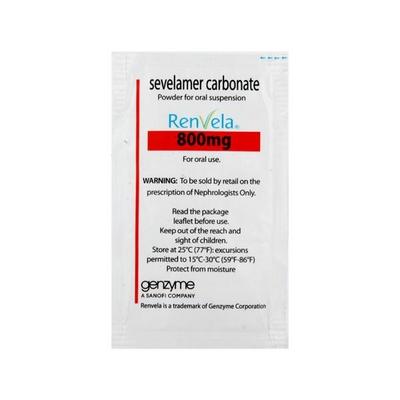


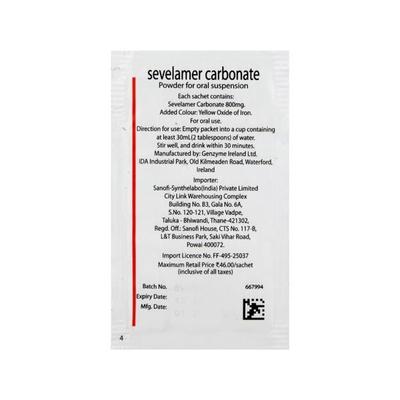

Renvela 800mg Sachet 1'S

Netmeds First Membership
Quick Links
Introduction About RENVELA 800MG SACHET
RENVELA 800MG SACHET contains sevelamer, which belongs to the group of medicines called Phosphate Binding Agents. It is used to control hyperphosphatemia (high blood phosphate levels) in adults who are on haemodialysis or peritoneal dialysis, in adults who have chronic kidney diseases but are not on dialysis, and in children (older than 6 years and above a specific height and weight) who have chronic kidney disease.
RENVELA 800MG SACHET should be used with other supplements such as calcium and vitamin D to manage the development of bone disease. Renal failure is the most common cause of high phosphorous levels, as there is reduced filtration of inorganic phosphate, increasing its serum levels. The symptoms depend on the underlying conditions.
During management, your doctor might ask you to take certain tests to avoid any untoward side effects. Follow the diet as advised by your doctor.
RENVELA 800MG SACHET is not recommended for use in patients with low levels of phosphorus in the blood or bowel obstruction. RENVELA 800MG SACHET should be used with caution in patients who have motility problems in the stomach and bowel, bowel inflammation, have been sick frequently, and have undergone major bowel surgery.
RENVELA 800MG SACHET is not intended for use in children below 6 years of age. Caution must be exercised while using RENVELA 800MG SACHET in pregnant and breast-feeding women, so consult your doctor before taking it.
The most common side effects of taking RENVELA 800MG SACHET are constipation, vomiting, upper abdominal pain, nausea, diarrhea, indigestion, and flatulence. Ask for your doctor’s advice if any of these worsen or don’t improve.
Uses Of RENVELA 800MG SACHET
Used to reduce the serum phosphorus levels in:
- adults on haemodialysis or peritoneal dialysis
- adults who have chronic kidney diseases and are not on dialysis
- children (older than 6 years and above specific height and weight) having chronic kidney disease
How RENVELA 800MG SACHET Works
RENVELA 800MG SACHET helps in reducing the phosphorus levels in the blood by binding to the phosphate that enters the body with food and managing its absorption.
How to use RENVELA 800MG SACHET
Always take RENVELA 800MG SACHET as directed by the physician. Take it after your meal or with food. Mix RENVELA 800MG SACHET from the dosing spoon in 30 mL of water. Stir thoroughly and drink it within 30 minutes of being prepared. Make sure to drink all of the liquid to ensure that all the powder is swallowed.
Do not stop taking RENVELA 800MG SACHET without informing your doctor. Your doctor will prescribe the correct dose and duration of RENVELA 800MG SACHET depending upon your or your child’s age, disease condition, and body weight.
Side Effects Of RENVELA 800MG SACHET
Common
- constipation, diarrhoea
- nausea, vomiting, and upper abdominal pain
- indigestion, flatulence
Stop taking RENVELA 800MG SACHET and contact your doctor immediately if you experience any of the following side effects:
- allergic reactions (rash, swelling, hives, trouble breathing)
- blockage in the intestine (abdominal pain, severe bloating, swelling or cramps, severe constipation)
- rupture in the intestinal wall (chills, fever, nausea, severe stomach pain, vomiting, or a tender abdomen)
- serious inflammation of the large intestine (severe abdominal pain, stomach or intestine disorders, blood in the stool)
- crystal deposit in the intestine
How To Manage Side Effects
Constipation
Consume enough fiber-rich foods like fresh fruits, vegetables, and cereals, and drink ample amounts of water. Exercise more regularly. If the symptom persists, contact your doctor.
Diarrhea
Drink plenty of liquids, like water or fruit juice, to maintain hydration. If symptom persists, contact your doctor.
Indigestion
Keep your head and shoulders raised while sleeping so that stomach acid won’t come up. Do not eat for 3 to 4 hours before going to sleep, and avoid tea, coffee, cola, or alcohol. If the symptom persists, contact your doctor.

Nausea And Vomiting
Take RENVELA 800MG SACHET with or just after meals. Stick to simple meals. Avoid eating oil-rich or spicy foods. Consult your doctor if your nausea worsens.

Stomach Pain
Try to rest and relax. Eat and drink slowly or try to eat smaller meals with small breaks. Keep a heat pad on your stomach. If the symptom persists, contact your doctor.
Warning & Precautions

Pregnancy
Use with CautionRENVELA 800MG SACHET should be used with caution in pregnant women as its potential risk in this population is unknown. Consult your doctor before taking it.

Breastfeeding
Use with CautionRENVELA 800MG SACHET should be used with caution in breastfeeding women, as it is unknown if the medicine is excreted in human milk and may affect your baby. Consult your doctor before taking it.

Driving and Using Machines
Use with CautionRENVELA 800MG SACHET does not impair your ability to drive or use machines.

Allergy
ContraindicatedDo not take RENVELA 800MG SACHET if you are allergic to Sevelamer or any of the other ingredients in this medicine.

Use In Pediatrics
ContraindicatedRENVELA 800MG SACHET is not recommended for use in children (under 6 years of age) as the safety and efficacy have not been established in this age group. Consult your child’s doctor for advice.

Use In Geriatrics
Consult your doctorYour doctor will decide the correct dose and duration of the management with RENVELA 800MG SACHET for you depending upon your age, health condition, and body weight. Consult your doctor before taking it.
Others
RENVELA 800MG SACHET is not recommended for use if you:
- have reduced levels of phosphorus in the blood
- have bowel obstruction
Before taking RENVELA 800MG SACHET, tell your doctor if you have:
- motility problems in the stomach and bowel
- bowel inflammation
- been sick frequently
- undergone major bowel surgery
Interactions
A. Drug-Drug Interactions:
Inform your physician if you are taking any of the following drugs before taking RENVELA 800MG SACHET:
- antibiotics such as ciprofloxacin (medicines used to manage bacterial infections)
- propranolol or metoprolol (used to manage an irregular heart rate)
- phenytoin (used to manage epilepsy)
- ciclosporin, tacrolimus, or mycophenolate mofetil (used to suppress the immune system)
- levothyroxine (used in managing low thyroid hormone levels)
- proton pump inhibitors such as omeprazole, lansoprazole, and pantoprazole (used to manage heartburn and reflux from the stomach or oesophagus)
Overdosage:
If you or anyone else accidentally takes too much of RENVELA 800MG SACHET, consult your doctor immediately or visit the nearby hospital.
Synopsis
| Drug | : | Sevelamer |
| Pharmacological Category | : | Chelating Agents |
| Therapeutic Indication | : | Hyperphosphatemia |
| Dosage Forms | : | Tablet, Sachet, Granules |
More Information
- Keep RENVELA 800MG SACHET out of reach of children
- Store RENVELA 800MG SACHET below 30°C
FAQs About RENVELA 800MG SACHET
Q: What is RENVELA 800MG SACHET and why is it prescribed?
A: RENVELA 800MG SACHET contains Sevelamer, which is used to control hyperphosphatemia (high blood phosphate levels) in adults who are on haemodialysis or peritoneal dialysis, in adults with chronic kidney diseases who are not on dialysis, and in children (older than 6 years and above a certain height and weight) with chronic kidney disease. RENVELA 800MG SACHET should be used with calcium supplements and vitamin D to manage the development of bone disease.
Q: Can I stop taking RENVELA 800MG SACHET on my own?
A: You should not stop taking RENVELA 800MG SACHET until your doctor advises you to. Taking RENVELA 800MG SACHET is important to maintain an appropriate phosphate level in the blood. Stopping RENVELA 800MG SACHET may lead to consequences such as calcification in the blood vessels, making it hard for your body to pump blood, itchy skin, red eyes, bone pain, and fractures. If you wish to discontinue taking RENVELA 800MG SACHET, contact your doctor first.
Q: What other precautions shall I take while taking RENVELA 800MG SACHET?
A: Due to either your kidney condition or your dialysis management, you may have disturbed levels of calcium, vitamin A, E, K, D, folic acid, and bicarbonates in your blood. RENVELA 800MG SACHET should be used with calcium supplements and vitamin D to manage the development of bone disease. Your doctor might check these levels in your blood frequently.
Q: Can RENVELA 800MG SACHET be taken on an empty stomach?
It is suggested to take RENVELA 800MG SACHET after your meal or with food. Avoid taking it on an empty stomach, as it may cause unwanted side effects. Consult with your doctor.
Q: Is RENVELA 800MG SACHET meant for use with children?
A: RENVELA 800MG SACHET is used to reduce the phosphorus levels in pediatric patients with chronic kidney disease above the age of 6 years and certain heights and weights. RENVELA 800MG SACHET is not recommended for use in children (under 6 years of age) as the safety and efficacy have not been established in this age group. Consult your doctor before taking it.
Q: Is constipation a side effect of RENVELA 800MG SACHET?
A: Constipation is a very common side effect of taking RENVELA 800MG SACHET. It can also be an early symptom of a blockage in your intestine. If you experience constipation, please inform your doctor immediately.
References
1. Barbara G. Wells, Joseph T. DiPiro, Terry L. Schwinghammer, Cecily V. DiPiro. Chronic Kidney Disease: Management of Complications. Pharmacotherapy Handbook. Eighth Edition. 2011. Page-805.
2. Sahar Fathallah-Shaykh, Dorota Drozdz, Joseph Flynn, Randall Jenkins, Katherine Wesseling-Perry, Sarah J Swartz, Craig Wong, Beverly Accomando, Gerald F Cox, Bradley A Warady. Efficacy and safety of sevelamer carbonate in hyperphosphatemic paediatric patients with chronic kidney disease. NIH National Library of Medicine, National center for biotechnology information. Pubmed.gov. February 2018. [Accessed on 13th July 2022] https://pubmed.ncbi.nlm.nih.gov/28900759/
3. Claudia Yuste, Evangelina Mérida, Eduardo Hernández, Ana García-Santiago, Yolanda Rodríguez, Teresa Muñoz, Gonzalo Jesús Gómez, Ángel Sevillano, Manuel Praga. Gastrointestinal complications induced by sevelamer crystals. Oxford Academy. Clinical Kidney Journal. April 2017. [Accessed on 13th July 2022] https://academic.oup.com/ckj/article/10/4/539/3098419
4. Caroline M Perry, Greg L Plosker. Sevelamer carbonate: a review in hyperphosphataemia in adults with chronic kidney disease. NIH National Library of Medicine, National center for biotechnology information. Pubmed.gov. May 2014. [Accessed on 13th July 2022] https://pubmed.ncbi.nlm.nih.gov/24811546/
5. PubChem Compound Summary for CID 3085017, Sevelamer. National Center for Biotechnology Information. September 2022. [Accessed on 13th July 2022] https://pubchem.ncbi.nlm.nih.gov/compound/Sevelamer
6. Sanofi Ltd. Electronic Medicines Compendium (EMC). [Revised in April 2022]. [Accessed on 13th July 2022] https://www.medicines.org.uk/emc/files/pil.13045.pdf
Useful Diagnostic Tests
- Kidney Profile (Kft) With Electrolytes
- Kidney Function Test (KFT)
- Vitamin D 1,25 Dihydroxy
- 25 Oh Vitamin D (Total) (D2+D3)
- Creatinine, Serum
- Blood Urea
- Uric Acid, Serum
- Albumin, Serum
- Potassium, Serum
- Bun Urea Nitrogen, Serum
- Microalbumin, Urine Spot
- Advanced Renal Profile
Author Details