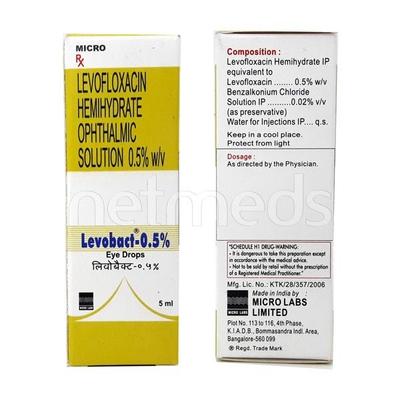


Levobact Eye Drops 5ml

Netmeds First Membership
Quick Links
Introduction About LEVOBACT EYE DROPS
LEVOBACT EYE DROPS contains levofloxacin which belongs to the group of medicines called Antibiotics. LEVOBACT EYE DROPS is used in adults and children (aged above 1 year) to manage bacterial infections (such as bacterial conjunctivitis) that affects the front surface of the eye.
It is also used to manage corneal ulcer (open sore/inflammation of cornea) caused by susceptible strains of bacteria in affected individuals.
LEVOBACT EYE DROPS is not recommended for use in patients allergic to levofloxacin and/or other quinolone antibiotics.
Before using LEVOBACT EYE DROPS, inform your doctor if you use contact lenses.
LEVOBACT EYE DROPS should be used with caution in pregnant and breastfeeding women only if it is clearly necessary. The medicine is not recommended for use in children (aged below 1 year) which is used with caution in elderly patients (aged above 65 years) after consulting the doctor.
The most common side effects after using LEVOBACT EYE DROPS are burning sensation in eyes, decreased/blurred vision, headache, altered taste, throat irritation, irritation/discomfort (at the site of instillation) and/or discomfort/pain in eye. Consult your doctor if any of these symptoms worsens.
Uses Of LEVOBACT EYE DROPS
- Manage bacterial infections (such as bacterial conjunctivitis) that affects the front surface of the eye in adults and children (aged above 1 year)
- Manage corneal ulcer caused by susceptible strains of bacteria in affected individuals.
How LEVOBACT EYE DROPS Works
LEVOBACT EYE DROPS works by inhibiting DNA gyrase (enzyme responsible for DNA synthesis) in bacteria which results in destruction of bacterial cell structure thus managing the occurrence of bacterial infection and corneal ulcer (caused by susceptible strains of bacteria) in affected individuals.
How to use LEVOBACT EYE DROPS
Instil LEVOBACT EYE DROPS as directed by your doctor. It is for ophthalmic use only. Wash your hands and open the bottle. Tilt your head backwards and hold the bottle upside down over the eye. Avoid dropper tip touching the eye. Pull your lower eyelid downwards and gently squeeze the bottle to let one drop fall into the space between the lower eye lid and eye. Close your eye and gently press the inner corner of the eye. Wipe off any excess solution from the skin around the eye and replace the cap. Your doctor will decide exact dose and duration according to your disease condition, weight and age.
Side Effects Of LEVOBACT EYE DROPS
Common
- burning sensation in eyes
- decreased/blurred vision, mucus in the eye
- headache, altered taste, throat irritation
- diarrhoea, indigestion, nausea
- irritation/discomfort at the site of instillation
- discomfort/pain in eye.
Uncommon
- stinging sensation in eyes
- dryness/soreness, swelling/redness in eyes
- sensitivity to light
- itchy eyes, sticky eyelids, rashes around the eye
- runny/stuffed nose.
Rare
- signs of allergic reactions such as skin rashes
- ocular infections (such as chemosis, corneal erosion, corneal ulcer, diplopia, floaters, hyperaemia, lid edema and/or lid erythema).
Stop using LEVOBACT EYE DROPS and consult your doctor immediately in case you experience:
- signs of severe allergic reactions such as swelling and tightness in the throat, breathing difficulties.
- signs of other allergic reactions such as worsening of redness and itching of the eyes, increased or sudden swelling of eyelids
- develop tendinitis (pain/swelling of the tendons).
How To Manage Side Effects
Headache:
If LEVOBACT EYE DROPS causes headache, then take rest and drink plenty of fluids. Ask your doctor to recommend a painkiller. Headaches should usually go away after the first week of using LEVOBACT EYE DROPS. If it lasts more than a week or becomes severe then inform your doctor.
Diarrhea:
Drink plenty of water and stay hydrated. Try to avoid taking any medicine on your own to manage diarrhea. Consult your doctor and inform them if the symptom gets worse.
Indigestion:
Try to have smaller and more frequent meals and drink slowly. Reduce consumption of coffee, cola, tea or alcohol and lose weight if you are obese. Try to avoid smoking and don’t have rich, fatty or spicy foods. Consult your doctor and inform if the symptom does not improve.
Nausea:
Use LEVOBACT EYE DROPS with or just after a meal. Stick to simple meals. Avoid eating oil rich or spicy foods, sugary snacks and drinks. Avoid drinking too much liquid along with your meals, drink slowly in between meals. Talk with your doctor if the condition worsens.
Warning & Precautions

Pregnancy
LEVOBACT EYE DROPS should be used with caution in pregnant women only if it is clearly necessary. Consult your doctor before using the medicine.

Breastfeeding
LEVOBACT EYE DROPS should be used with caution in breastfeeding women only if it is clearly necessary. Consult your doctor before using the medicine.

Driving and Using Machines
Do not drive or operate machines if you experience blurred vision after using LEVOBACT EYE DROPS.

Allergy
Do not use LEVOBACT EYE DROPS if you are allergic to levofloxacin, other quinolones and/or other ingredients of this medicine.
Others
Before using LEVOBACT EYE DROPS inform your doctor if you:
- use contact lenses.
Use in Paediatrics:
LEVOBACT EYE DROPS is not recommended for use in children (aged below 1 year). Consult your doctor before using LEVOBACT EYE DROPS.
Use in Geriatric:
LEVOBACT EYE DROPS should be used with caution in elderly patients (aged above 65 years). Consult your doctor before using the medicine.
Interactions
A. Drug-Drug interactions:
Before using LEVOBACT EYE DROPS, inform your doctor if you are using any other medicines for eyes or any prescription, non-prescription medicines or herbal medicines.
Overdosage:
If you or anyone else accidentally instils too much of LEVOBACT EYE DROPS, flush your eyes. Consult your doctor or visit the nearby hospital if symptoms worsen.
Synopsis
| Drug | : | Levofloxacin |
| Pharmacological Category | : | Antibiotics |
| Therapeutic Indication | : | Bacterial infections (such as bacterial conjunctivitis), Corneal ulcer |
| Dosage Forms | : |
Tablet, Syrup, Oral Suspension, Oral Solution, Injection, Infusion, Eye drops, Eardrops |
More Information
- Keep LEVOBACT EYE DROPS out of reach of children.
- Store LEVOBACT EYE DROPS below 25°C.
FAQs About LEVOBACT EYE DROPS
What is LEVOBACT EYE DROPS used for?
LEVOBACT EYE DROPS is used in adults and children (aged above 1 year) to manage bacterial infections (such as bacterial conjunctivitis) that affects the front surface of the eye. It is also used to manage corneal ulcer (open sore/inflammation of cornea) caused by susceptible strains of bacteria in affected individuals.
What are the side effects of LEVOBACT EYE DROPS?
The most common side effects after using LEVOBACT EYE DROPS are burning sensation in eyes, decreased/blurred vision, headache, altered taste, throat irritation, irritation/discomfort (at the site of instillation) and/or discomfort/pain in eye. Consult your doctor if any of these symptoms worsens.
How LEVOBACT EYE DROPS works?
LEVOBACT EYE DROPS works by inhibiting DNA gyrase (enzyme responsible for DNA synthesis) in bacteria which results in destruction of bacterial cell structure thus managing the occurrence of bacterial infection and corneal ulcer (caused by susceptible strains of bacteria) in affected individuals.
How to use LEVOBACT EYE DROPS?
Instil LEVOBACT EYE DROPS as directed by your doctor. It is for ophthalmic use only. Wash your hands and open the bottle. Tilt your head backwards and hold the bottle upside down over the eye. Avoid dropper tip touching the eye. Pull your lower eyelid downwards and gently squeeze the bottle to let one drop fall into the space between the lower eye lid and eye. Close your eye and gently press the inner corner of the eye. Wipe off any excess solution from the skin around the eye and replace the cap. Your doctor will decide exact dose and duration according to your disease condition, weight and age.
Can LEVOBACT EYE DROPS be used in pregnant and breastfeeding women?
Yes, LEVOBACT EYE DROPS can be used but with caution in pregnant and breastfeeding women only if it is clearly necessary. Consult your doctor before using the medicine.
References
1. KD Tripathi. Sulfonamides, Cotrimoxazole and Quinolones. Essentials of Medical Pharmacology. Seventh edition. 2013. Page – 713.
2. Vivek Podder, Nazia M. Sadiq. Levofloxacin. NIH National Library of Medicine. National Center for Biotechnology Information. StatPearls [Internet]. September 2022. [Accessed on 8th October 2022] https://www.ncbi.nlm.nih.gov/books/NBK545180/
3. Yoshiko Kanda, Tomoko Kayama, Shinji Okamoto, Masako Hashimoto, Chiemi Ishida, Tomoko Yanai, Mitsuru Fukumoto and Eiichi Kunihiro. Post-Marketing Surveillance of Levofloxacin 0.5% Ophthalmic Solution for External Ocular Infections. NIH National Library of Medicine. National Center for Biotechnology Information. PMC PubMed Central. December 2012. [Accessed on 8th October 2022] https://www.ncbi.nlm.nih.gov/pmc/articles/PMC3586049/
4. Balkanpharma-Razgrad AD. Electronic Medicines Compendium (EMC). [Revised in August 2021]. [Accessed on 8th October 2022] https://www.medicines.org.uk/emc/files/pil.7357.pdf
5. Popular Pharmaceuticals Ltd. Levobac TS Eye Drops. [Accessed on 8th October 2022] https://www.popular-pharma.com/products/253
Useful Diagnostic Tests
- Slit-lamp examination.
Author Details