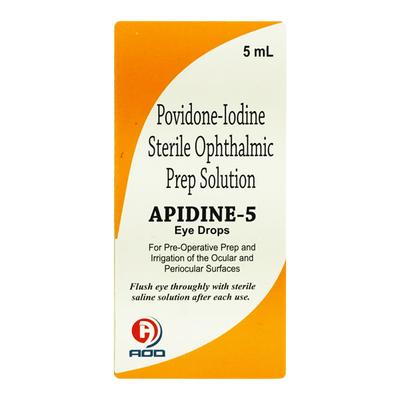


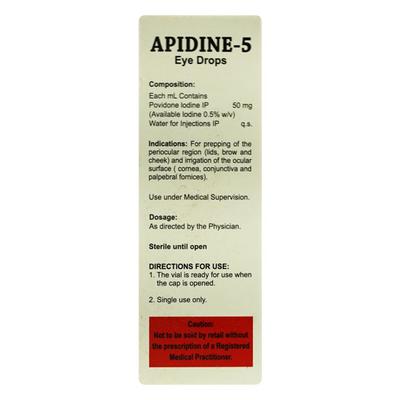
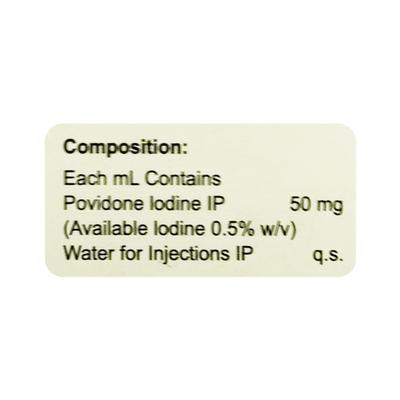

APIDINE 5 Eye Drops 5ml

Netmeds First Membership
Quick Links
Introduction About APIDINE EYE DROPS
APIDINE EYE DROPS contains Povidone Iodine, which belongs to the group of medicines called antiseptic agents. It is used for cleaning the surface of your eyes before performing eye surgery or eye injection. It is usually used by a healthcare professional in the operating room/doctor’s office (depending on the procedure).
Before using APIDINE EYE DROPS, inform your doctor if you are allergic to povidone iodine or any other ingredient of this medicine, have or ever had a thyroid problem, or if you are suffering from dry eyes. APIDINE EYE DROPS should be used with caution in pregnant and breastfeeding women, children, and the elderly. This medicine is not indicated for use in pre-term babies.
APIDINE EYE DROPS may cause rare side effects such as severe damage to the clear layer at the front of the eye (the cornea) developing cloudy patches on the cornea due to calcium build-up during management, skin rashes with irritation and hives (red, raised, itchy bumps), thyroid problems, eye redness, eye irritation and discoloration of the skin. Consult your doctor immediately if your symptoms get worse or persist.
Uses Of APIDINE EYE DROPS
- Cleans the surface of your eye before eye surgery or eye injection
How APIDINE EYE DROPS Works
APIDINE EYE DROPS contains povidone-iodine that enters microbial cell membranes and interacts with its essential proteins, nucleotides and fatty acids ultimately causing bacterial cell death.
How to use APIDINE EYE DROPS
APIDINE EYE DROPS will be given to you only by a doctor or a nurse in the hospital. It is for ophthalmic use only. Your doctor will decide the correct dose and duration for you depending on your age and the clinical condition of the eye.
Side Effects Of APIDINE EYE DROPS
Rare
Stop using APIDINE EYE DROPS and contact your doctor immediately if you experience any of the following:
- severe damage to the cornea, cloudy patches on the cornea
- allergic-type reactions, including difficulty breathing or swallowing, swelling of the face, lips, throat, or tongue (anaphylactic shock and anaphylactoid reaction), skin rash with irritation and hives red, raised, itchy bumps (urticaria)
- contact dermatitis
- effect on the thyroid
- conjunctival redness (redness of the whites of the eyes)
- eye irritation, superficial pinpoint inflammation of the surface of the eye
- residual yellow discoloration of the eyes and transient brown discoloration of the skin
Warning & Precautions

Pregnancy
APIDINE EYE DROPS should be used with caution during pregnancy. Consult your doctor before using APIDINE EYE DROPS.

Breastfeeding
APIDINE EYE DROPS should be used with caution by breastfeeding women. Consult your doctor before using APIDINE EYE DROPS.

Driving and Using Machines
APIDINE EYE DROPS does not have any effect on the ability to drive or use machines.

Allergy
Do not use if you are allergic to povidone iodine or any other ingredients of this medicine.
Others
Before using APIDINE EYE DROPS inform your doctor if you have:
- thyroid disorder
- dry eyes syndrome
Use in Paediatrics:
APIDINE EYE DROPS must be used in with caution in children and adolescents. This medicine is not recommended for use in preterm babies. Consult your doctor for advice before using APIDINE EYE DROPS.
Use in Geriatrics:
APIDINE EYE DROPS should be used with caution in the elderly especially in those having thyroid disorders where constant monitoring of thyroid function should be considered during regular repeated use of this medicine. Consult your doctor for advice before using APIDINE EYE DROPS.
Interactions
A. Drug-Drug Interactions:
Before using APIDINE EYE DROPS, inform your doctor if you are taking any medicine, herbal or ayurvedic medicines, especially for the eye.
Overdosage:
APIDINE EYE DROPS will be used on you only by a doctor or nurse in a hospital or operating room so it is unlikely to receive an overdose. However, if you accidentally swallowed the medicine contact a doctor or visit a hospital immediately.
Synopsis
| Drug | : |
Povidone-Iodine |
| Pharmacological Category | : |
Antiseptics |
| Therapeutic Indication | : |
Disinfects the surface of the eye before surgery or eye injection |
| Dosage Forms | : |
Eye drops, Scrub, Soap, Cream, Dressing pad, Dusting powder, Gargle, Gel, Liquid, Lotion, Ointment, Mouth wash, Mouth spray, Pessarie, Powder, Sachet, Spray, Syrup, Wash |
More Information
- Keep the medicine out of reach from children
- Store APIDINE EYE DROPS at room temperature at not more than 25°C without refrigeration
FAQs About APIDINE EYE DROPS
What is APIDINE EYE DROPS used for?
APIDINE EYE DROPS is used for cleaning the surface of your eyes before eye surgery or eye injection. This medicine is usually used by a healthcare professional in the operating room/doctor’s office (depending on the procedure) and after the anaesthetic has been applied to your eyes.
Can APIDINE EYE DROPS be used on children?
Yes, APIDINE EYE DROPS can be used with caution in children and adolescents. However, this medicine is not recommended for use in preterm babies. Consult your doctor for advice before using APIDINE EYE DROPS.
What are the precautions before using APIDINE EYE DROPS?
Before using APIDINE EYE DROPS, inform your doctor if you are allergic to povidone iodine or any other ingredient of this medicine, have or ever had thyroid problems or if you are suffering from dry eyes. APIDINE EYE DROPS should be used with caution in pregnant and breastfeeding women, children, and the elderly. This medicine is not recommended for injection into the eye and its surroundings. Consult your doctor before using.
How to use APIDINE EYE DROPS?
APIDINE EYE DROPS is used by a healthcare professional on you in the operating room/doctor’s office (depending on the procedure). It is for ophthalmic use only. Firstly, the anaesthetic is applied, followed by cleaning the area surrounding your eyes. The medicine is then instilled into your eyes. After the medicine has been left in contact with the parts of the eye (conjunctiva and the conjunctival sacs) for 2 minutes, your eyes should be flushed thoroughly with a sterile 0.9 % saline solution. Your doctor will decide the correct dose and duration for you depending on the age and clinical condition of the eye.
What are the side effects of using APIDINE EYE DROPS?
There are very rare side effects from using APIDINE EYE DROPS such as patients with severe damage to the clear layer at the front of the eye (the cornea) have developed cloudy patches on the cornea due to calcium build-up during management, skin rashes with irritation and hives (red, raised, itchy bumps), thyroid problems, eye redness, eye irritation and discoloration of the skin. Consult your doctor immediately if experience any of these symptoms.
References
1. KD Tripathi. Section 14, Antiseptics, Disinfectants and Ectoparasiticides. Seventh edition. 2013. Page – 897-905.
2. Povidone iodine. PubChem Compound. National Center for Biotechnology Information (2022). [Accessed on 3rd September 2022] https://pubchem.ncbi.nlm.nih.gov/compound/Povidone-iodine
3. Ridder III, William H., Caren Oquindo, Kavita Dhamdhere, and James Burke. Effect of povidone iodine 5% on the cornea, vision, and subjective comfort.Optometry and Vision Science. 2017. [Accessed on 3rd September 2022] https://www.researchgate.net/publication/317599785_Effect_of_Povidone_Iodine_5_on_the_Cornea_Vision_and_Subjective_Comfort
4. Laboratoire Chauvin. Electronic Medicines Compendium (EMC). [Revised in September 2019] [Accessed in August 2022] https://www.medicines.org.uk/emc/files/pil.3018.pdf
5. Laboratoire Chauvin. Health and Products Regulatory Authority. [Revised in September 2019] [Accessed in August 2022] https://www.hpra.ie/img/uploaded/swedocuments/a2b512b4-b846-4622-bfbd-475cb299523c.pdf
Useful Diagnostic Tests
- Thyroid Function Tests
Author Details