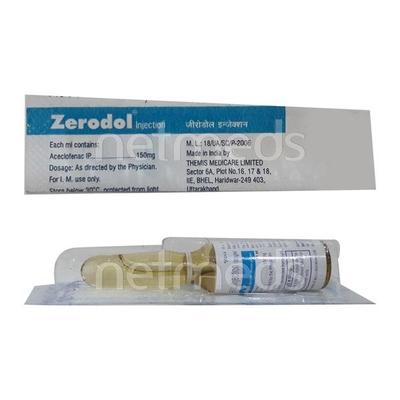


Zerodol Injection 1ml

Netmeds First Membership
Quick Links
Introduction About ZERODOL INJECTION
ZERODOL INJECTION contains Aceclofenac which belongs to the group of medicines called Non-steroidal anti-inflammatory drugs (NSAIDs). It is used for the short-term management of pain due to post operative and post-traumatic cases.
ZERODOL INJECTION is not recommended for use in patients with active or suspected peptic ulcer, intestinal haemorrhage and with severe renal impairment.
Before receiving ZERODOL INJECTION inform your doctor if you have impaired kidney, liver or heart function and gastrointestinal disorders like ulcerative colitis or with crohn's disease, bleeding diathesis (increased tendency to bleed or bruise) or haematological abnormalities.
ZERODOL INJECTION is not recommended for use in pregnant or breast-feeding women. It is not recommended for use in children and should be used with caution in elderly patients due to increased risk of serious side effects.
The most common side effects of receiving ZERODOL INJECTION are dizziness, nausea, diarrhoea and stomach pain. Inform your doctor if any of the side effects worsen.
Uses Of ZERODOL INJECTION
Used as short-term management:
- For pain due to post-operative or post-traumatic cases
How ZERODOL INJECTION Works
ZERODOL INJECTION works by exhibiting anti-inflammatory and painkiller properties by blocking the enzyme cyclo-oxygenase, which is involved in the production of prostaglandins which are responsible for causing pain and inflammation (swelling).
How to use ZERODOL INJECTION
ZERODOL INJECTION will be given to you only by a doctor or a nurse into a muscle (as an intramuscular injection). Your doctor will decide the correct dose and duration for you depending upon your age, body weight and disease condition.
Side Effects Of ZERODOL INJECTION
Common
- indigestion, abdominal pain, nausea, diarrhea
- dizziness
- elevated hepatic enzymes
Uncommon
- flatulence, gastritis, constipation, vomiting
- ulcerative stomatitis, vertigo
- itching, rash, dermatitis
Rare
- pancreatitis, melena (dark stools)
- stomatitis (sore or inflammation inside of the mouth)
- burning or prickling sensation usually in hands or feet, tremor
- depression, abnormal dreaming, sleepiness, insomnia
- eczema, flushing, purpura (purple-colored spots and patches that occur on the skin)
- odema (fluid retention), palpitation, cramps legs
- shortness of breath, stridor (noisy breathing)
- nephrotic syndrome
- headache, fatigue, facial oedema, weight gain and allergic reactions such as anaphylactic shock
- abnormal vision, abnormal taste
How To Manage Side Effects
Nausea or vomiting:
Take regular sips of cold drink. Stick to simple meals. Avoid eating oily, fried, or spicy foods. Do not lie down or sleep immediately after eating. If the symptoms does not improve, inform your doctor.
Constipation:
Take fiber rich foods in your diet such as fresh fruits, vegetables and whole grain cereals and drink plenty of fluids. Exercise more regularly (such as daily walk) and stay active. Inform your doctor if the symptom does not improve.
Diarrhoea:
Drink lots of fluids, such as water or fruit juices to keep yourself hydrated. Inform your doctor if the symptom did not improve.
Stomach pain:
Rest and relax. Eat and drink slowly or try to have smaller and frequent meals. Keep a heat pad on your stomach. Inform your doctor if the symptom did not improve on its own.
Warning & Precautions

Pregnancy
ZERODOL INJECTION is not recommended for use in pregnant women or women planning for pregnancy. Consult your doctor before receiving it.

Breastfeeding
ZERODOL INJECTION is not recommended for use in breastfeeding women. Consult your doctor before receiving it.

Driving and Using Machines
Do not drive or operate any machines if you feel dizziness, vertigo or other central nervous system disorders after receiving ZERODOL INJECTION.

Kidney
ZERODOL INJECTION is not recommended for use in patients with severe renal impairment. It should be used with caution in patients with impaired renal function. Consult your doctor before receiving it.

Liver
ZERODOL INJECTION should be used with caution in patients with severe hepatic impairment. It should be used with caution in patients with hepatic porphyria (rare genetic disease). Consult your doctor before receiving it.

Allergy
Do not receive ZERODOL INJECTION if you are allergic to Aceclofenac or aspirin or any other nonsteroidal anti-inflammatory drugs (NSAIDs) (such as ibuprofen, naproxen or diclofenac).

Lungs
ZERODOL INJECTION is not recommended for use in patients with asthma due to the use of nonsteroidal anti-inflammatory drugs. Consult your doctor before receiving it.

Heart Disease
ZERODOL INJECTION should be used with caution in patients with impaired cardiac function. Consult your doctor before receiving it.
Others
ZERODOL INJECTION is not recommended for use if you have:
- intestinal haemorrhage, active or suspected peptic ulcer
- acute rhinitis or urticaria (due to the use of nonsteroidal anti-inflammatory drugs)
Before receiving ZERODOL INJECTION, inform your doctor:
- gastrointestinal disorders like gastro-intestinal ulceration, ulcerative colitis or Crohn's disease, bleeding diathesis or haematological abnormalities
- gastro-intestinal bleeding or ulcerative perforation, hematemesis and melena
Use in pediatrics:
ZERODOL INJECTION is not recommended for use in children. Consult your child’s doctor for advice.
Use in geriatrics:
ZERODOL INJECTION should be used with caution in elderly patients due to increased risk of serious side effects. Consult your doctor before receiving it.
Interactions
A. Drug-Drug interactions:
Before receiving ZERODOL INJECTION, inform your doctor if you are taking any of the following medicines:
- lithium (used to manage depression)
- medicines used to manage heart failure and irregular heartbeats (Ex. digoxin)
- medicines that stop blood clotting (anticoagulants) Ex. warfarin, heparin
- glibenclamide, glicazide, tolbutamide (medicines used to manage diabetes)
- aspirin, ibuprofen and naproxen (used to manage pain and inflammation)
- drugs used to increase the rate of urine excretion (Ex. thiazides such as indapamide, furosemide and amiloride)
- medicines used to suppress the immune system after organ transplant to manage rejection (Ex. cyclosporin)
- methotrexate (used to manage cancer)
Overdosage:
ZERODOL INJECTION will be administered to you only by a doctor or a nurse in a hospital and so it is unlikely to receive an overdose. However, consult your doctor if you experience any unusual symptoms.
Synopsis
| Drug | : |
Aceclofenac |
| Pharmacological Category | : |
Non-steroidal Anti-inflammatory drugs |
| Therapeutic Indication | : |
Post operative and post-traumatic pain for short-term |
| Dosage Forms | : | Tablet, Dispersible tablet, Capsule, Injection |
More Information
- Store ZERODOL INJECTION below 30°C
FAQs About ZERODOL INJECTION
What is ZERODOL INJECTION used for?
ZERODOL INJECTION contains Aceclofenac which belongs to the group of medicines called Non-steroidal anti-inflammatory drugs (NSAIDs). It is used for the short-term management of pain due to post operative and post-traumatic cases.
Can ZERODOL INJECTION be used in elderly patients?
ZERODOL INJECTION should be used with caution in elderly patients due to increased risk of serious side effects. Your doctor will initiate the management with the lowest effective dose for shorter duration. Consult your doctor before receiving ZERODOL INJECTION.
What are the common side effects of ZERODOL INJECTION?
The most common side effects of receiving ZERODOL INJECTION are indigestion, dizziness, nausea, diarrhoea and stomach pain. Inform your doctor immediately if any of the side effects worsen.
Is ZERODOL INJECTION safe to use in patients with kidney disease?
ZERODOL INJECTION is not recommended for use in patients with severe renal impairment. It should be used with caution in patients with impaired renal function. Consult your doctor before receiving ZERODOL INJECTION.
Can ZERODOL INJECTION be used in pregnant women?
ZERODOL INJECTION is not recommended for use in pregnant women or women planning for pregnancy. Consult your doctor for advice to select a suitable alternative management for the pain management.
References
1. K.D Tripathi. Nonsteroidal Anti-inflammatory Drugs and Antipyretic-Analgesics. Essentials of medical pharmacology. Seventh edition. 2013. Page – 204.
2. Parvati B. Patel and Tejas K. Patel. Efficacy and safety of aceclofenac in osteoarthritis: A meta-analysis of randomized controlled trials. NIH. National Library of Medicine, National centre for biotechnology information. PubMed Central. March 2017. [Accessed on 16th April 2022] https://www.ncbi.nlm.nih.gov/pmc/articles/PMC5335881/
3. Daewon Pharmaceutical Co., Ltd. Phase IV Clinical Trial to Evaluate the Efficacy and Safety of PlbCR and Aceclofenac in the Treatment of Patients With Osteoarthritis of the Knee. NIH U.S. National Library of Medicine ClinicalTrials.gov. [Revised in October 2016] [Accessed on 16th April 2022] https://clinicaltrials.gov/ct2/show/NCT02682524
4. Themis Medicare Limited. National Agency for Food and Drug Administration and Control (NAFDAC). [Accessed on 16th April 2022] https://www.nafdac.gov.ng/wp-content/uploads/Files/SMPC/V1_2022/Aceclofenac-Injection-150-mg-per-ml.pdf
5. Aceclofenac injection. Rewine Pharmaceuticals. [Accessed on 16th April 2022] https://m.rewinepharmaceutical.com/aceclofenac-injection-7158247.html
Useful Diagnostic Tests
- Kidney function tests
- Liver function tests
Author Details